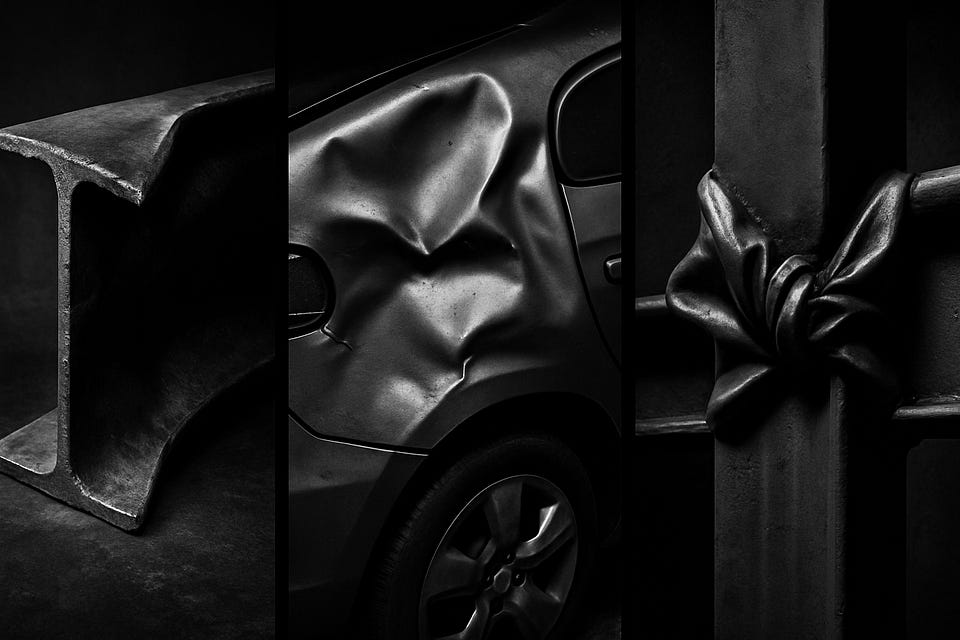
The car’s crumple zone was an ethical invention. Engineers designed steel to fail on purpose, to absorb the crash instead of the driver’s body.
The choice was explicit: a human life mattered more than an intact car. Every structure prioritizes something, and design is where the priority gets set.

View source
%% title: Where a denied claim’s damage lands
%% caption: An algorithm denies the claim and a chatbot loops the appeal, so the person patches the error by hand and stays braced for the next one. The software stays smooth, and the strain ends as exhaustion in the person using it.
flowchart TD
  E["Algorithm denies<br/>your claim"]:::concept --> F["Chatbot loops<br/>your appeal"]:::burden
  F --> G["You patch the<br/>data error by hand"]:::burden
  G --> H["Hypervigilance: waiting<br/>for the next error"]:::burden
  H --> I(["Exhaustion that<br/>does not spring back"]):::failure

  classDef concept stroke-dasharray:2 2;
  classDef burden stroke-width:2px;
  classDef failure stroke-width:2.2px,stroke-dasharray:6 3;
Most carmakers didn’t adopt it out of compassion. Mercedes-Benz fitted the first one in 1959, from an engineer’s 1952 patent. It spread once liability law and safety regulation made human life too expensive to ignore.
Where the damage lands now
Digital systems inherited the same calculus and reversed the answer.
Wasting a million hours of user time costs less than slowing a machine for one second. That is not moral decay but efficiency pointed at a different target.
An algorithm denies your claim. A chatbot loops your appeal. A moderation model deletes your work with no explanation.
Every time, the software stays smooth while you scramble.
Your patience, your time, and your attention soak up the system’s failures. What “frictionless” design produces is the user’s exhaustion. Friction is no virtue, yet its absence is a form of erasure. When a design never bends, the user is forced to become the mechanism of correction.
The burden is biological as well as economic, a metabolic debt: the human body pays for the system’s efficiency in real time.
Institutions stay intact by pushing consequences outward. The data center gets redundant power and constant monitoring. The software SLA (the service-level agreement that sets how reliably the system must run) is rigid and the code immutable. The only component in the whole apparatus that can be stretched, sleep-deprived, and hyper-vigilant without triggering a system-wide alert is a human body.
Living in the crumple zone means the hypervigilance of waiting for the next error, the sensory overload of fighting broken interfaces, and the decision fatigue of constantly performing “manual overrides” for automated failures.
The usual word for surviving this is resilience, which borrows from springs and shock absorbers, parts that take a blow and return to position. Many of the people doing this work don’t return. The crumple zone is the more accurate figure, because its metal stays deformed after the crash it absorbed.
Being the “unseen repairer” is a moral injury: you’re the person who must lie to a chatbot, work through an impossible arbitration clause, or manually patch a data error just to keep a system from collapsing. The tool looks competent because you’re covering for its failures.
The machine should yield first
Good design assumes failure and builds room to handle it; it doesn’t promise perfection.
In a humane system, “handling failure” means reducing the cognitive tax on the person. It means visible mechanisms: clear appeal routes, transparent logs, and predictable human-in-the-loop paths. It means admitting harm will happen and building ways to catch it before it becomes a personal crisis.
Ethics is not decoration. It should be a structure that absorbs shock.
When a system can’t admit error, it exports the problem. When friction has nowhere else to go, it lands on a person, who becomes the human crumple zone.1
Power can legitimately be delegated to software, to bureaucracies, to automated workflows. What cannot be handed off is the right of the person who pays for the failure to force a review of the rule or model that caused it. Delegation without that right leaves them under the system’s control with no recourse.
Mid-century engineers accepted the tradeoff. Steel would crumple so people could walk away.
Software needs the same calculation.
Safety means knowing where to put the breaking point.
With every crash comes a choice about who is built to break.
The fatigue, the hypervigilance, and the exhaustion of the user are a situated signal. Being the buffer is the clearest sign that a system no longer serves its purpose.
When the next impact comes, the machine should yield first.
Getting past the human buffer means giving the person who takes the hit a way to get the system corrected, so the error doesn’t land on the next person.
Further reading
Notes
The term is not mine. Madeleine Clare Elish named the moral crumple zone in “Moral Crumple Zones: Cautionary Tales in Human-Robot Interaction”, Engaging Science, Technology, and Society 5 (2019), for the human who absorbs responsibility when an automated system fails, the operator held liable for what the machine did. This essay takes the same figure outside human-machine interaction and asks it of institutional arrangements generally. The extension is mine; the name and the image are hers, and full sources are at Lineage.