Work gets scored in productivity metrics, neighborhoods get rebuilt for profit-driven development, and online friendships get counted as engagement. Call that process compression: turning time, creativity, relationships, and even ecosystems into units of value someone can extract. It shows up in many systems at once, and in each one the payoff goes to whoever controls and extracts the most. Under it, burnout gets presented as personal failure, alienation as inevitable, and imperfection as weakness.
But compression is presented as inevitable, and it can be resisted.
Where compression demands we shrink, sprawling invites us to expand, recklessly refusing extraction in favor of regeneration. Sprawling is more than rebellion. It’s the deliberate practice of growing life in overlooked places, in the cracks where systems falter. The practice turns neglected spaces and strained relationships into ecosystems of care, creativity, and connection. It builds interdependence, refuses the idea that harm is inevitable, and makes lived alternatives that regenerate people, communities, and the planet.
It’s also a blueprint for futures rooted in reciprocity with each other and with the earth. Philosophy, ecology, and social movements each supply part of a practical way to break the cycle of compression: reclaim space, practice care, and build living ecosystems in the cracks.
Compression and the cracks in it
Michel Foucault’s concept of biopolitics reveals how compression governs bodies and populations through discipline and surveillance. Herbert Marcuse’s critique of one-dimensionality shows how systems suppress imagination, narrowing life to consumption and compliance. Frantz Fanon’s analysis of colonialism exposes how entire communities are compressed into tools of extraction, a dynamic that persists today in gentrification, privatization, racialized neglect, and environmental degradation.
Compression fails in places, though, and those cracks show how fragile the system is. As James C. Scott suggests, systems depend on oversimplification to keep control, and the cracks are where the oversimplification runs out.
Sprawling starts there, as deliberate regeneration rather than chaos. When Hurricane Sandy devastated New York in 2012, institutional relief fell short. The Occupy Sandy Relief Network organized care without hierarchy, building mutual aid networks that adapted as they went and bypassed the compressed systems entirely.
Barcelona’s superblocks take streets back from cars and turn them into pedestrian-first zones that support relational life and ecological balance. They break up urban compression and change what public space is for.
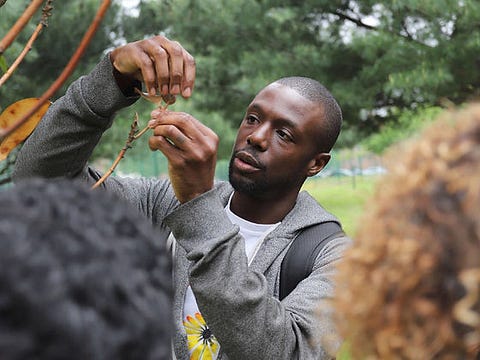
In Detroit, the Detroit Black Community Food Sovereignty Network reclaims underused city land for urban farming. In a city compressed by industrial decline and racialized neglect, the farms build food sovereignty and community resilience outside the extractive food system.
Who sprawling has to include
Sprawling can’t succeed without dealing with the intersecting forces of oppression that shape our lives (racism, sexism, classism, ableism) and how they compound under systems of compression. In Detroit’s urban farms or Chiapas’ Zapatista communities, sprawling takes on economic exploitation and the structural inequities of race and colonial history together. To liberate anyone, sprawling has to center the marginalized voices compression hits hardest and stay accessible to people regardless of ability or resources. It also has to treat care as political: liberation requires dismantling systems that commodify human relationships while building alternatives rooted in equity.
There’s no universal template for sprawling. It works when it adapts to what a particular community needs.
Compression also treats nature as a resource to be extracted, controlled, and commodified, and cuts human life off from the ecosystems that sustain it. Sprawling treats human liberation and ecological regeneration as one project.
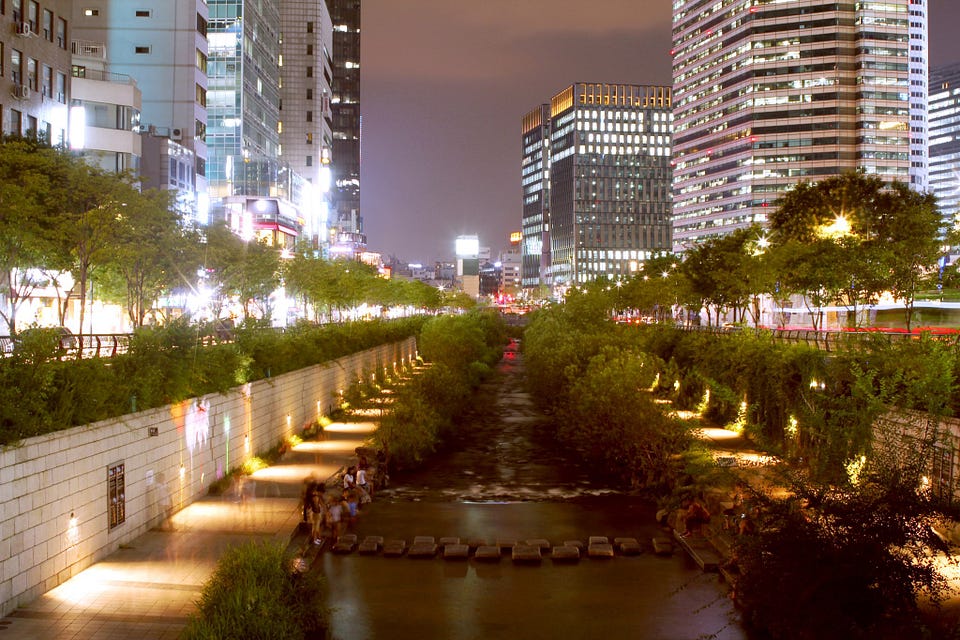
In Seoul, the Cheonggyecheon Restoration Project replaced an expressway with a living stream and public park. The project revived the local ecosystem and made communal spaces that put ecological balance ahead of efficiency. Guerrilla gardening networks around the world reclaim barren urban spaces with food forests and community gardens, restoring biodiversity and building collective stewardship of the land.
Scandinavia’s forest schools trade the compressed classroom for outdoor learning that builds curiosity, adaptability, and interdependence with nature.
Permaculture practices such as Cuba’s el Organopónico urban farms join agroecology to social organization, and the food systems that result take care of people and the planet at once.
Regeneration doesn’t stop at our own species.
The mess and the care are the point
Compression promises smoothness, optimization, and predictability, but life happens in the mess. Productivity metrics and engagement algorithms treat authenticity as noise to remove, because it makes output harder to predict. Sprawling takes imperfection back as a strength. Messiness is how people and places behave when no metric is shaping them.
José Esteban Muñoz described utopia as a continual process rather than a fixed destination, and sprawling works the same way. It keeps changing, and it depends on complexity, unpredictability, and experimentation.
Mess produces invention where no one planned for it. DIY spaces put experimentation ahead of polish and leave room for collective imagination. Radical book fairs reclaim intellectual freedom by building shared knowledge outside commodified academic systems. Guerrilla gardens turn forgotten corners into ecosystems by growing in ways no one can predict.
Living with complexity is how we survive, not only how we resist.
Sprawling is also relational. It resists isolation by building networks of mutual support. In systems designed to commodify relationships and isolate people, care is a radical act of resistance.
The Black Panther Party’s Free Breakfast for Children Program met immediate needs and built long-term community power at the same time. Feeding thousands of children a day in the 1960s and 1970s, the Panthers exposed systemic neglect and built solidarity and trust in their communities.
In Chiapas, the Zapatista movement shows what relational sovereignty looks like: self-governed indigenous communities built on ecological stewardship and collective decision-making. They refuse state-driven compression by putting care for people and land first. At a smaller scale, activist circles that practice consent culture show how deliberate care can turn interpersonal dynamics into sites of liberation and away from the transactional logic compression imposes.
Taking sprawl online and to scale
Online, compression intensifies through surveillance capitalism and algorithmic control. Platforms turn human interaction into engagement metrics and extract data for profit. Sprawling can take virtual space back for connection, reciprocity, and autonomy.
Federated, open-source platforms like Mastodon, whose software comes from a nonprofit and whose servers are run by communities, offer an alternative to corporate tech: mutual governance instead of extraction. Mesh networks build decentralized communication infrastructure that resists centralized control and keeps marginalized communities connected. Digital gardens, personal knowledge-sharing sites, skip algorithmic optimization and grow organically, through connections between people.
Sprawling begins with small acts, like reclaiming a vacant lot or tending a strained relationship, but it can reach well past isolated projects. To become systemic change, it has to scale without losing its grassroots ethos. That takes:
- Networks: Linking local initiatives into larger coalitions that can share resources, extend their reach, and influence policy.
- Adaptability: Staying flexible enough to meet local needs while carrying solutions into other contexts.
- Other measures of success: Judging success by indicators other than GDP, such as:
- Community resilience (e.g., strengthened social ties)
- Ecological health (e.g., biodiversity restoration)
- Relational well-being (e.g., trust networks)
Brazil’s Landless Workers’ Movement (MST) shows sprawling scaling without losing its values. By occupying unused land and turning it into collectively governed farms, the MST has built sustainable communities and challenged capitalist land ownership.
Start with a crack where compression has already failed: an abandoned lot, a strained relationship, a neglected community. Tend it with care and creativity, connect it to others doing the same, and let it stay messy.
Take up space, intentionally rather than recklessly, regeneratively rather than destructively, expansively rather than apologetically.