In Can the Subaltern Speak?, Gayatri Spivak examines the limits of representing marginalized voices (those silenced or spoken for within dominant discourse) and the violence built into that representation. I want to extend her critique with an analogy from quantum physics: the Heisenberg Uncertainty Principle. The principle says that position and momentum can’t both be sharply defined at once: the more precisely one is fixed, the more spread out the other has to be. It is often confused with the observer effect, the disturbance a measurement causes, and the analogy here leans on the observer effect. Something similar happens to the subaltern. Observing marginalized voices, placing them within a system of classification and representation, changes them, so they can never be captured as they are. The subaltern is not the one who cannot be heard; it is the one whose death has already been priced into the arrangement.
Seen this way, representation is itself a form of surveillance. When marginalized people, such as Indigenous speakers, are put on panels or given platforms to “speak,” they’re already under an external gaze that confines them to predefined roles. Being observed and expected to “speak truth to power” changes the content and impact of what they say, the way observation changes a particle.
The Predefined Subaltern
An Indigenous speaker invited to a panel is expected to offer a counter-narrative or challenge the dominant discourse. That expectation writes their role in advance, so they can’t speak on their own terms. The invitation is presented as a progressive move toward diversity, but it’s often a containment strategy.
Miranda Fricker’s concept of testimonial injustice (credibility discounted through structural prejudice) shows up here as an inverse trap: the audience grants credibility only when the speaker recites an assigned identitarian script. Step outside that script to contest the institutional machinery itself, and the audience stops registering the testimony. Fricker also describes hermeneutical injustice, where listeners lack the concepts to make sense of what someone is telling them. A sponsoring institution with no category for a critique of its own structure hears that critique as a personal complaint or a matter of taste.
Spivak named the problem: when marginalized voices enter dominant spaces, they rarely gain autonomy. They’re put to use instead. They let the institution show that it hosts dissent while the people who run it keep every decision. Albert Hirschman argued that channels for voice (complaining from inside) can reduce exit (leaving), and a sponsored panel works that way. Critics get a microphone and stay in the room, but nothing said into it changes a decision. Testimony meant to disrupt ends up fitting the program.
Expectation as Prejudice
The expectation shapes how the speaker is received. Take the Indigenous speaker on the panel. The audience assumes they’ll advocate for Indigenous rights or call for the liberation of marginalized communities. That assumption is a prejudice: the audience hears the speaker through the filter of what it expects, rather than for who they are or what they want to say.
The audience thinks, “Of course they would call for liberation,” and in thinking it trivializes the message. The speech loses its force because it fulfills an expectation rather than disturbing an institution.
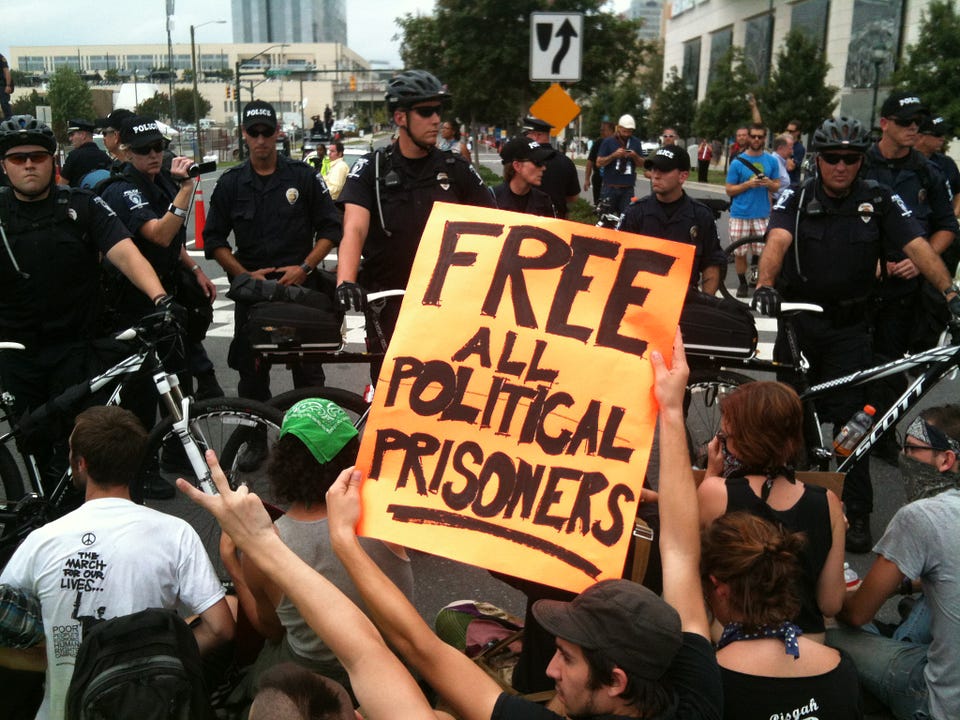
The Palestinian Protests at the DNC
The protests outside the 2024 Democratic National Convention in Chicago show expectation amplifying and constraining marginalized voices at the same time. Palestinian protesters, backed by hundreds of organizations, demanded an end to U.S. aid to Israel and drew attention to the occupation and what they termed genocide in Gaza. After being sidelined and denied permits, they sued. A federal judge upheld the city’s route, within sight and sound of the United Center, over the coalition’s longer one. The authorities decided where the protest could be seen.
Palestinian protesters’ call for liberation matters, but it is anticipated before it is made, and that dilutes its radical potential. The DNC’s panel on Palestinian human rights, held inside the convention, acknowledged the issue symbolically without giving the protesters the platform they demanded. That’s how power co-opts dissent while keeping control.

Breaking the Bind
Getting out of this cycle of surveillance, expectation, and dismissal means rethinking how representation and listening work. Some ways to break the bind:
- Decentralizing Representation: Panels and conferences often reinforce the power of the dominant group. Marginalized voices need self-determined spaces where marginalized people set the terms of their own engagement, such as decentralized, community-led platforms they control.
- Encouraging Dialogue Over Tokenism: Instead of placing marginalized people in token roles, make room for actual dialogue, where no one is expected to represent an entire group and each person’s perspective is heard as their own.
- Training Audiences to Unlearn Expectations: The problem is representation, but it’s even more reception. Audiences need to practice active, non-judgmental listening and confront their biases about who gets to speak and what they are expected to say.
- Expanding What It Means to ‘Speak’: Verbal articulation isn’t the only way marginalized people express themselves. Art, protest, and even silence can resist dominant structures of representation. Example: Indigenous land reclamation movements, where occupying land is itself a way of speaking back to colonial systems, show that non-verbal resistance can carry as much force as speech, or more.
- Embracing Multiplicity: Marginalized groups should not be expected to present a unified perspective. Their experiences vary, and the narratives that come out of them will be contradictory and messy. Example: Panels with several speakers from the same marginalized group who disagree with one another break the assumption that there is one “correct” story for the marginalized to tell.
- Redefining Liberation as a Collective Project: Liberation is not the responsibility of marginalized groups alone. It requires dominant institutions to dismantle the systems that oppress marginalized voices. Example: Restorative justice programs and community-led decision-making are models of liberation as a collective effort.
- Reclaiming the Right to Silence: Sometimes the most radical act is to refuse to speak. If marginalized voices are given space only within the constraints of dominant expectations, silence becomes a form of resistance. Example: Movements that deliberately withdraw from dialogue with oppressive systems, such as Indigenous groups refusing to negotiate with colonial governments, use silence to keep their autonomy.
Hearing the Subaltern on Their Own Terms
Breaking this bind of representation takes more than giving marginalized people a seat at the table. An institution can hand a speaker the microphone and the program slot. For the speech to count, the speaker also needs the power to make the institution change what it does when they show it’s wrong. Without that power, the panel ends and the institution’s policies stay as they were.
An institution starts hearing the speaker when it builds an unscripted process that lets their testimony change how it operates, and commits to following it.