Walk through almost any city, and you can’t help but notice the contradictions: rows of empty apartments while people sleep on the street, extra hospital beds that won’t admit those without the “right” insurance, bins of surplus food locked or thrown out behind supermarkets. We’re told, over and over, that the problem is simply scarcity: too few resources, too little money, too few qualified workers to meet everyone’s needs.
But a closer look tells a different story. Where neighbors already have the food, the spare room or the time, what they’re short on is permission, meaning the legal and bureaucratic sign-offs that decide who can use resources, and who cannot.
Gatekeeping structures block us from sharing what we already have and leave us convinced we’re up against a perpetual shortage. Laws, ordinances and cultural narratives punish neighbors who help one another directly, unless they do it through “officially sanctioned” channels.
Full shelves, hungry neighbors
Where the goods are already on the shelf or the bed is already empty, the contradictions don’t arise from genuine lack; they arise because someone (a landlord, a hospital system, a chain of grocery stores) withholds the go-ahead to share these goods.

Take “anti-camping” laws, which forbid people from sleeping outdoors or providing tents to the unhoused. Or “special event” permits, requiring volunteers to jump through legal hoops (and often pay fees) just to hand out meals at a public park. At first glance, these measures sound practical; maybe they’re about “health codes” or “public safety.” But they essentially say, You can’t just help people on your own.
The same withholding manufactures scarcity elsewhere:
- Vacant apartments artificially inflate market rents, forcing families onto the street or into shelters.
- Pharmaceutical monopolies lock up drug patents, withholding lifesaving medicines from those who can’t afford high prices.
- Food waste becomes normalized: supermarkets trash surplus goods rather than risk “liability” by giving them away.
The liability in that last case is mostly a belief. Since 1996 the Bill Emerson Good Samaritan Food Donation Act has protected anyone who donates apparently wholesome food in good faith to a nonprofit that passes it to people in need, unless the donor acts with gross negligence or intentional misconduct. A 2023 amendment extended the same protection to grocers, restaurants, caterers and schools that give food directly to people for free.1 Harvard Law School’s Food Law and Policy Clinic reports that research “does not turn up a single court case related to food donation liability.”2 Food businesses still “cite fear of liability as one of the main barriers to donating food,” the clinic and the Natural Resources Defense Council found, while “many seem unaware of these protections.”3 Where liability is the reason given, a permission nobody believes in works like a refusal.
Helping neighbors directly gets punished
In many communities, placing a “free fridge” on your sidewalk, where neighbors can give and take food, can trigger fines or forced removal. Building tiny shelters on your property for the unhoused can violate local zoning codes. Together, these rules send a clear signal: only certain licensed, government-approved, or corporately sponsored avenues can deliver aid.
Where does that mindset come from? Historically, you can trace it to colonial poor laws that distinguished between the “deserving” and “undeserving” poor, regulating who should receive help and how. In the 19th century, “vagrancy” laws outright punished many forms of grassroots assistance. The so-called Progressive Era introduced professional charities and bureaucratic welfare systems, overshadowing old-fashioned mutual aid among neighbors.
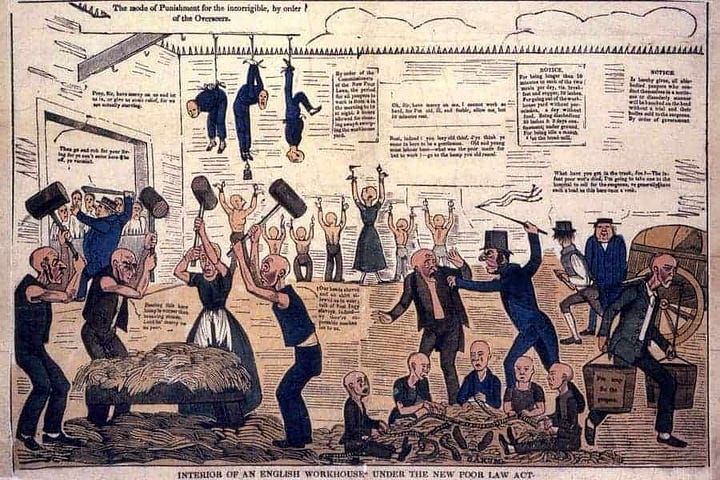
Fast-forward to today, and that legacy remains: handing out meals in public or offering a makeshift shelter can still be illegal unless you jump through official hoops. That legacy also serves the people who sell food, housing and care. If everyday people saw how easily they could feed or house each other (no massive budgets or philanthropic grants required), the notion of having to pay for the right to live would be much harder to defend.
In Fort Lauderdale the hoops were written down in October 2014, when the city amended its zoning code so that any site “temporarily used to furnish meals to members of the public without cost” counted as a social service facility, an “outdoor food distribution center.”4 A site had to be at least 500 feet from residential areas, have toilets and hand-washing equipment, and have the property owner’s consent. Indoor meals at houses of worship were allowed.5 In downtown Stranahan Park, where homeless people tend to gather, sharing food took a conditional-use permit, with application fees of up to $6,000.6 A separate park rule barred “social service purposes,” defined to include providing food, unless the city agreed in writing.4
Arnold Abbott, 90, had been feeding homeless people on the city’s beach for more than two decades,7 and he’d beaten the city in state court over those meals once before, in 2000.6 On November 2, 2014, police gave him a notice to appear for handing out food, and on November 5 they gave him another. Each count carried up to a $500 fine and 60 days in jail.5 In early December a Broward County judge suspended enforcement for 30 days and sent the city and the advocates into mediation.8
Fort Lauderdale Food Not Bombs, which shared vegetarian meals in Stranahan Park every week, sued in federal court in January 2015.6 The district court ruled for the city twice, and the Eleventh Circuit reversed it twice. In 2018 the appeals court held that the group’s food sharing was expressive conduct protected by the First Amendment. In August 2021 it held that the park rule left that expression to “the standardless discretion of the City’s permitting officials,” because the rule “provides no guidance and in no way explains when, how, or why the City will agree in writing.”9 The final judgment that December awarded $2,500 each to the group and four of its members and barred the city from denying the group’s food sharing in its parks.6 In December 2023 the city commission voted 5–0 to pay $638,196 in the group’s legal fees and costs, after one commissioner proposed taking the money out of the next year’s homeless services budget.10
Supply wasn’t the problem anywhere in that sequence. Abbott had the food and the volunteers, and so did Food Not Bombs. They lacked the city’s consent to hand it out where hungry people were, and it took seven years in federal court to establish that the city couldn’t withhold it at will.
Enclaves that build their own permission
If the real problem is that we aren’t allowed to use the surplus around us, then how do we break free? As I discuss in Control Makes Institutions Brittle, there’s a growing movement of “enclaves” that reject meltdown fantasies (waiting for capitalism to collapse) or philanthropic illusions (hoping a billionaire will bail us out). Instead, these enclaves directly form local networks that share resources unconditionally, governed by those who actually use them.
Such efforts might be:
- Free clinics or mental health pop-ups that refuse to bill insurance and so skip the gatekeeping built into it.
- Community fridges where you can drop off or pick up items as needed, with no forms and no proof of “deservingness.”
- Tenant cooperatives that buy buildings, removing them from speculative markets and setting rules collectively.
We don’t have to wait for permission.
These enclaves may face pushback (from the city, from corporate-backed nonprofits), but they also demonstrate a limited and important truth: access barriers can manufacture or aggravate scarcity even where usable surplus exists. Vacant apartments, unused beds, discarded groceries and volunteer clinics show that better distribution is possible. Whether enough suitable capacity, staffing, maintenance, transport and resources exist to meet every relevant need is a separate, empirical question. Where they already exist, as the meals in Stranahan Park did, permission is what runs short.
When officials insist we have no choice but to comply with pay-to-survive rules, it’s easy to forget that mutual aid is as old as humanity. Historically, across cultures, people cooperated with neighbors to survive. Criminalizing direct care is the anomaly in that long record.

If we’re bold enough to defy the assumption that only sanctioned institutions can help, we can start providing for each other right now.
In solidarity,
Kanav Jain
syadvada.com
Notes
Bill Emerson Good Samaritan Food Donation Act, 42 U.S.C. § 1791, as amended by Public Law 117-362, signed January 5, 2023, which added protection for “qualified direct donors” giving food to needy individuals at no cost. govinfo
Harvard Law School Food Law and Policy Clinic, “Connecticut Food Donations: Liability Protections,” October 2024; the clinic’s fact sheets for other states report the same absence of cases. CHLPI
Harvard Food Law and Policy Clinic, “FLPC and NRDC Release New Fact Sheet on Food Donation,” September 29, 2016. CHLPI
Fort Lauderdale Food Not Bombs v. City of Fort Lauderdale, 901 F.3d 1235 (11th Cir. 2018), which quotes Ordinance C-14-42, enacted October 22, 2014, and Park Rule 2.2: parks “shall not be used for business or social service purposes unless authorized pursuant to a written agreement with City,” where social services include “the provision of food.” CourtListener
Amy Sherman, “Jack Seiler says Arnold Abbott, 90-year-old, wasn’t taken into custody for feeding homeless,” PolitiFact, November 17, 2014: police reports show run-ins on October 6, November 2 and November 5; Abbott was given notices to appear, and faced “up to a $500 fine and 60 days in jail for each offense.” PolitiFact
Dan Christensen, “Fort Lauderdale, taxpayers about to learn cost of city’s unconstitutional folly shutting down public feedings,” Florida Bulldog, March 23, 2022, on the January 2015 suit, the permit fees, Abbott’s 2000 win, and the December 2021 judgment and injunction. Florida Bulldog
“90-year-old who broke law by feeding homeless undeterred in Florida,” CBS News and the Associated Press, November 7, 2014: Abbott “has been serving the homeless for more than two decades in honor of his late wife.” CBS News
“Judge Blocks Fla. City’s Limit on Feeding Homeless Outdoors,” Chronicle of Philanthropy, December 4, 2014. Chronicle of Philanthropy
Fort Lauderdale Food Not Bombs v. City of Fort Lauderdale, 11 F.4th 1266 (11th Cir. 2021), filed August 31, 2021. CourtListener
Gerard Albert, WLRN, December 22, 2023: the city had offered $334,000 before a federal judge set the amount, and the fees came from a separate liability account. City Commission agenda item CM-9, 23-1203, December 19, 2023. WLRN; City of Fort Lauderdale