When poverty rises, they blame laziness and leave economic policy alone. When climate disasters accelerate, they blame individual consumption while fossil capital goes unnamed. And now, as disability rates surge, these reactionaries claim the real crisis is not public health failure, exploitative labor conditions, or mass infection but a population growing weaker, softer, and less productive.
This narrative is a tactical reframing, one that casts disabled people not as citizens to be accommodated but as liabilities to be managed, optimized, or eliminated.
Governments can harm disabled people without targeting them directly, by creating conditions they can’t survive: economic exclusion, algorithmic gatekeeping, and medical neglect. Cuts and restrictions of this kind get presented as efficiency, sustainability, and progress rather than as cruelty.
Some of this is already in use, including AI pilots that reject disability claims automatically.
Further reading: Every Crisis Leaves Capitalism Stronger – how capitalism absorbs critique and reconfigures power to maintain dominance.
Why disability rates are rising
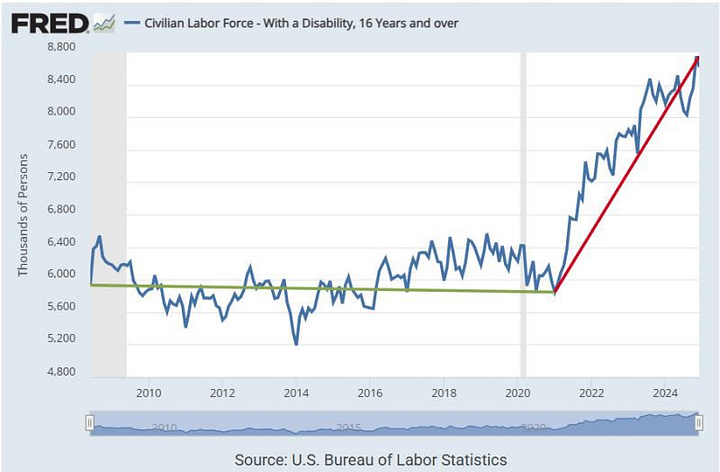
Disability among working-age adults is surging, and the reasons aren’t mysterious or “unnatural.” In the US, self-reported cognitive disability among adults aged 18 to 39 nearly doubled between 2013 and 2023, from 5.1% to 9.7%, with young adults driving the national rise. In 2024 the employment-population ratio for disabled people aged 16 and over stood at 22.7% against 65.5% for those without disabilities. In the UK, an estimated 1.9 million people reported long COVID symptoms as of March 2023 (2.9% of the population), of whom 1.3 million had been symptomatic for more than a year and 762,000 for more than two. Meanwhile, 4.2 million working-age adults now claim a health-related benefit, up from 3.2 million in 2019, and spending on them is forecast to reach £63 billion a year by 2028-29.
A rational society would read those numbers as a brief: expand healthcare, restructure labor, invest in accessible infrastructure.
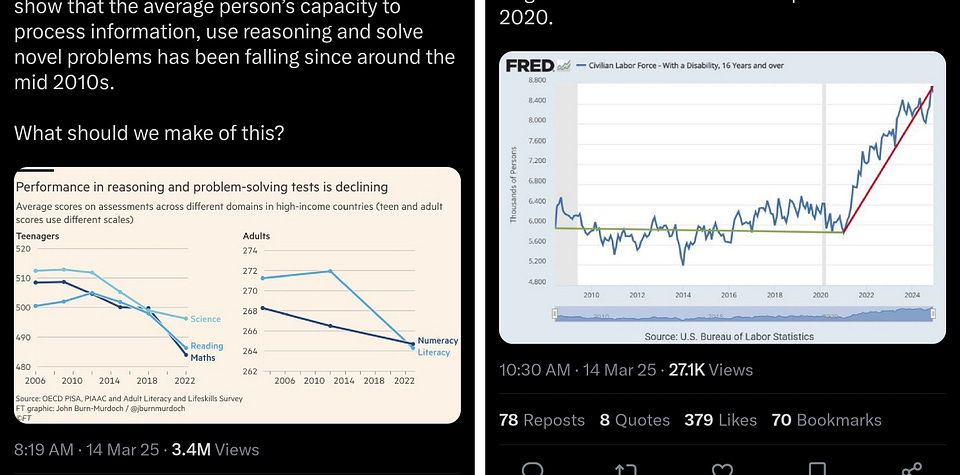
Instead, reactionary commentators and some tech leaders read them as evidence of civilizational decline, and as grounds for tighter control over disabled people’s benefits, diagnoses, and reproduction.
Further reading: Bad Rules Outlast Bad People – how profit-driven healthcare prioritizes efficiency over care.
How disability gets recast as a threat
That reframing will arrive in a few narratives, each with its own policy program.
Under capitalism a person’s value is their productivity, so as disability rates climb, reactionaries will argue that “the economy can’t sustain this,” that it can’t afford this many non-contributors. In practice that means tighter restrictions on benefits. Bureaucratic obstacles go up under the banner of fraud prevention, and more disabled people fall out of the welfare system as a result. It means AI-driven productivity policing of the kind Amazon already runs, where surveillance tracks worker efficiency and terminations follow automatically from performance metrics. And it means automation used as cover for mass layoffs, with disabled workers offered as the reason to replace human labor entirely.
Taken together, these measures push disabled people out of paid work whenever their disability can’t be argued away.
Further reading: AI Is Being Built for Austerity – AI as a tool for enforcing economic precarity.
As diagnoses of ADHD, autism, and chronic illness rise, reactionaries will say “kids these days just want to be disabled” and call disability a trend rather than a reality. The program that follows is harsher medical gatekeeping, where people have to prove they’re disabled enough to deserve accommodation. It adds stricter statutory definitions that exclude conditions deemed subjective, such as chronic pain, cognitive fatigue, and sensory processing disorders. And it brings a moral panic in which accessibility measures are said to weaken society and breed an entitlement culture.
If lawmakers adopt this framing, it becomes the justification for legal rollbacks, mass disenfranchisement, and institutional abandonment.
Further reading: ABA Is a Capitalist’s Wet Dream – how disability “treatment” industries enforce compliance and exclusion.
Others will ask “why are we becoming more disabled?” and read rising rates as biological degeneration. Eco-fascist versions blame processed food, vaccines, or air pollution for weakening the population, carefully avoiding corporate malfeasance. Silicon Valley versions promote embryo selection, gene editing, and cognitive enhancement as preventative medicine. Accelerationist versions treat disability as proof of inevitable collapse, in which only the “fittest” will endure.
Each of these stories moves disability from something to accommodate to something to prevent. When prevention is aimed at the condition through prenatal selection or gene editing, the practical effect is eliminating disabled people from future generations rather than removing the barriers they face. That conflation is the danger, and it doesn’t make every prevention effort elimination.
Some of the tools already exist
Measures like these are packaged as progress, and some of the tools they’d need are already documented practice. AI is being piloted to reject disability claims automatically, which can make appeals harder to win. Non-invasive prenatal testing is already being used to select against disability populations. Other pieces are still proposed policy: brain-computer interfaces and pharmaceutical interventions are promoted as accessibility tools, and in some versions as requirements for education or employment. But an optional intervention becomes a requirement only if an employer, insurer, or state makes access conditional on it, and that decision is the one to watch. Microbiome and gene therapies are sold as ending suffering. Whether they functionally end disabled births is a speculative risk that depends on how their use is priced and pressured.
By the time any of this is legible as policy, the infrastructure may be in place. These are contingent risks, not a guaranteed timeline: the direction of pressure is clear, but the pace and the specific pathway aren’t.
Refuse the premise of the independent worker
The most dangerous trap is arguing inside their frame: debating whether rates are “really” rising, whether ADHD is overdiagnosed, whether some disabled people are faking. Those conversations have no floor.
The entire reactionary panic rests on a foundational fiction: the myth of the atomistic, completely independent worker. Liberal capitalism tells us that the “normal” person enters the world self-sufficient and unencumbered, while the disabled person is an expensive anomaly—a dependent drag on collective resources.
Disability justice scholarship, from Mia Mingus to Alison Kafer and Marta Russell, dismantles this premise. Nobody is independent. Every human being is structurally, physiologically, and socially dependent on collective infrastructure: on supply chains, water pipes, energy grids, agricultural labor, and networks of care. What capitalism flatters as “independence” is merely living inside an infrastructure that was custom-built to support your specific embodiment without comment. The moment a staircase blocks a wheelchair user, or an inflexible schedule excludes a chronic pain patient, the defect sits in the lossy category of the institution, however loudly the institution points at the body.
So freedom can’t be defined as independence from others—an impossible condition for any mortal creature. Freedom is having a say over your own life while depending on others, as every person does.
When institutions treat disabled people as “liabilities,” they claim to defend economic reality while punishing people for making visible the dependence that every human shares. If more people are disabled, the only democratic response is universalized access, and punitive eligibility is its opposite. If economic arrangements cannot accommodate the bodies that inhabit them, then it’s the arrangements that need restructuring. If surveillance is proposed as a solution, recognize it as a mechanism of control.
Rising disability rates measure how many people the current benefit rules, buildings, and work schedules weren’t built for.