It’s no secret that much of U.S. healthcare prioritizes revenue ahead of patient well-being. But Applied Behavior Analysis, widely praised as the “gold standard” for autism, is something past the usual hospital-chain-seeks-cash story. ABA is a near-perfect capitalist venture: coverage guaranteed by law, complaints kept private, a moral shield against criticism, and data illusions that fortify the monopoly, often at the expense of the autistic people it claims to serve.
Mandated insurance coverage and the argument over whether ABA can be ethical at all are the parts that surface. The cheap-labor pipeline of Registered Behavior Technicians, and the way behavior data can stand in for emotional welfare, mostly don’t.
A legislated money pipeline
All 50 states have autism insurance mandates, and nearly every one covers ABA or behavioral health treatment, which isn’t true of most other mental or behavioral health services (Bierman Autism Centers, 2021). Add ABA-specific CPT codes and you get stable, high-volume billing: once a child is diagnosed, clinics prescribe 20 to 40 hours a week, sometimes for years, which is a multi-year revenue stream per family. You also get a market with almost no elasticity. Mandates leave families without a real alternative, and many are told other therapies are unproven.
Capital follows that arithmetic. Private equity firms, KKR and Blackstone among them, see low risk where moral urgency meets guaranteed reimbursement. They’ve consolidated local clinics into chains such as BlueSprig, Centria, InBloom and Hopebridge, and they’ve standardized protocols in ways that maximize hours and revenue (CEPR, 2023). Blackstone bought the largest chain, CARD, in 2018; even so, CARD filed for bankruptcy in 2023 after closing more than 100 locations (NBC News, 2024). State law manufactures a captive consumer base for one therapy and marginalizes acceptance-based approaches by leaving them uncovered.
Complaints settled, critics sidelined
Profit-driven healthcare routinely stifles bad press; ABA providers are unusually good at it. Families who suspect inflated billing or mishandled meltdowns get settlements tied to NDAs. Staff, especially RBTs, face forced arbitration if they talk about ghost hours or about physically blocking a child’s stims.
The environment is hardest on families of disabled kids who lack the time or money to litigate. Most sign without a fight, so individual cases rarely surface, and the criticism that does appear hasn’t dented ABA’s standing as the gold standard.
In most of healthcare, patient advocacy eventually forces ethical reform. Here the advocacy channel is captured. Industry-aligned nonprofits such as Autism Speaks and TACA have lobbied for expanded ABA coverage. Legislative hearings tend to take testimony from those large organizations, funded by insurers and therapy chains, rather than from people describing mishandled meltdowns, punished stims, or PTSD-like harm (NeuroClastic, 2020).
Critics, most of them autistic, are cast as unrepresentative, and the line holds: ABA is the only proven therapy.
A manufactured gold standard
Legislators, insurers, and educators treat ABA as untouchable, and the bodies that certify, accredit and lobby for it explain much of why. The Behavior Analyst Certification Board certifies BCBAs and RBTs but rarely takes up meltdown mismanagement or forced normalization. The Behavioral Health Center of Excellence accredits clinics and is often funded by the clinics it evaluates. APBA and CASP lobby to keep ABA labeled the only evidence-based option, which writes child-led and neurodiversity-focused interventions out of the category.
Underneath sits the data. Day-to-day behavior-reduction numbers give ABA the air of scientific success, but many of the behaviors being reduced are self-regulatory stims or meltdown expressions—that is, the child’s own regulation. One survey of 460 autistic adults and caregivers found that nearly half of those exposed to ABA met the diagnostic threshold for PTSD (AIA, 2018). For private equity the compliance charts do double duty as marketing, which is what preserves the billing rate.
Plenty of healthcare services claim to help. ABA’s moral aura is unusually resistant to criticism, because critics get painted as denying therapy to disabled children. That framing does real work: “we’re saving children” ends the inquiry before it starts.
Long hours, cheap labor
Other fields inflate billing too. Sustained 20-to-40-hour weeks across multiple years are still an outlier. Each child can represent tens of thousands of dollars annually, and parents told that 35 hours is standard rarely push back on a number presented as clinical.
“If a client is recommended for 20 hours of therapy a week, it is because evidence shows that this is the prescription. If a client only attends 10 hours per week, that is only 50% of recommendation. It would be similar to taking half of an antibiotic and likely not effective.” —Summit Health Services, an ABA provider.
Staff who try to reduce hours for child-centered reasons meet internal resistance, or leave.
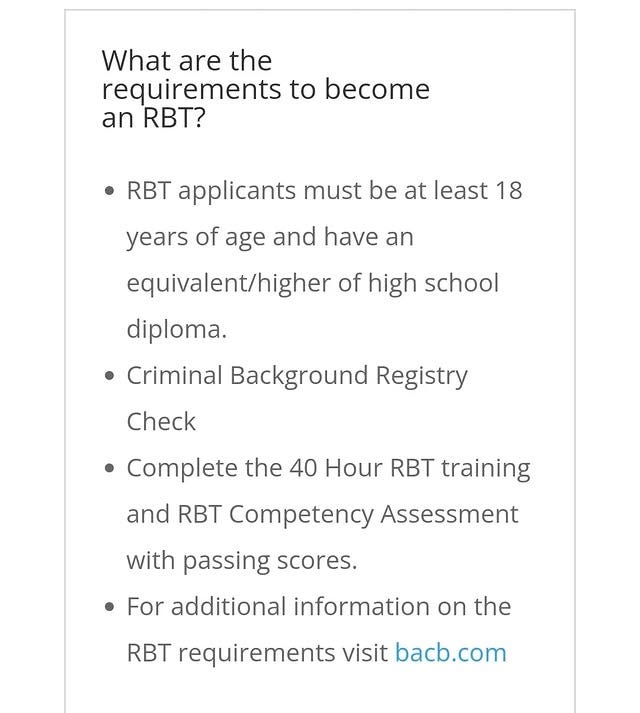
Who delivers those hours matters as much as how many there are. RBTs, often paid near minimum wage, handle the bulk of face-to-face therapy while insurer reimbursement stays high, and the gap between the two is the margin.
A post shared by @skillometry_aba
The same blueprint, and what breaks it
It would be comforting to read ABA as an exception. The blueprint—moral panic, legislative mandate, corporate expansion, hush tactics, compliance as proof of success—recurs across caretaker sectors. Private prisons have guaranteed occupancy, silence around detainee abuse, and a moral panic about dangerous criminals. For-profit nursing homes have federal reimbursement, minimal staffing, and NDAs covering neglect. Addiction rehab has coverage for 28-day cycles and successful-discharge numbers that outlive the relapse rate. Cochlear implant programs sell expensive surgery while Deaf culture and sign language go underfunded.
Acceptance-focused and child-led approaches exist, as do Deaf-culture-affirming and mental-health-centered models. They’re underfunded by the same laws and coverage rules that favor the incumbents.
Parents can ask why 35 to 40 hours is standard, and look at staff turnover, at how meltdowns are handled, and at whether their child’s emotional comfort is being traded for compliance metrics. Lawmakers and journalists can investigate hush clauses, forced arbitration, and the small circle of executives shaping policy, and can take testimony from adult autistic people. The autistic community and its allies can keep exposing staff intimidation and data illusions and press for coverage of acceptance-based models. Everyone else can watch for the same formula in nursing homes, private prisons, oralism, and rehab, because the cycle only breaks when the moral posturing stops working.
Changing the machinery means decommodifying care: treating neurodiversity, Deaf culture, mental health, and disability acceptance as parts of human variation rather than as revenue lines.
Referenced links and readings
- AIA (2018) Evidence of Increased PTSD Symptoms in Autistics Exposed to Applied Behavior Analysis
- Bierman Autism Centers (2021)
- CEPR (2023) “Pocketing Money Meant for Kids: Private Equity in Autism Services”
- NBC News (2024)
- NeuroClastic (2020) “An Open Letter to the NYT: Acknowledge the Controversy Surrounding ABA”