 Critical sobriety is a discipline: refusing any consolation, style, or moral drama that makes reality easier to bear by making it less exact. It rejects distortion without drifting into cynicism.
Cynicism offers no cure for distortion. It is often wounded vanity wearing the costume of intelligence—presenting itself as terminal lucidity while assuming the worst in advance, then mistaking preemptive disappointment for depth. It protects the self from implication by declaring implication impossible.
Critical sobriety demands something less glamorous and more difficult. It refuses flattery, but it also refuses the easy prestige of total disgust. It does not ask reality to be uplifting. It asks that reality be seen at the right scale.
Its main antagonist is false upgrading: language that beautifies degradation, pads humiliation with moral rhetoric, or confers grandeur on what is merely squalid. Institutions rename damage as care. Technologies rename thinning as access. Bureaucracies rename substitution as efficiency. Individuals rename confusion as depth, passivity as peace, and self-protection as wisdom.
The fraud is often in the ratio between event and description, not in the facts themselves. Something ugly is made to sound noble. Something degrading is made to sound inevitable, mature, spiritually serious. Once suffering is sold as necessary, the system that produced it becomes harder to see.
Seriousness is frequently treated as truth's natural register, yet in practice it is a primary entry point for distortion. Once a thing is described in the proper register—administrative, therapeutic, historical, spiritual—it acquires borrowed dignity. It seems sadder, wiser, more necessary than it is.
Critical sobriety withholds that dignity until earned. Solemnity can function as a laundering mechanism: the ugly goes in and emerges scented. Exploitation rebranded as necessity. Retreat rebranded as healing. Managed deprivation rebranded as innovation. The impoverishment of human contact rebranded as scale.
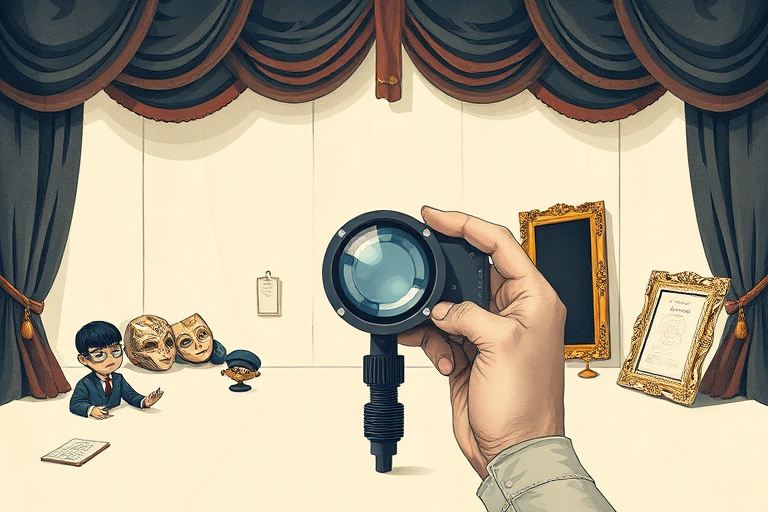
By then, sobriety may have to sound unserious—not because reality is trivial, but because so much seriousness is theatrical. When official description arrives overdressed, accurate reply may need indecorum. When institutions speak in uplift, precision may require mockery. When vanity enters in a grave voice, the cleanest answer may be comic.
In that register, comedy is a diagnostic instrument. It drags inflated things back to size and punctures the fantasy that every wound is meaningful, every compromise profound, every humiliation spiritually useful, every technological substitute democratizing. Sometimes a grotesque image tells the truth more faithfully than a measured paragraph, because the measured paragraph has already been socially captured.
Absurdity, there, is not exaggeration but realism using damaged materials. That correction depends on something remaining outside captured language—some still-living part of the self that can notice inflation. Modern systems target that remainder directly. The cruelty is that people are given a vocabulary in which bearing the cost sounds like wisdom.
Critical sobriety is hostile to euphemism and impatient with self-dramatization. Euphemism protects power, and self-dramatization is one of the fastest ways to grow unavailable to truth. It is also suspicious of any arrangement that converts dependence into shame while exploiting dependence at every level.
Human life is interdependent all the way down. We are fed, repaired, instructed, tolerated, and carried by arrangements and people we did not make. One of modernity's standard evasions is to enjoy total dependence while describing oneself as fully self-authored.
This is not an argument for sentimental dependence, which can be humiliating, coercive, unevenly distributed, and politically weaponized. But denial does not remove dependence; it hands it over to hypocrisy. Much cruelty begins in the refusal to admit what one owes.
Correcting public language is not enough; public form has a private correlate. A culture that tolerates vulnerability only as branded identity, therapeutic script, or bureaucratically legible need eventually turns inward life into administration—belief filed as policy, conscience filed as procedure, suffering filed as content.
The languages most eager to organize inward life are often the languages most committed to making it tidy, compliant, and low-risk. The most intimate falsifications arrive in the most caring vocabulary. People are asked not only to endure distortion, but to describe adaptation as growth, suppression as equanimity, and attrition as maturity. The person is made to inhabit what should have been redesigned.
When external laundering and internal explanation begin to rhyme, damage is nearing completion. The decisive move is not harm itself—harm is common—but learning to describe harm in a register that makes it sound chosen.
Critical sobriety is not despair, which has its own vanities: it totalizes too quickly and flatters itself for doing so. It remains a romance, only in negative form. Critical sobriety is more chastened. It does not require optimism, but it does require honesty about the continued presence of the good.
People remain capable of mercy without theory, humor without nihilism, and endurance without self-congratulation. They care for one another badly, unevenly, and sometimes with mixed motives, but genuinely. The sober mind does not deny manipulation, corruption, or decay; it denies that these exhaust the field.
It is therefore not closed against tenderness—just against sentimental tenderness, redemptive uplift, and the consoling fiction that everything broken is meaningful. Once false transcendence is abandoned, smaller goods become visible: imperfect loyalties, ordinary maintenance, unadvertised repair, forms of companionship that do not present themselves as salvation and do not need to.
The alternatives remain seductive. Consolation is kinder to the nerves, drama to the ego, and cynicism to pride. Critical sobriety is kinder to none of them.
It asks us to renounce the pleasures of noble suffering, superior disgust, and flattering confusion, and to see without anesthesia and speak without laundering. Its harshness is directed first at falsification: every tone, style, and vocabulary that makes the degrading sound noble, the coercive sound inevitable, and the managed sound like peace.
What it offers is proportion. In every scene, it asks: what is this, actually; what is tone hiding; what inflation is happening; what moral costume has been supplied; what sentence would return the thing to its true size?
Sometimes that sentence is plain. Sometimes analytical. Sometimes cutting. Sometimes absurd in exactly the right way, as when architecture itself exposes the lie of formal freedom.
The criterion is not decorum. It is fidelity.