Comparisons between humans and automated systems usually turn on intelligence or processing speed. They leave out a constraint that matters when people act: you have to live with what the action makes of you.
A system acts without having to live inside what its actions mean. It executes a command, reverses itself overnight or optimizes metrics that degrade the people inside it, and nothing fractures. It never has to ask, what does this make me? For a person that question can outweigh the expected outcome. A choice can be correct, even rewarded, and still feel impossible because doing it requires becoming someone we can’t stand.
The barrier is less often “can I?” and more often “what would it make me if I did?”
Speak up, and become disloyal. Leave, and become unreliable. The action exists, but it requires an identity nobody can live in.
If you assume humans are just outcome-optimizers, control looks like restricting options. If people have to live with what their actions mean, control can work by making self-protection feel selfish and truth-telling feel disloyal.
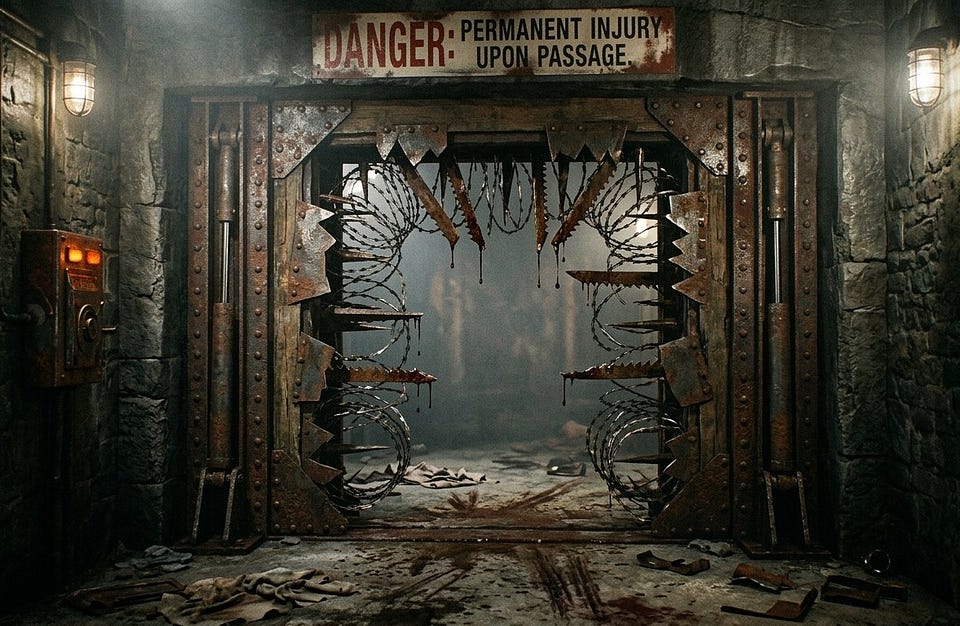
So an institution can leave the door open and still have almost no one walk through it.
Which helps explain why a formal right goes unused. We’re told that once people have rights and incentives, movement follows, and when it doesn’t, the individual eats the blame and gets called fearful, passive or lazy.
That diagnosis confuses available action with inhabitable action.
An action is functionally real only if a person can survive being the one who takes it. If using a right makes you unsafe or morally compromised, the option sits there unused. That non-use then gets cited as evidence that the institution did its part and the person didn’t. What made the right too costly to use drops out of the account.
US harassment law runs the whole loop. Title VII protects employees from sexual harassment at work, and in practice that protection runs through the employer’s complaint procedure. Most people don’t use it. The EEOC’s 2016 task force on workplace harassment found that roughly three in four people who experienced harassment never even talked to a supervisor, manager or union representative about it, and that studies put the share who file a formal complaint at 6 to 13 percent.1 Most of the reasons it lists are about who the reporter would become: blamed for the conduct, humiliated, ostracized, damaged in career and reputation. The task force called those fears well founded, citing a 2003 study in which 75 percent of employees who spoke out against workplace mistreatment faced some form of retaliation.1
Then the non-use is entered as evidence. In 1998 the Supreme Court gave employers a defense against liability for a supervisor’s harassment that hasn’t ended in a firing, demotion or similar action: show that the company took reasonable care to prevent and correct it, and that the employee “unreasonably failed to take advantage” of the procedures it offered. Showing that she unreasonably failed to use a complaint procedure, the Court said, “will normally suffice” for the second half.2
Sheri Minarsky was a part-time secretary in Susquehanna County, Pennsylvania. From soon after she started in 2009, her boss, the director of the county’s Department of Veterans Affairs, made unwanted sexual advances toward her nearly every week, and she never reported them. Her daughter was ill, and she needed the job to pay the medical bills. He told her the county officials she’d report to couldn’t be trusted and might “get rid” of her, and she knew he’d been warned before and nothing had come of it. “I know I didn’t dare speak up to him,” she said in her deposition. The county had an anti-harassment policy she knew about. The magistrate judge set the county’s “reasonable policies and responses” against her “refusal or unwillingness to avail herself” of the policy, and the district court gave the county summary judgment.3
In July 2018 the Third Circuit sent the case back for a jury, holding that her silence might have been reasonable. It noted that several circuits treat a “generalized fear of retaliation” as insufficient to explain a long delay in reporting, and said a jury can be told her fears must be “specific, not generalized.”3 Under that rule the cost of reporting counts only when it can be shown specifically, and what reporting would make of a person is hard to show that way.
Treating this hesitation as personal weakness hides what the institution is demanding. As more of daily life runs through automated systems built to read people as clean data, people are pushed to become frictionless too: faster, clearer, more compliant.
A person stops when an action becomes unlivable, even if it works perfectly, and we usually call that stopping point conscience. In a workplace that measures only whether the task got done, conscience is the one brake that measure does not remove.
The same feature that makes us capable of refusal makes us uniquely vulnerable. We stay in bad situations because leaving would collapse our sense of who we are.
A person can know that leaving would help and still be unable to bear becoming, in their own eyes, someone who abandoned people. An exit designed around incentives alone misses that obstacle entirely.
Systems must execute. Human beings must inhabit.
Some institutions already treat conscience as inefficiency, paralysis as preference, and domination as a problem of bad choice architecture. I don’t know what it takes to make one of them stop.
What Happens to the Web When AI Agents Do the Clicking
For thirty years, the internet was built around a specific political subject: a human being with eyes, hands, and time. The entire economy of the web, from ad impressions to checkout flows, relied on the assumption that persuasion happens at eye level. If you could design the screen, you could design the person.
Notes
Chai R. Feldblum and Victoria A. Lipnic, Select Task Force on the Study of Harassment in the Workplace: Report of Co-Chairs, U.S. Equal Employment Opportunity Commission, June 2016. Employees who don’t report anticipate “disbelief of their claim; inaction on their claim; receipt of blame for causing the offending actions; social retaliation (including humiliation and ostracism); and professional retaliation, such as damage to their career and reputation.” EEOC
Faragher v. City of Boca Raton, 524 U.S. 775, 807–08 (1998), decided June 26, 1998, the same day as Burlington Industries v. Ellerth, 524 U.S. 742, which set out the same defense. Legal Information Institute
Minarsky v. Susquehanna County, 895 F.3d 303 (3d Cir. 2018), filed July 3, 2018, which quotes the magistrate judge’s report (2017 WL 4475978). Its footnote 12 notes that in the wave of harassment allegations then in the news, “In nearly all of the instances, the victims asserted a plausible fear of serious adverse consequences had they spoken up at the time that the conduct occurred.” CourtListener