Reassurance in Failing Systems Is a Tool of Governance
Reassurance typicallysignals kindness. However, in systems that cannot reliably repair harm, it serves a different function: it becomes a mechanism fordeferring obligation. It allows an institution to acknowledge a user without committing to repair, ending theinteraction without ending the failure.
This is not a matter of tone; it is a matter of mechanics. When a system cannotcorrect itself on demand, soothing language begins doing structural work. It masks a lack of obligation with the appearance ofcare—offering recognition without bindability (no clock, no owner, no enforceable outcome).
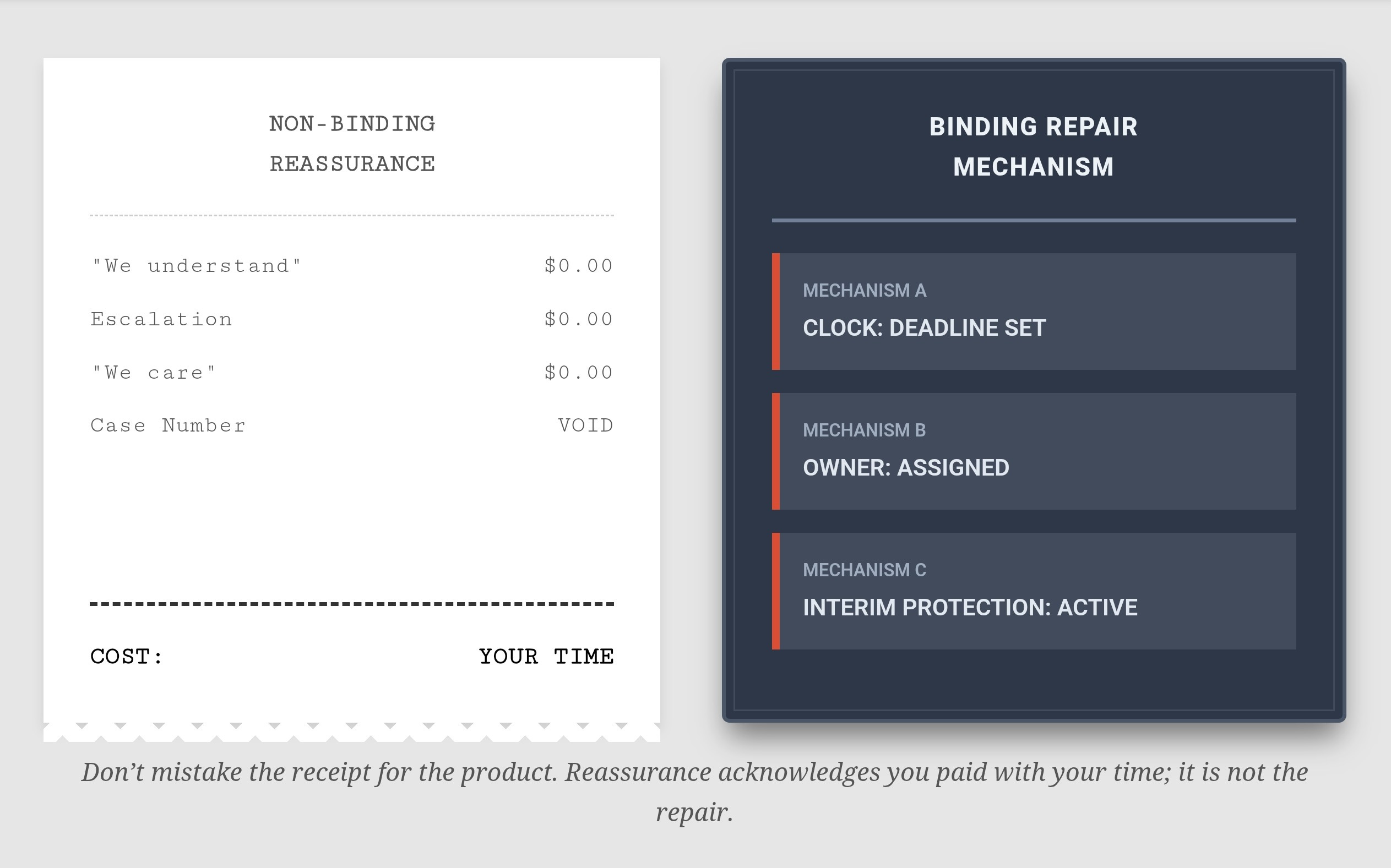
Don’t mistake the receipt for the product. Reassurance acknowledges you paidwith your time; it is not the repair.
Soft Language Resolves the Interaction Without Resolving the Failure
The pattern is standard. Your account is frozen “for your protection,” your appeal is “underreview,” or your ticket is “escalated” without resolution. Then comes the standard automated response:
We are sorry. We understand. We take this seriously. We appreciate your patience.
The outcome is rarely repair; it is recalibration. Your urgency is dampened, and yourexpectations are lowered. The institution secures what it needs—reduced conflict—without providing a path torestoration. Reassurance becomes a substitute for obligation. Harm is acknowledged, but no binding commitments follow.
Nothing is owned, nothing is time-bound, and nothing materially changes.
Delay Is Disguised asKindness to Outlast Your Capacity
This dynamic is dangerous because it allows delay to be presented asprocess. Delay is an effective form of power for an institution. If a system can act quickly to harm you but slowlyto fix you—without consequence—it can remain wrong indefinitely. It does not need to win the argument; it only needs tooutlast your capacity to pursue it.
Reassurance makes that delay tolerable and easy to interpret asstandard procedure. It converts “we are not capable of correcting this reliably” into “please be patient while welook into it.” Because the language is polite, the failure becomes harder to name, and the waiting periodlooks less hostile—even as access remains blocked.
Reassurance is Used to Reframe Persistence asMisconduct
Reassurance enables a critical shift: it changes the framing of the interaction. Once a user has been“heard” and “reassured,” continued insistence begins to look unreasonable. If you keep pushing, you are nolonger a person seeking correction; you become a person who refuses to let it go.
Consequently, the system’sfailure is obscured by your demeanor. The problem is no longer that the process cannot reliably produce repair; the problem becomes how you are behaving inside the process. The institutiongains an excuse: it claims it wants to help, provided you are calmer or more grateful. It converts distress intodisqualification, turning emotional regulation into a requirement for access.
That is not care. That is screening.
Real Safety Requires Binding Mechanisms, Not Better Manners
**Question:**Does the reassurance bind the institution, or does it only soften the person?
Legitimate reassurance is additive; itoperates alongside enforceable structure. A clock starts when harm is reported. An owner is named. Interim protection applies whilean investigation happens. A reversal path functions without extraordinary effort.
In a functioning system, an apology issecondary; the primary requirement is a clear, enforceable timeline for resolution.
We must stop lettingreassurance do the job of engineering. Users do not needinstitutions to empathize; they need them to function.
The test of a system is not how politely it fails, but how reliably itrepairs.