Concept map
Care, inherent care, and care theater
Separates actual support from its performance by asking whether concern changes material conditions, or only manages optics, reassurance, and institutional self-image.
Paired reading path: Care and care theater. Open that path when you want the same terrain arranged as a short sequence instead of a map.
Start from this map without getting stuck in taxonomy
Take the paired path when you want sequence, the opening essay when you want one strong example, or the guide when you want the larger frame around the same pattern.
Care and care theater
For readers who can feel the gap between humane language and humane conditions and want a sequence that keeps that distinction sharp.
Don’t Let Reassurance Do Engineering's Job
Why “we care” substitutes for obligation—and how delay gets disguised as kindness.
Glossary and deeper vocabulary
Jump into Understand the idea at the primitives glossary section.
Questions this map helps you ask
Use these as the quick recognition layer before you branch into the glossary, essays, paths, or archive views.
- What changed besides tone, empathy language, or ethical branding?
- Is care being offered as obligation, or only as a story the institution tells about itself?
- Where is care happening inherently, informally, or downstream after the official system has failed?
Ideas tied to this map
These links point either to the concept essay itself or to the archive with that concept already searched so the map is immediately usable.
Inherent care
Go straight to the essay that introduces or centers inherent care.
Care theater
Search the archive for essays that mention care theater.
No unprofitable people
Go straight to the essay that introduces or centers no unprofitable people.
Reassurance as governance
Search the archive for essays that mention reassurance as governance.
Reading paths connected to this map
Use these when you want to move from the map into a shorter ordered sequence.
Care and care theater
Essays about the gap between real care and its performance: reassurance, ethical branding, tenderness language, and managerial concern without obligation.
Burden
Essays about how systems shift labor, fallout, maintenance, and proof onto the people least able to refuse it.
Survivability
Permission is not freedom. These essays ask whether an option is actually usable, not just available in principle.
Guide sections tied to this map
These sections drop you into the grouped glossary and synthesis guides at the exact anchors that match this pattern.
Glossary and deeper vocabulary
From Understand the idea
Jump into Understand the idea at the primitives glossary section.
Read the archive in the same dependency order as the glossary
From Core claims of the archive
Use the same stack everywhere: start from the foundational claims, move into institutional mechanisms, judge them with legitimacy and recourse tests, then carry the applied diagnostics back…
The mechanisms that keep reappearing across the archive
From Core claims of the archive
Use these as the mechanism layer inside the broader conceptual stack: they sit downstream of the foundational claims and upstream of the legitimacy tests and applied diagnostics. The public…
Anchor essays for the archive’s main claim
From Core claims of the archive
These are strong entry points because each names a different part of the same structure: burden, livability, delay, and maintenance.
Use the archive by structure, not only by path
From Method reference
These synthesis pages compare essays across domains so readers leave with a structural overview, not just a single argumentative thread.
Nearby concept maps
These neighbors are computed from shared reading paths, guide sections, and coined concepts so the connections stay grounded in the same source registry.
Burden and load-bearing
Shared reading paths: burden, survivability.
Survivability and inhabitable action
Shared reading paths: care theater, burden, survivability.
Delay and temporal governance
Shared reading paths: care theater, survivability.
Infrastructural power and ambient coercion
Shared reading paths: burden, survivability.
Archive views to try next
These links are derived from the essays already attached to this map, so the page feeds back into the archive instead of ending here.
Essays mapped here
4 of 4 mapped essays are currently available.
-

Why “we care” substitutes for obligation—and how delay gets disguised as kindness.
-

Before an institution can do immense harm, it must first learn to feel good about itself. It must learn to translate its contradictions into virtues and its ri…
-
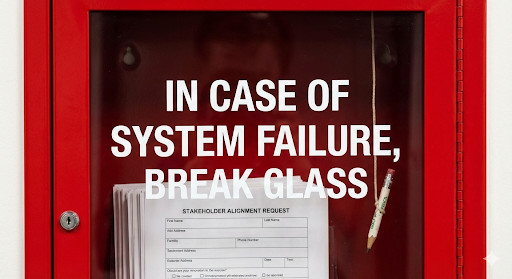
A guide to the difference between moral language and structural constraint
-

institutions cannot provide care; they are only capable of restricting our natural propensity to care for one another