Concept map
Infrastructural power and ambient coercion
Collects the concepts that show how power hardens into defaults, categories, interfaces, and mid-level systems until control feels like ordinary background reality.
Paired reading path: Infrastructural power. Open that path when you want the same terrain arranged as a short sequence instead of a map.
Start from this map without getting stuck in taxonomy
Take the paired path when you want sequence, the opening essay when you want one strong example, or the guide when you want the larger frame around the same pattern.
Infrastructural power
For readers who want the systems layer: how force becomes routine, default, category, platform, or ambient constraint before any explicit command appears.
Mesopower and the Shaping of Possibility
Representative opening essay for the infrastructural power and ambient coercion map.
The public model set
These three diagrams are now the site's stable visual language: the official framework set reused across onboarding, reference pages, and future share surfaces.
Questions this map helps you ask
Use these as the quick recognition layer before you branch into the glossary, essays, paths, or archive views.
- Where did power become architecture, default procedure, or background expectation instead of an explicit command?
- Which systems shape the field of possibility before anyone argues about choice?
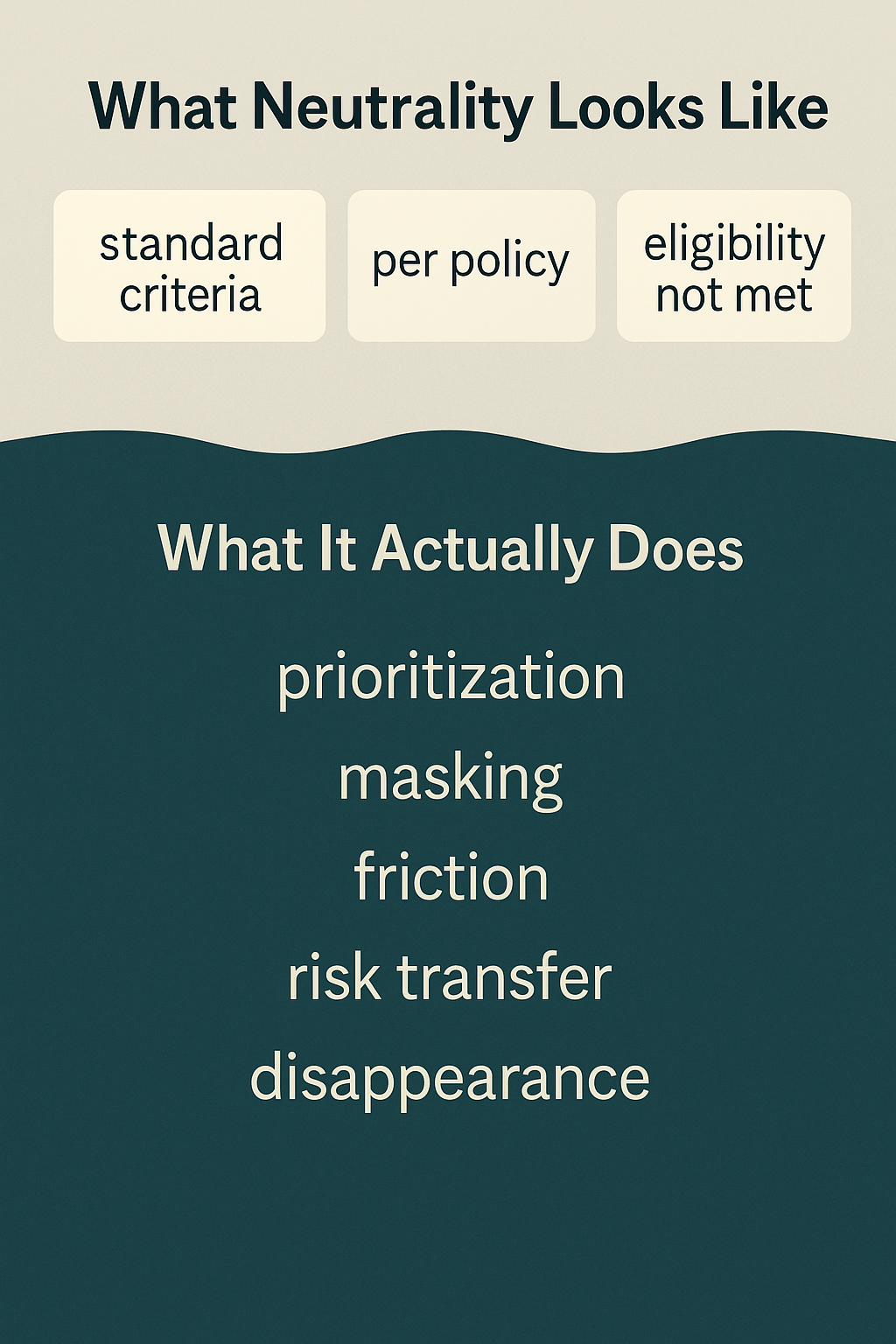
- What is being presented as neutral even though it quietly arranges dependence, exposure, or compliance?
Ideas tied to this map
These links point either to the concept essay itself or to the archive with that concept already searched so the map is immediately usable.
Mesopower
Search the archive for essays that mention mesopower.
Seemingly neutral systems
Go straight to the essay that introduces or centers seemingly neutral systems.
Post-user web
Search the archive for essays that mention post-user web.
Infrastructural power
Search the archive for essays that mention infrastructural power.
Reading paths connected to this map
Use these when you want to move from the map into a shorter ordered sequence.
Infrastructural power
Essays about how power settles into defaults, platforms, procedures, categories, and institutions until it starts to feel like the background of everyday life.
Burden
Essays about how systems shift labor, fallout, maintenance, and proof onto the people least able to refuse it.
Survivability
Permission is not freedom. These essays ask whether an option is actually usable, not just available in principle.
Guide sections tied to this map
These sections drop you into the grouped glossary and synthesis guides at the exact anchors that match this pattern.
The public model set
From Understand the idea
These three diagrams are now the site's stable visual language: the official framework set reused across onboarding, reference pages, and future share surfaces.
The mechanisms that keep reappearing across the archive
From Core claims of the archive
Use these as the mechanism layer inside the broader conceptual stack: they sit downstream of the foundational claims and upstream of the legitimacy tests and applied diagnostics. The public…
Human vs System: Inhabitation vs Execution
From Method reference
People experience an action from the inside, but institutions tend to process it as a rule, throughput problem, or continuation path. Use this when a system calls something simple or availa…
Use the archive by idea
From Method reference
Once the framework feels clear, choose the topic that best matches the pattern you want to follow next.
Nearby concept maps
These neighbors are computed from shared reading paths, guide sections, and coined concepts so the connections stay grounded in the same source registry.
Burden and load-bearing
Shared reading paths: infrastructural power, burden, survivability.
Interface, legitimacy, and public feeling
Shared reading paths: infrastructural power.
Reversibility and institutional rollback
Shared reading paths: infrastructural power, survivability.
Care, inherent care, and care theater
Shared reading paths: burden, survivability.
Archive views to try next
These links are derived from the essays already attached to this map, so the page feeds back into the archive instead of ending here.
Essays mapped here
6 of 6 mapped essays are currently available.
-

-

Why neutrality isn’t fairness—and what it hides when institutions say it is.
-

-

-
-

The interface is dying because the “User” is obsolete. On the post-user web, AI agents, friction economics, and the rise of adversarial infrastructure.