When climate disaster, failing healthcare, and rampant inequality dominate the headlines, two levels of power get the attention: macro (governments, giant corporations) and micro (individual habits, consumer choices). There’s a sprawling middle we rarely discuss: philanthropic foundations, trade associations, accreditation committees, and professional boards. They don’t pass laws like Congress, and they’re not as flashy as famous CEOs.
But in quiet, everyday ways, these mid-tier institutions decide which reforms count as “possible” and which vanish before debate even begins.
That’s mesopower.
These groups rarely claim the limelight the way top politicians or big-name brands do. Philanthropic foundations (the Bill & Melinda Gates Foundation, the Robert Wood Johnson Foundation) decide what qualifies for funding, like “market-based innovations” in healthcare or “pilot projects” for housing, and so steer which ideas get taken seriously. Trade associations (the American Petroleum Institute, the American Hospital Association, ALEC) develop industry “best practices” or even draft model legislation that state or federal lawmakers often adopt verbatim. Accreditation councils and professional committees (the Joint Commission, the American Medical Association’s CPT Panel) set standards for “quality care” or medical billing codes. Those standards lock entire sectors into specific frameworks until more radical alternatives start to seem unthinkable or “unfeasible.”
These organizations mostly work behind closed doors, and voters and the press rarely confront them. Their decisions shape policy in advance. By the time you or I hear about a new reform, the bolder possibilities may already be off the table.

View source
%% title: How rent caps leave the table before any vote
%% caption: Renters’ anger over rent reaches a foundation’s grant committee first, and its criteria fund housing pilot projects instead of rent caps. By the time a bill reaches the legislature, the cap is no longer among the options.
flowchart TD
  classDef actor stroke-width:1.6px;
  classDef system stroke-width:1.2px;
  classDef gate stroke-width:1.6px;
  classDef binding stroke-width:3px,font-weight:bold;
  classDef status stroke-dasharray:4 3;
  classDef load stroke-width:2px;
  classDef repair stroke-width:2.4px,font-weight:bold;
  classDef failure stroke-width:2.2px,stroke-dasharray:6 3;

  subgraph Macro["Macro tier: the vote the news covers"]
    M1["State legislature votes on<br/>the bill that reaches it"]:::system
  end

  subgraph Meso["Meso tier: the committee nobody covers (mesopower)"]
    G1{"Foundation grant committee<br/>decides what qualifies"}:::gate
    G1 --> F1["Grant criteria fund<br/>housing ‘pilot projects’"]:::binding
  end

  subgraph Micro["Micro tier: the renters"]
    U1(["Renters and organizers<br/>asking for rent caps"]):::actor
  end

  Macro -. "takes up only what survived" .-> Meso
  Meso == "a pilot, not a rent cap" ==> Micro
  Micro -. "anger over rent" .-> Meso
Why careful staff choose small reforms
It’s tempting to paint these gatekeepers as faceless, self-serving elites. More often they’re ordinary professionals (grant managers, policy specialists, analysts) trying to do good work without putting their livelihoods at risk.
Proposing a radical overhaul, like fully public healthcare or a ban on all fossil-fuel extraction, can scare off funders or provoke pushback inside the organization. Staffers know it: “Will this risk my career? Will donors pull funding?” They also follow professional norms, the “best practices” that grant officers, lobbyists, and accreditation officials pick up in training sessions, at conferences, and from peers. In those cultures, being “too radical” reads as a failing. Short grant cycles and project deliverables reward quick fixes over decade-long change, so a small pilot project looks safer and more achievable than a system overhaul. And reputations are at stake. Failing with a moderate initiative stings less than backing a sweeping change that flops spectacularly. So people in these roles prefer small, tidy wins that sit inside donors’ comfort zones.
Even those who privately support bigger ideas find themselves retreating to small, “safe” reforms. Over time the drift produces a brand of incrementalism that rarely upends core power structures.
How the filtering works

View source
%% title: The three mechanisms of mesopower
%% caption: How mid-tier gatekeepers defuse systemic demands by redirecting anger into grants, by strategic invisibility, and by progressive absorption.
flowchart TD
  classDef actor stroke-width:1.6px;
  classDef system stroke-width:1.2px;
  classDef gate stroke-width:1.6px;
  classDef binding stroke-width:3px,font-weight:bold;
  classDef status stroke-dasharray:4 3;
  classDef load stroke-width:2px;
  classDef repair stroke-width:2.4px,font-weight:bold;
  classDef failure stroke-width:2.2px,stroke-dasharray:6 3;

  D["Radical systemic demand<br/>Rent caps, public health, climate"]:::actor --> M{"Mesopower filter"}:::gate

  M -- "1. Anger redirected into grants" --> S1["Small innovation grants<br/>Treats symptoms, protects profits"]:::status
  M -- "2. Strategic Invisibility" --> S2["Apolitical technical standards<br/>Locks sectors into legacy paths"]:::system
  M -- "3. Progressive Absorption" --> S3["Adopts activist vocabulary<br/>Repackages as market-friendly pilot"]:::repair

  S1 & S2 & S3 ==> R([Domesticated reform / safe crumbs]):::failure
Foundations redirect anger into grants. One takes widespread anger about unaffordable housing and reframes it as a few small “innovation grants” that treat symptoms without touching the profit motives underneath. The real demands (rent caps, large-scale public housing) get channeled into less controversial pilot programs, and the urgent cause loses momentum.
Standard-setters work through strategic invisibility. An accreditation board or trade association presents itself as “neutral,” setting standards the public barely hears about. These bodies seem apolitical, so few people ask how or why their guidelines lock us into a particular path, like expanding telehealth instead of improving staffing or widening coverage.
Philanthropic boards practice progressive absorption: they take up activist language (“universal healthcare,” “equity”) and repackage it into mild, market-friendly versions. It feels like progress, but the radical edge (a full single-payer system, strict profit regulations) disappears early on.
We get “reforms” that look fresh on the surface and rarely challenge core problems like profit extraction or entrenched inequality.
Who wins and who loses
The winners are consultants and policy insiders, who master the game of small, feasible reforms and earn contracts and a reputation for “realism”; corporate and wealthy donors, who avoid the threat of real redistribution or structural change that could disrupt profits; and the mid-tier institutions themselves, whose claim to “expert” or “official” status reinforces their authority and makes others follow their guidelines.
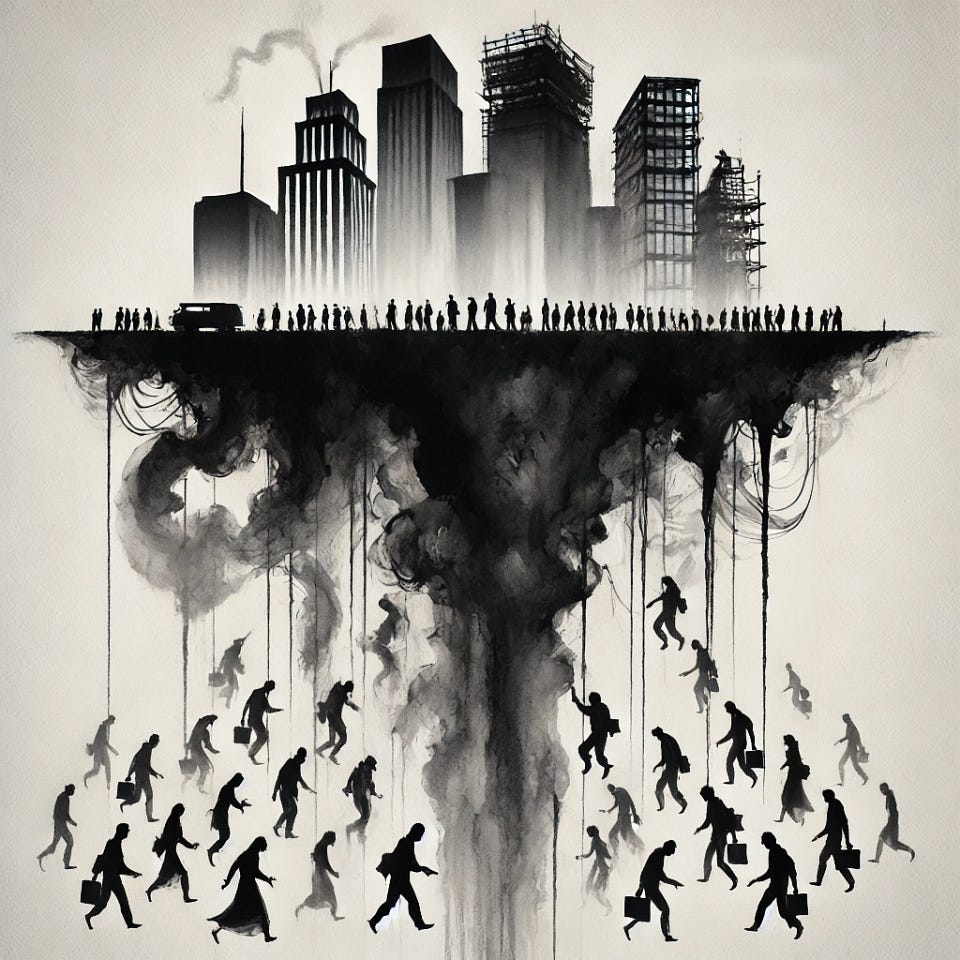
The losers start with frontline workers, the nurses, teachers, and local organizers who see urgent needs every day and watch grand proposals shrink into polite, incremental steps. Communities desperate for big solutions lose too, as their calls for broad public ownership, major wealth redistribution, or large-scale social housing get sidelined as “unworkable.” So does democratic debate as a whole, which rarely even sees the radical or large-scale ideas to argue about, because mid-tier gatekeepers have already decided “that’s unrealistic.”
Arguing over crumbs
If you’ve wondered why ambitious proposals for universal healthcare keep getting boiled down to minor insurance expansions, or why climate action shrinks to modest carbon offsets, look at mesopower.
We’re often arguing over crumbs because the main course was taken off the menu long ago.
When a bold plan (Medicare for All, massive public housing) gets dismissed as “impossible,” someone decided that. Chances are the verdict came from a philanthropic grant’s fine print, a trade group’s “model legislation,” or an accreditation body’s standards, months or years before any official public debate happened.