A form can deny a decision without saying “no.” The portal may simply stop updating, the phone call might never be returned. The language is polite: “based on our standard criteria,” or “you did not meet eligibility requirements.” No one raises their voice, no explicit exclusion is stated, and someone has still been left out.
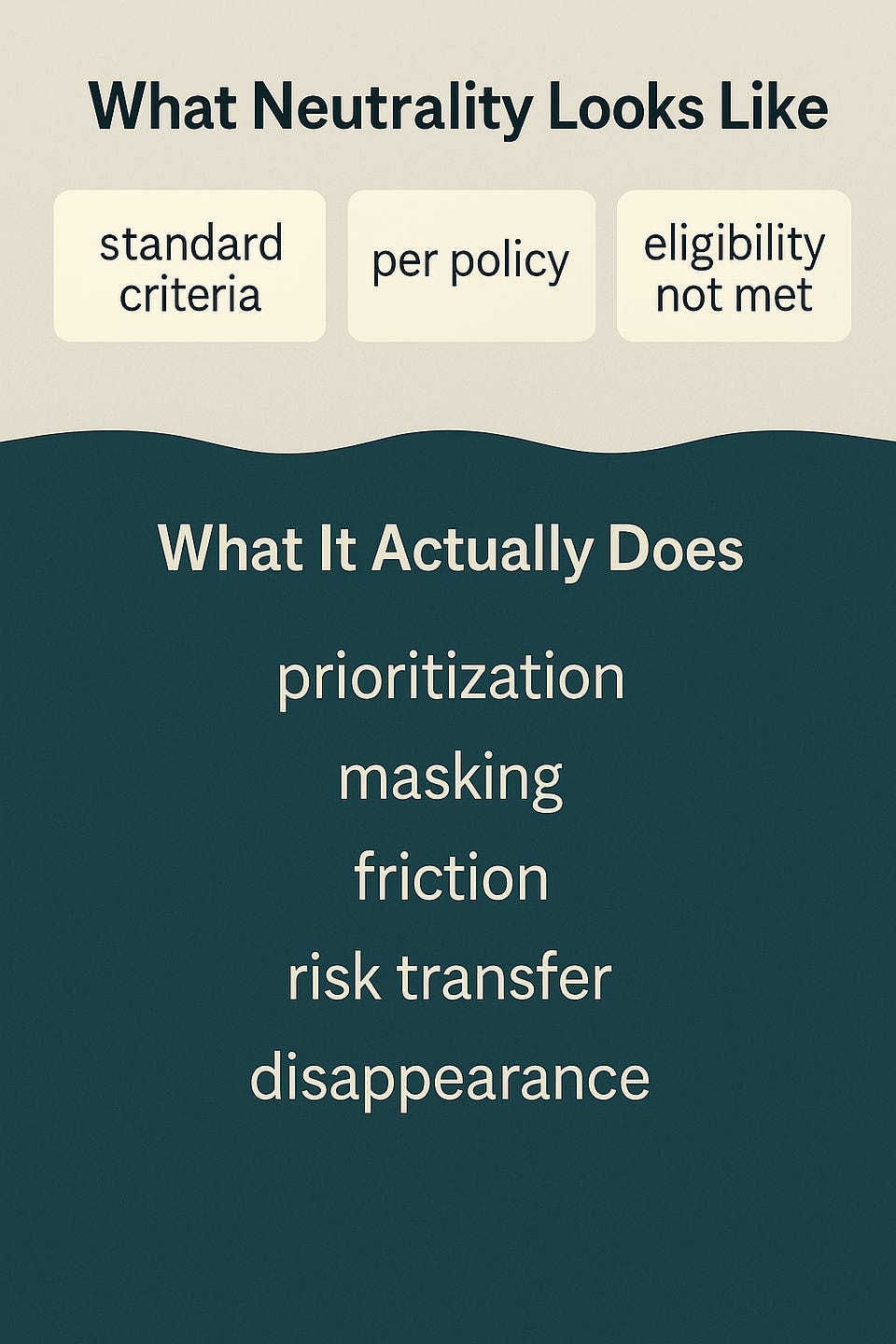
Neutrality operates like this inside institutions. It turns judgment into protocol, making harm feel like a function of process rather than choice. The bias stays in the criteria, and responsibility for it moves from the person making the call to the protocol they follow.
We’re trained to link neutrality with fairness, but in practice neutrality often serves as insulation. Under its cover, systems can enforce exclusion while appearing impartial. The appearance makes the harm hard to spot and even harder to challenge.
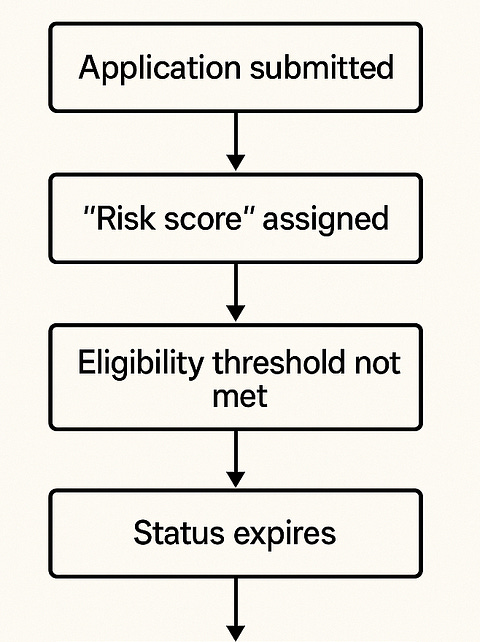
In healthcare, risk scores often decide which patients get extra follow‑up. Health systems use commercial algorithms to pick patients for care‑management programs, which give people with several chronic conditions extra resources and closer medical supervision. In 2019 Ziad Obermeyer and colleagues examined one such algorithm, which they described as typical of the industry and affecting millions of patients.1 At the hospital they studied, patients at or above the 97th percentile of risk score were automatically identified for enrollment, and those from the 55th to the 96th were flagged for possible enrollment depending on their doctor’s input.2 The score predicted next year’s health‑care costs. Less money gets spent on Black patients with the same needs, so at any given score Black patients were sicker: at the 97th percentile they had on average 26 percent more chronic illnesses than white patients. Black patients made up 17.7 percent of the patients the algorithm picked automatically. Without the bias, the researchers calculated, they’d have been 46.5 percent.1
The harm in that design falls on whoever never gets flagged. A patient the score passes over receives no denial and no letter. She keeps the ordinary care she already had while a healthier patient gets the closer supervision, and every step can be audited as following the protocol. The authors traced the bias to a “seemingly effective” proxy: cost looked like a measure of need and tracked unequal access instead.1
A similar pattern exists in disaster financing. A growing number of governments buy catastrophe bonds—insurance‑like instruments that pay only if a disaster meets specific technical triggers. If a hurricane falls short of a wind‑speed threshold or an earthquake falls short of a magnitude threshold, the bond pays nothing. The devastation may be real, but the model says “no event.”
The World Bank’s pandemic bonds show the threshold at work. In July 2017 the Bank’s Pandemic Emergency Financing Facility bought up to $425 million of cover against outbreaks, partly through bonds whose coupons the former World Bank economist Olga Jonas put at about 13 percent a year.3 For Ebola, the bonds would release $45 million once officially confirmed deaths reached 250, but only if at least 20 deaths occurred in a second country.4 The outbreak that began in eastern Congo in August 2018 passed 250 confirmed deaths by mid‑December of that year, and by the time it was declared over in June 2020 it had killed 2,287 people.5 In Uganda, which the outbreak reached in June 2019 through three members of one family, a few people died, far short of 20.6 No insurance payment ever came for that outbreak. Its responders got $50 million from the facility’s separate cash window, donors paid $107.2 million in premiums, and the insurance paid out once, $195.84 million for COVID‑19, before the bonds matured in July 2020.3 In those cases, precision becomes an alibi for inaction.
Neutrality also shapes how people are allowed to speak. In many organizations, raising a concern too early or too bluntly is labeled unprofessional. The issue may be valid, but the tone becomes the problem, and employees are coached on delivery rather than taken seriously for content, a standard mechanism for managing early discomfort. Neutrality discredits urgency and protects consensus over clarity.
The heaviest costs of neutrality fall on people who don’t easily fit institutional expectations. People who communicate differently, who process information at a different pace, or who express discomfort in ways outside the norm often have to mask—to adjust themselves constantly in order to stay legible. It’s exhausting, and the institution counts it as good fit or professionalism rather than labor. For neurodivergent people, masking often becomes the price of remaining in the system. In care settings the same rule covers pain: patients who are too vocal, or who don’t recover quickly enough, get written off as difficult or noncompliant.
Eventually, people leave. They wanted to stay, and staying demanded too much.
And when people do leave, the system often treats that as a neutral outcome. But it’s structured attrition, excluding people without ever having to say “no”.
So refusal—saying “this isn’t working,” or simply walking away—matters. If a system punishes people for opting out, then it wasn’t built on consent: real choice requires that exit be survivable.
To achieve fairness, neutrality is insufficient. Fairness demands exposure: who gets left out, what labor goes unacknowledged, how discomfort is reclassified as deviance.
A fair system would admit its limitations. It would publish its exclusions, treat early insight as valuable even if disruptive, pay for the invisible labor it relies on, and make refusal a legitimate option—not a last resort.
Publishing is what both cases lacked. The World Bank didn’t advertise the pandemic bonds’ exact terms, and Jonas found the second‑country rule by reading the 386‑page prospectus.4 The risk‑score bias surfaced only because researchers got the algorithm’s outputs and the hospital’s data, access that outside researchers rarely get. When they reran the analysis with the developer and changed what the score predicted, the bias fell by 84 percent.7
Because if the same people keep getting filtered out,
if urgency is consistently penalized,
if silence counts as consent,
then neutrality isn’t what’s happening.
And the quiet that follows gets counted as safety, when it means that raising a problem now costs people more than it changes.
Notes
Ziad Obermeyer, Brian Powers, Christine Vogeli and Sendhil Mullainathan, “Dissecting Racial Bias in an Algorithm Used to Manage the Health of Populations,” Science 366, no. 6464 (2019): 447–453 (doi:10.1126/science.aax2342). The abstract: “Remedying this disparity would increase the percentage of Black patients receiving additional help from 17.7 to 46.5%,” and the bias “arises because the algorithm predicts health care costs rather than illness.” Science
Jeff Cockrell, “How Racial Bias Infected a Major Health-Care Algorithm,” Chicago Booth Review, October 25, 2019, on the enrollment thresholds and the 26 percent figure. Chicago Booth Review
World Bank, “Fact Sheet: Pandemic Emergency Financing Facility.” The insurance, obtained in July 2017 as bonds and swaps, covered up to $425 million. The cash window paid $11.4 million in 2018 for Congo’s ninth Ebola outbreak and $50 million in 2019 for its tenth. The COVID-19 payout was the insurance window’s only one, and the bonds and swaps matured on July 15, 2020. World Bank
Olga Jonas, “Pandemic bonds: designed to fail in Ebola,” Nature, August 2019. Jonas, a World Bank economist for three decades, writes that the facility “stipulates a payout of $45 million for Ebola if the officially confirmed death toll reaches 250 (which occurred in the DRC by mid-December last year), but only if at least 20 deaths occurred in a second country.” For the terms she worked from the bond prospectus. Nature
World Health Organization, “Ebola virus disease – Democratic Republic of the Congo,” Disease Outbreak News, June 26, 2020: 3,470 cases and 2,287 deaths in North Kivu, Ituri and South Kivu, declared over on June 25, 2020. WHO
WHO Disease Outbreak News, June 13, 2019, on Uganda’s three imported cases, all from one family; Center for Global Development, April 9, 2020, on why the bonds did not pay: “the criteria required 20 people in a neighbouring country to die from the virus,” and Uganda recorded only a few deaths. WHO; CGD
Heidi Ledford, “Millions affected by racial bias in health-care algorithm,” Nature 574 (October 31, 2019): 608–609. Studies like this are rare because researchers seldom get access to proprietary algorithms and the health data needed to test them; working with the developer, Optum, the team found that “making these changes reduced bias by 84%.” Nature