“Hey, can you take a quick look before this goes out?”
The draft is spotless. Then you see the gloss. Harm presented as a trade-off. A back-room call recast as group consensus. So you flag it with a comment.
“Looks good—can you reword that so it still feels aligned?”
A request like that asks for plausible deniability and calls it feedback.
If you can turn danger into “something to consider,” you’ll be tapped again. Not to steer direction, just to sand the edges. You become the buffer between what an org does and the story it tells.
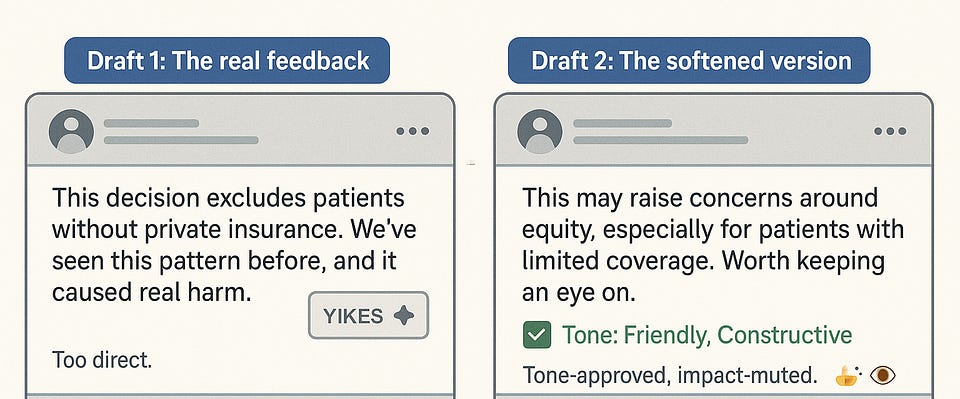
That’s pretending labor. You don’t lie. You package the truth until it no longer alarms anyone.
- Causes harm → may raise questions.
- This was a mistake → we might revisit.
You avoid burning people by serving truths lukewarm.
Soon those “quick gut check” pings arrive daily. You leave meetings unsure whether you changed anything or just made it easier to ignore.
Then you stop smoothing:
“I flagged this weeks ago. I’m not rephrasing it again.”
Instantly you’re “blunt,” “harder to work with.” Nothing else changed. You just quit absorbing what no one else will name.
I learned the script while I worked in product at a network of cancer hospitals, after flagging a flaw that could have negatively affected patients’ family members. As a member of the product team I thought it was my job to raise such issues. Privately, the CEO admonished me:
“Very often you are right. Your job here isn’t to always be right.”
Momentum beat accuracy, even where health was at stake. Clarity, unbuffered, was treated as a threat.
The smoothing is a role the organization relies on.
Organizations like that one reward insulation from bad news more than insight. They lean on people already trained to self-filter: women, people of color, autistic professionals, first-gen staff, anyone who gets taught that how you speak matters more than what you say.
Many of us learned to do that translation to keep our jobs, and refusal means no longer doing it.
Refusal doesn’t need a speech. Sometimes it’s:
“If it lands hard, that’s the point.”
“I’m done softening this.”
“That’s not comms; that’s a decision.”
That kind of refusal is precise without being aggressive, and it makes visible the emotional labor the organization had been getting for free.
So when someone says, “You’ve changed,” they really mean:
You stopped shielding us from ourselves.
They’re right. And you’re done.
Further reading
- Institutions Prefer Crises to Early Warnings: how critique gets absorbed and selectively forgotten, why early warnings get treated as noise, and what happens to the messenger who raises them