Modern life rewards a “maturity” that has very little to do with being right.
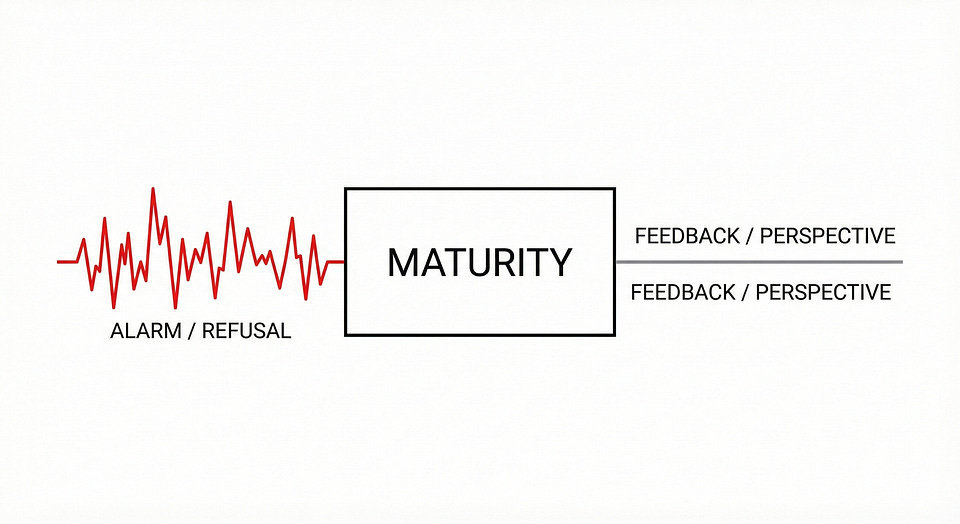
It rewards being able to notice something is wrong and keep things moving anyway: registering harm without forcing repair, accepting delay without demanding a deadline, speaking in ways that can be acknowledged without binding anyone. Institutional corridors work like that, passing a request from step to step so that nothing is denied and nothing is owed.
Most writing about institutions stops at the institution: the queue, the process, the “we hear you,” the waiting designed to outlast your stamina. That story is real.
The next layer down is what the corridor trains in the person walking through it. When continuity is the goal, a system works best when your refusal arrives pre-softened. Alarm gets filed as “a concern,” a demand as “feedback,” clarity as “a perspective,” and language absorbs the failure without reversing it, the same way reassurance stands in for obligation.
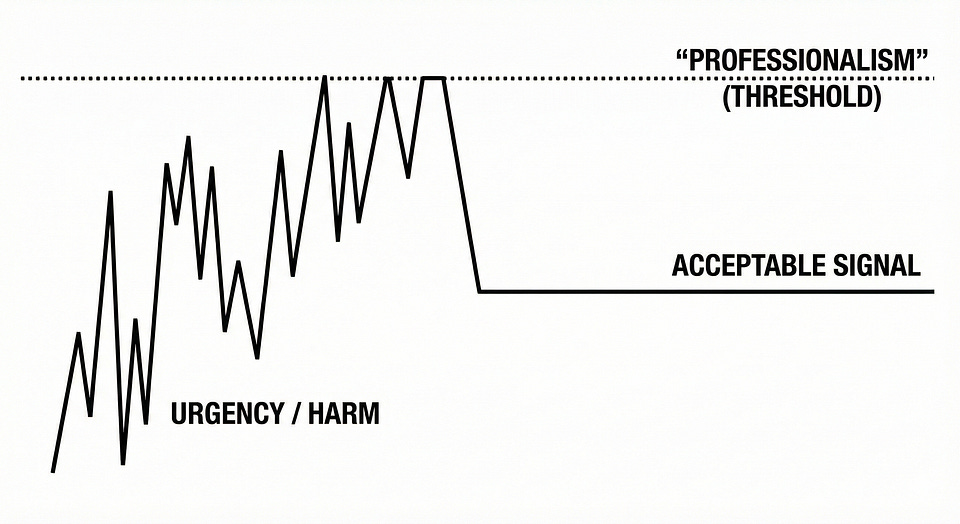
That competence gets praised as calm, professionalism, realism, perspective, and the praise sounds supportive while teaching you what not to do.
The training runs through filters that turn harm into something survivable, and then into something optional.
Calm shows what escalation costs
“If you were competent, you’d stay calm.”
Calm gets treated like proof of judgment. In practice it’s a cost signal.
People learn fast what escalation costs by watching what happens to the person who insists. Urgency gets reclassified as temperament, and the conversation drifts from the harm to whether the messenger is handling it well. Distress is allowed as long as it never turns operational, so people learn to be upset in ways that cost the organization nothing.
Professionalism does its main work right here. Something happens that should stop the room, and it gets translated into something the plan can carry: a ticket, a backlog item, a follow-up.
And because the meeting continues, the body learns a bad rule. Relief comes from returning to flow, whether or not anything was repaired.
“If it were serious, it would be actionable.”
“Actionable” sounds like a property of the problem. It is a property of what the room is willing to bind itself to.
Actionability gets shaped by hierarchy, liability management, staffing and risk appetite. Urgency runs into permission here. A situation can be severe, documented and ongoing and still get downgraded to a concern or a learning. Acknowledgment is cheap and obligation is expensive, so you can be heard without getting the kind of standing that makes a clock start.
The corridor effect: harm gets routed into steps, responsibility diffuses, and time stretches until reversal is optional. Each step is defensible on its own, and together they make a path long enough that a lot of people adapt, disengage, or vanish.
Making harm costly gets called immature
“Adults don’t make scenes.”
A scene gets presented as childishness or instability. It is also the moment harm stops being privately absorbable: someone refuses to carry it without comment, and the system can’t keep the problem non-binding anymore without admitting it won’t fix it.
Scenes are taboo, whether or not a given scene is right, because they force decisions, make inaction visible, and create liability. When a problem starts to cost money or time, attention moves from the problem to the person who raised it, and “reasonable” becomes the standard they are judged against.
“Being realistic means accepting how things work.”
Realism blesses the arrangement, so it feels adult instead of coerced.
“Realism” is usually resignation with better branding: what you call it after you’ve tried to force repair and learned what it costs, after the timelines stretched, after responsibility diffused, after your insistence became the problem.
Eventually training stops you pushing where persuasion never did, and the people around you call the result wisdom.
Complexity holds the arrangement in place. It’s real, and it also works as deferral without refusal: “this is wrong” gets filed as “this is complicated,” urgency drains out, and humility replaces commitment. A safety threshold is missed in a meeting and risk is climbing. Instead of stopping, the room debates variance for an hour, and by the end the danger hasn’t changed but the room feels calmer. The hazard has been turned into an intellectual object, and that conversion works as permission to proceed.
So does pricing refusal. You’re told you can opt out, appeal, refuse, choose differently, and formally you can. But the penalties are calibrated: refusal costs promotion, access, or reputation here, and time, money, or safety elsewhere. Accepting the penalties gets presented as responsibility, and questioning the pricing model gets presented as immaturity. Options stay available, and livable only for people with surplus.
What the filters produce
A person who can acknowledge harm without making it bind, who keeps their tone acceptable so the room stays comfortable, who downgrades urgency into formats that can be filed and forgotten, who accepts process without demanding deadlines, and who eats costs without complaint and calls it growth. On paper that looks like maturity. In practice it mostly means nothing has to change because of you.
Where non-disruption is treated as the highest adult virtue, people get good at tolerating unrepaired harm and bad at making it stop.
Inside one person’s head the same training goes by denial, and denial is less about belief than about buying time. “It’s temporary” and “it’s standard practice” are what you tell yourself while the rent is due and naming the harm could cost the job or the benefit. Each alibi you swallow lowers the threshold for the next, until conditions you’d once have refused feel normal. An employer or an agency that asks for “resilience” is drawing on that lowered threshold.
You don’t have to psychoanalyze anyone to tell which calm you’re looking at. Watch what happens after it.
After the calm, does anyone have to act on a timeline?
If yes, calm followed responsibility and repair is underway. If no, everything stays optional, slow, diffuse, and socially gated, and calm replaced responsibility. It made the harm easier to carry without making it easier to fix, inside the basic asymmetry modern systems run on: harm can be done fast, and correction is slow, discretionary, and procedurally gated.
Seen that way, a lot of everyday praise reads differently.
“Thanks for not making this harder for us.”