We are trained to read “pending” as a neutral gap, a technical pause while the system works. In the modern administrative state, pending is the answer.1
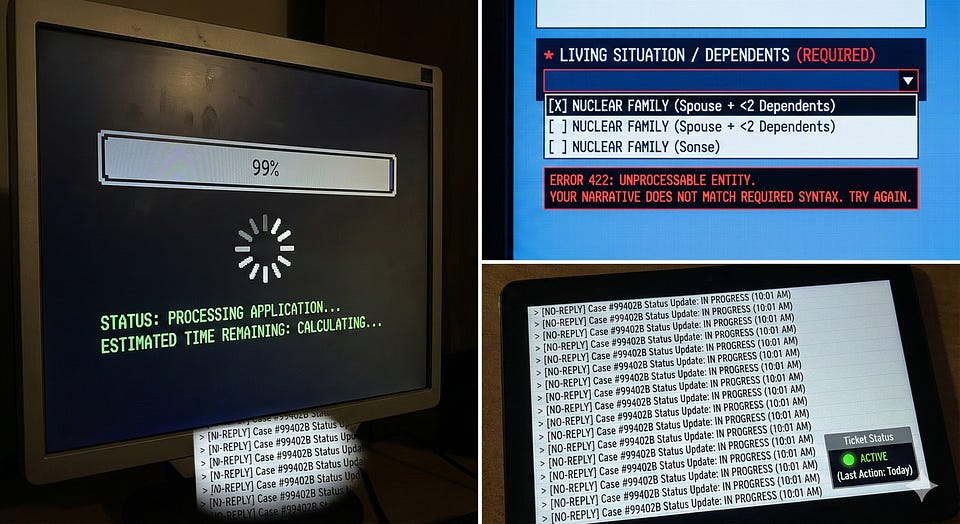
It moves authority away from the moment of decision, where a human has to look you in the eye and say no, and hides it in the architecture of the interface, where nobody has to say anything.
Where someone once had to write a denial and sign it, a form’s required fields and validation rules now do the refusing.

View source
%% title: How a pending application closes without a denial
%% caption: The application sits at pending while polite emails, requests to re-upload documents and the open-ended wait wear the applicant down. The eviction notice arrives first, and the case closes as inactive without anyone signing a denial.
flowchart TD
  classDef actor stroke-width:1.6px;
  classDef system stroke-width:1.2px;
  classDef gate stroke-width:1.6px;
  classDef binding stroke-width:3px,font-weight:bold;
  classDef status stroke-dasharray:4 3;
  classDef burden stroke-width:2px;
  classDef repair stroke-width:2.4px,font-weight:bold;
  classDef failure stroke-width:2.2px,stroke-dasharray:6 3;

  C(["Applicant files the form"]):::actor --> I["Case number generated"]:::system
  I --> P(["Status: Pending"]):::status
  P -.-> N["Polite email, tracker at 10%"]:::system
  N -.-> P
  P --> F["Please clarify: re-upload<br/>the expired documents"]:::burden
  F --> P
  P -- "no deadline on<br/>the institution" --> L["Eviction notice arrives<br/>while under review"]:::burden
  L --> A(["Closed: No response / Inactive"]):::failure
The form is the gatekeeper
In older bureaucracies power was exercised through an event. The judge banged the gavel; the clerk stamped DENIED. It had an author. You could point at the person who rejected you and demand a reason.
In digital bureaucracy the rejection happens before you submit. Politics has moved into the schema: the drop-downs, the required fields, the file-size limits.
The institution can skip the argument entirely and fail to recognize your format.
If your life is too messy for the categories on offer, if your employment history doesn’t fit the box or your family structure defies the drop-down, you are not formally rejected. You are unprocessable. The file sits with no decision and no date, waiting for a validation check that’s never going to run.2
The institution does not need to be cruel. It just needs to be slow.
The “efficiency” lie
We’re told moving services online makes them efficient. It is cost-shifting.
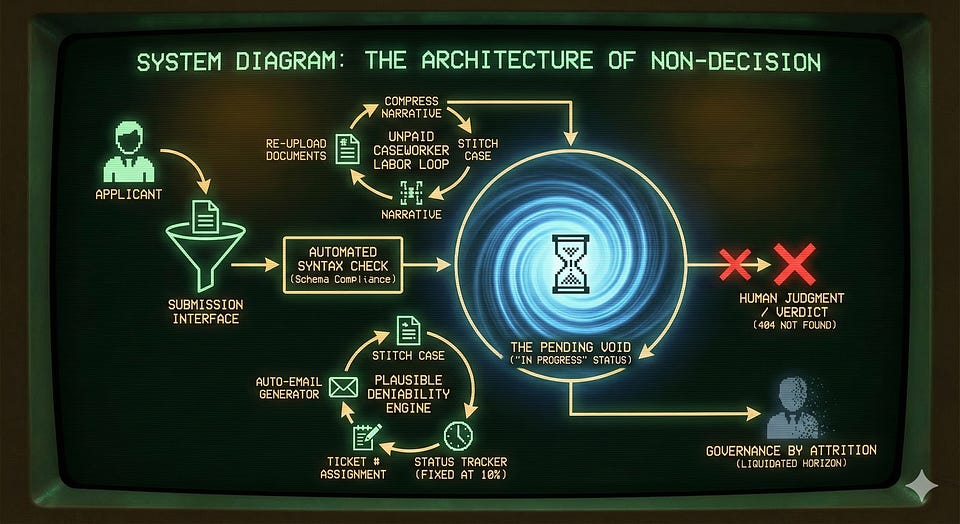
“Pending” turns the applicant into an unpaid caseworker for their own survival. You compress your narrative into keywords. You re-upload the documents when they expire. You stitch the case back together every time the system dissolves it.
And the system can always ask for more specificity. “Please clarify” costs nothing to send and hours to answer, and every request adds a failure point. When you stumble, predictably, under stress, the stumble is counted against you. The system makes keeping up expensive and then calls the cost “responsibility.”
The institution looks efficient on its spreadsheet only because it has offloaded the cost of its own memory onto the person whose life is at stake.
Plausible deniability
Instead of deciding, the institution sends noise.
You fill out the form. A confirmation screen appears, a case number is generated, and an email arrives, polite and calm: We have received your request. We take this seriously. Someone will follow up. For a second something loosens in your chest: there’s a record.
Then the status changes just enough to keep you from concluding nothing is happening. In review. Pending verification. Assigned to the appropriate team. A tracker sits at 10% forever. It’s responsiveness performed to hide the fact that the system has suspended all obligation.
Signals of care are cheap. Acknowledgments, apologies and status updates cost the institution almost nothing, and they calm people down. An outcome is expensive. It leaves a written decision that can be appealed, audited or compared to other cases, and it can set precedent or force an admission of error that travels. So the system produces the cheap thing abundantly and rations the expensive thing.
When reassurance closes the conversation
A warm reply can end an interaction while leaving the failure open. It is a style of care used to calm a complaint that nobody has committed to resolve: the frozen account is still frozen, but the person has been acknowledged.
After the reassurance, continuing to insist can start to look unreasonable. The institution’s missing decision becomes a dispute about the claimant’s patience, gratitude, or tone. People too distressed to stay calm are filtered out by a process that still presents itself as care.
Reassurance earns trust when it comes with a named owner, a review deadline, interim protection, and a way to reverse the error. Fraud prevention doesn’t require abandoning those limits. A freeze can stop a thief while stating its reason and naming who must review it by when. An open-ended freeze with a sympathetic form letter leaves everyone waiting. The staff member sending that letter may have no power to start the clock; the change belongs with whoever wrote the process.
As long as the ticket stays open, nobody at the institution has to put their name to a refusal or issue a hard denial. While the status reads “In Progress” it can claim it’s helping you, and meanwhile it uses up your time.
Escalation usually moves the case to a new inbox in front of the same authority. The test is whether it changes who can decide, adds a deadline the institution has to meet, or forces a written outcome. If not, it is a coping feature.
For the precarious, a delay is a denial
For the wealthy a delay is a nuisance. For the precarious a delay is a denial.
The clock runs one way. A claimant has to respond in 48 hours, submit within 10 days, upload by Friday. For the institution there’s usually no point at which “in progress” tips into “overdue.” Your situation gets worse while the process stays serene. When the scholarship deadline passes, the surgery window closes, or the eviction notice arrives while the application is “under review,” the system has decided without ever issuing a decision.
Governance by attrition. The system doesn’t have to exclude you. It manages scarcity not by saying no but by waiting for you to give up.3
People do give up, because they’re exhausted or sick or have to work. Then the case closes without a decision, “No response” or “Inactive,” and dropout is filed as resolution, consent given after the fact. Such a process sorts people by who can stay in it without breaking, whatever the merits of the claim.
That leaves the design question: where does the institution become obligated to deliver an outcome, and what happens when it does not? “We Believe You” Is Not a Decision proposes a decision guarantee, which puts the deadline on the institution.
Real corrigibility also needs an immediate stay power and substantive restitution, as argued in Nobody Broke a Rule, and Nobody Can Fix It and An Audit That Can’t Stop Anything Is Theater. If an institution cannot finish adjudicating within bounded latency, the cost of the uncertainty has to legally attach to the system rather than the applicant. Provisional benefits flow, evictions stay, and later vindication includes full restitution for the time the queue stole.4 Where the exhaustion follows a pattern, the remedy has to put the institution’s governing categories on trial.
Until those mechanics change, refuse to mistake the signal for the outcome. The polite email is a notification of stasis. The request for clarification is a throttle.5 Knowing that won’t shorten the wait. It can keep you from taking the system’s friction as your own moral failure.
Notes
Two literatures own the neighboring ground. Peter Bachrach and Morton Baratz, “Two Faces of Power,” American Political Science Review 56, no. 4 (1962), named the nondecision: power spent keeping issues off the agenda so no decision ever has to be made. Steven Lukes, Power: A Radical View (Macmillan, 1974), added the third face, shaping what people want. What this essay adds is the interface era, where the nondecision no longer needs an actor to suppress an issue. The schema, the required field and the loading screen do it by default, and “pending” turns suppression into a product state the applicant maintains at their own expense.
Pamela Herd and Donald Moynihan, Administrative Burden: Policymaking by Other Means (Russell Sage Foundation, 2018), document learning costs, compliance costs and psychological costs working as rationing by another name. “Unprocessable” is the schema-era version: the burden arrives before any application can even be evaluated.
Javier Auyero, Patients of the State: The Politics of Waiting in Argentina (Duke University Press, 2012), documents waiting as a state practice distributed by class: the poor wait longest, and the waiting itself teaches them their place. “Governance by attrition” is that finding with an interface attached.
Governance by attrition is what Forgiveness Is for the First Mistake calls strategic delay: the demand for evidence never converges, and the tell is who pays during the interval. Apologies Are Cheap When No One Can Challenge the Error separates the three clocks, harm in weeks, review in years, memory in decades, and makes whoever pays for the gap between them part of the design.
Signals of care that bind nothing are the second stage of containment in A Good Complaints Office Can Protect a Bad Rule: the contradiction is received as testimony while the rule that generated it stands. Feedback Without Standing Fixes Only the Cases It Finds has the consequence ladder that would make the polite email bind.