Variance is inevitable. Illness, economic downturns, and climate shocks all arrive eventually. The political question isn’t if they come, but who absorbs the hit. Every society already runs a risk-management plan, so every government is an engineering choice about where the shocks land. The stability on paper is the tell: airports run and universities finish their semesters because the people using them absorb the delays, resets and rule changes. And when the slack that absorbed error is eliminated rather than managed, the error arrives all at once.
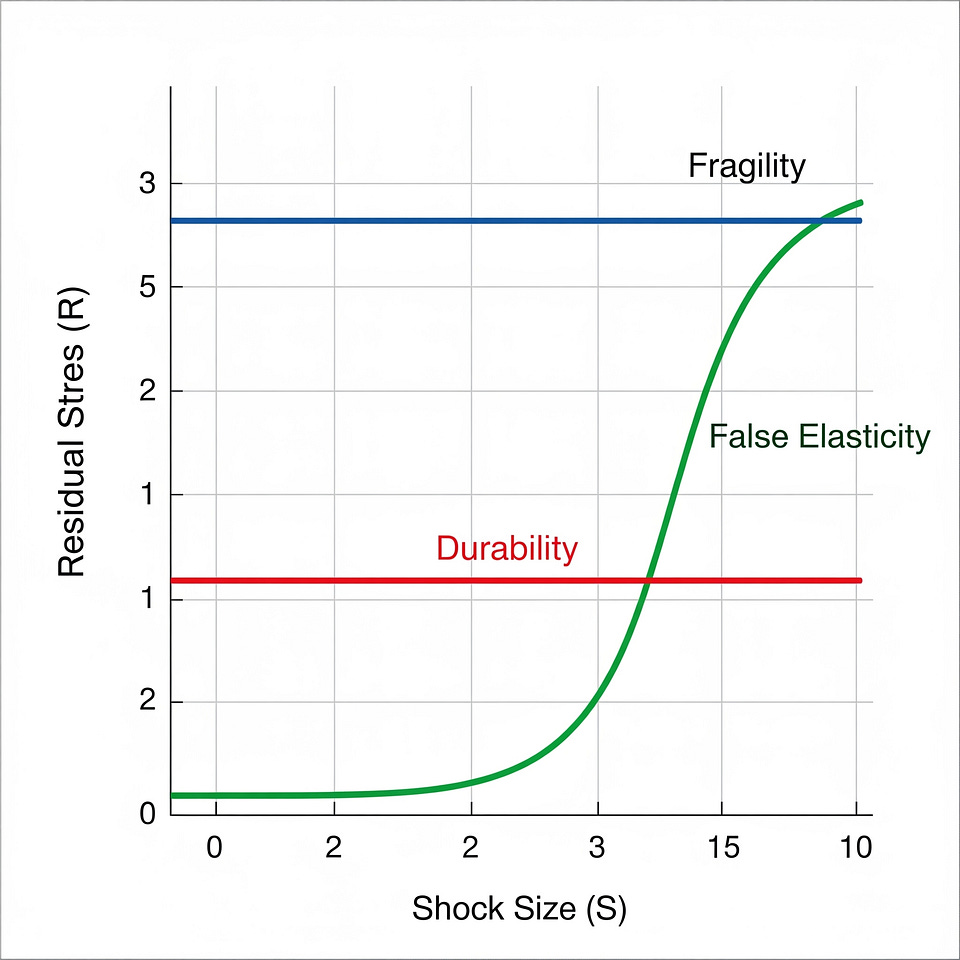
A citizen can be drawn as a free-body diagram. A downward press S represents the shock: a layoff, an illness, a flood. An upward push U is the counterforce from the system: healthcare, unemployment benefits, housing. The remainder is the stress the person must carry alone. It is a simple calculation: S − U. That leftover weight is not destiny or morality. It’s design. The strain on an individual is as measurable as gravity, which means politics is not metaphor but applied physics.

View source
%% title: Free-body diagram of the governed citizen
%% caption: Applied external shock minus upward systemic counterforce leaves residual stress: R = S - U. That remainder is an engineered outcome, not a moral verdict.
flowchart TD
  classDef actor stroke-width:1.6px;
  classDef system stroke-width:1.2px;
  classDef failure stroke-width:2.2px,stroke-dasharray:6 3;

  S["Applied Shock (S)<br/>Layoff • Illness • Climate • Inflation"]:::system
  U["Systemic Counterforce (U)<br/>Public healthcare • Housing • Income floor"]:::system
  C([Governed Individual / Household]):::actor
  R([Residual Stress: R = S - U<br/>Unmodeled personal debt • Burnout • Ruin]):::failure

  S -- "downward force (+S)" --> C
  U -- "upward counterforce (-U)" --> C
  C ==> R
The equation shows how different political systems perform under stress. A system providing almost no counterforce is Fragility (People Pay), where “personal responsibility” is the routing rule and burnout is an expected output. At the other end is Durability (System Absorbs), where universal programs distribute shocks widely, absorbing risk at population scale as sound engineering. In the middle sits today’s norm: False Elasticity (System Leaks). This system advertises flexibility but channels stress onto targeted groups, fueling resentment while elites deflect anger toward scapegoats.

View source
%% title: The load-bearing spectrum of political architectures
%% caption: Systems differ by where unmodeled variance lands: dumped on isolated individuals, leaked onto scapegoated groups, or spread across the whole population.
flowchart TD
  classDef system stroke-width:1.2px;
  classDef failure stroke-width:2.2px,stroke-dasharray:6 3;
  classDef status stroke-dasharray:4 3;
  classDef repair stroke-width:2.4px,font-weight:bold;

  subgraph Fragility ["Fragility (People Pay)"]
    direction TB
    F1["External shock"]:::system --> F2["No upward counterforce"]:::status
    F2 --> F3([Individual burnout & debt]):::failure
  end

  subgraph FalseElasticity ["False Elasticity (System Leaks)"]
    direction TB
    E1["External shock"]:::system --> E2["Selective offloading"]:::status
    E2 --> E3([Targeted groups absorb strain]):::failure
  end

  subgraph Durability ["Durability (System Absorbs)"]
    direction TB
    D1["External shock"]:::system --> D2["Universal counter-scaffolding"]:::repair
    D2 --> D3([Collective frame dissipation]):::repair
  end
  Fragility ~~~ FalseElasticity ~~~ Durability
Texas ran the calculation in February 2021. Winter Storm Uri supplied S. Its counterforce had been specified ten years earlier, when a cold snap forced rolling blackouts across the state and federal regulators recommended that generators be winterized. The recommendation, the chair of the Federal Energy Regulatory Commission said in 2021, “ended up turning into just guidance.”1 When the grid failed, the state health department counted 246 deaths. Hypothermia killed 158 people, most of them over sixty. Another 25 died when the storm worsened an illness they already had: dialysis or oxygen interrupted, medication frozen, life-sustaining equipment without power.2 The retailer Griddy passed the wholesale price straight through to its customers, who received the remainder as an invoice. For days the wholesale price sat at $9,000 per megawatt-hour, and bills of $7,000 and more arrived for less than a week of electricity.3 Only the cold was weather. What decided whose house the load landed in were settings: the unwinterized plants, the pass-through plan, the price held at its ceiling.
A durable system has to let go of the “safety net,” a metaphor that has always been wrong. Nets catch a few who fall; absorbers spread force across the entire frame. The state, reimagined, is not an emergency patch at the bottom but the central shock absorber, designed to dissipate impacts before they fracture lives.
GDP is the wrong scoreboard here. Success, in this model, is how much weight the system carries without breaking its people.

View source
%% title: The Texas freeze, caught after the fall or spread before it
%% caption: In the Texas freeze, relief came at the bottom: a bankruptcy plan released the Griddy customers who had not paid, and nothing caught the 246 people who died. Winterized plants and no pass-through pricing would have spread the load across the grid before it reached anyone’s house.
flowchart TD
  classDef actor stroke-width:1.6px;
  classDef system stroke-width:1.2px;
  classDef failure stroke-width:2.2px,stroke-dasharray:6 3;
  classDef repair stroke-width:2.4px,font-weight:bold;

  subgraph Net ["Safety net: relief after the fall"]
    direction TB
    N1["Storm Uri, grid fails"]:::system --> N2["$7,000 bill for under<br/>a week of power"]:::system
    N2 --> N3{"Bankruptcy plan releases<br/>customers who had not paid"}:::failure
    N3 --> N4(["Falls through: 246 deaths,<br/>most from hypothermia"]):::failure
  end

  subgraph Absorber ["Shock absorber: settings before the storm"]
    direction TB
    A1["Same storm arrives"]:::system --> A2["Plants winterized,<br/>as advised in 2011"]:::system
    A2 --> A3["No pass-through billing,<br/>price spike held upstream"]:::repair
    A3 --> A4(["The cold stays weather,<br/>load spread across the grid"]):::repair
  end
  Net ~~~ Absorber
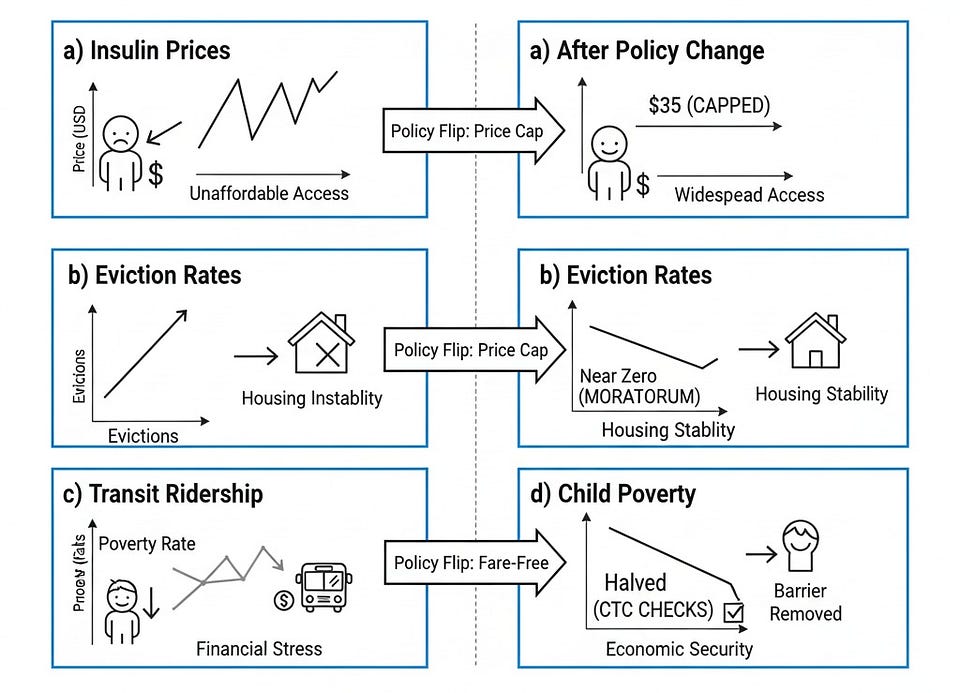
Every so often, the claim of inevitability collapses and we see the proof that these outcomes are deliberate settings (Manufacturing “Inevitability”). When insulin was capped at $35, prices were revealed not as “the market” but as policy. When eviction freezes stopped mass housing loss, “supply and demand” was exposed as discretionary law. When the Child Tax Credit arrived as monthly checks, child poverty was nearly halved—and it spiked back the moment the program ended.
For decades, the perfect alibi for fragile design has been the ideal of “personal responsibility.” It’s an argument that masterfully reframes systemic stress as a personal failing (Long On Exclusion).
The message is blunt: we are designing fragility, and we will blame the people it breaks.
But if responsibility is an alibi, then what is freedom? We’re often told it’s the absence of support. Yet a person buckling under medical debt or the judgment of an algorithm is coerced by precarity (Neutral Isn’t Fair). Real freedom requires a floor.
Freedom is the scaffolding needed to climb.
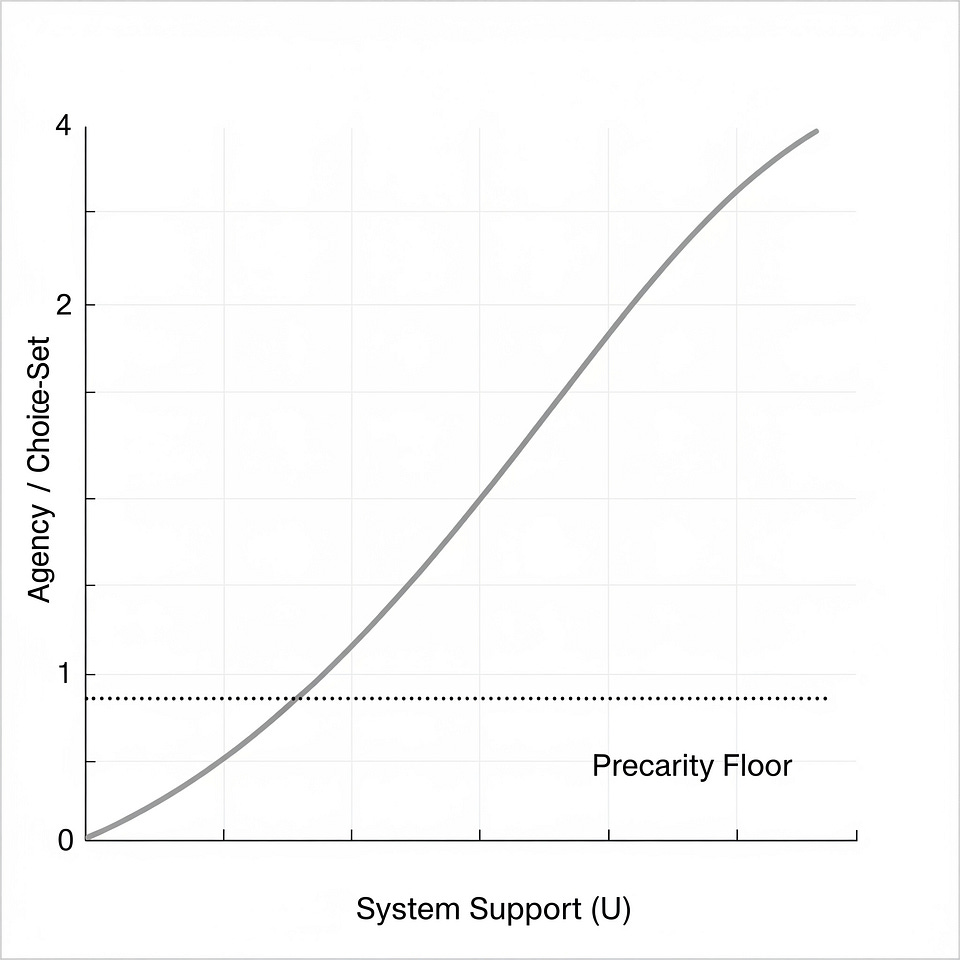
At the scale of a state, the link between support and agency is the basis of legitimacy. Legitimacy isn’t earned in speeches; it’s tested when shocks arrive. Systems that absorb variance deepen trust. Systems that dump or leak it corrode trust, exposing themselves as protection machines for the few. 2008 made it plain: the state absorbed risk for banks and bounced it onto homeowners. Early COVID replayed the script, bailing out institutions while citizens scrambled for masks, and both episodes cost the state legitimacy it has not recovered.
The mythology of “small government” dissolves under this frame. Choosing not to provide upward support is not neutrality; it’s an engineered decision to maximize exposure. There are no neutral systems (If You Can’t Cancel Easily, You Never Agreed).
Politics is applied physics. Freedom is measured not by slogans but by net stress.
Build for variance, or you will be building for resentment.
Measuring load shows who carries it and gives no one the right to settle the question for them, which separates it from the rule by models that “What the Numbers Say” Is Someone’s Decision warns about. Public or Private, She Was Denied Both Ways supplies the check the physics lacks by asking whether the institution can lose to the people it governs. An institution carries the load when its errors cost the institution itself.
Notes
FERC and NERC staff, Report on Outages and Curtailments During the Southwest Cold Weather Event of February 1–5, 2011 (August 2011), found that no reliability standard required generators to prepare for winter and recommended one. FERC chair Richard Glick’s account of what followed is in Catherine Morehouse, “Glick commits to avoid repeat of ‘disturbing lack of action’ in Texas,” Utility Dive, March 5, 2021.
Texas Department of State Health Services, “February 2021 Winter Storm-Related Deaths – Texas” (December 31, 2021). Of the 158 hypothermia deaths, 107 were people aged sixty or older. The report counts only deaths a medical certifier confirmed; outside estimates of the toll run several times higher.
Reese Oxner, “Griddy Energy customers may be off the hook for exorbitant energy bills after company files bankruptcy,” Texas Tribune, March 16, 2021. Griddy’s roughly 29,000 customers were charged about $29 million for the storm; some reported bills above $15,000. The bankruptcy plan released the customers who had not paid.