Two very different forms of maintenance share a single name, and much of our political confusion comes from mistaking one for the other. The older kind kept things alive so they could keep changing. The newer kind, picked up somewhere between the factory floor and the modern state, looks like care but behaves like control.
One is maintenance-as-sustenance, the kind I explored in To Be Is To Be Maintained. It creates slack, absorbs shocks, distributes load, and keeps people capable of weathering change. It’s maintenance as the precondition for new worlds.
The other, maintenance-as-stasis, is maintenance not as care but as containment, not as nourishment but as continuity enforcement. I critiqued this second kind in The Death of Slack and Human as Crumple Zone—maintenance that treats people as buffers for system fragility and regards any rupture as a threat to be managed, suppressed, or moralized away.
Since industrialization, the second kind has crowded out the first, and work that once kept people alive now goes into keeping institutions running.
From Rhythm to Regime
In pre-modern life, maintenance was cyclical and local: tending fields, mending tools, patching walls, restoring what time had worn down. It was the communal labor of staying in the world together. No one believed that repair could prevent change; repair existed to make change possible by carrying its costs.
Industrial capitalism broke that symmetry. A factory’s profits depended on its machines running continuously. Maintenance became constant, professionalized, and governed by compliance and record-keeping. Continuous output pushed aside the cyclical, communal, adaptive practices that had served other needs. The point wasn’t to sustain life but to sustain output.
Across the twentieth century, this logic expanded. States took responsibility for infrastructure, and public maintenance became the backbone of legitimacy. Roads must not buckle, bridges must not collapse, grids must not blink. Much of this was genuinely life-giving—maintenance-as-sustenance at scale—but it also centralized the question of whose life conditions were worth maintaining.
Then came the neoliberal turn, which didn’t simply neglect maintenance but withdrew it strategically. Geographer Ruth Wilson Gilmore calls this organized abandonment—the deliberate starving of certain systems and communities while elites celebrate a rhetoric of fiscal prudence.
Maintenance-as-stasis became the engine of premature death. Budgets kept favored systems running by cutting the upkeep of specific communities and letting them fall apart.
Moralizing the Wrong Kind of Maintenance
The most consequential development of the last forty years is that maintenance-as-stasis has been moralized. Withdrawing maintenance is only the setup; the moralizing is what makes it stick. As public institutions hollowed out, people were encouraged to treat patching the resulting holes as a personal virtue.
We can see this everywhere:
- Teachers in crumbling buildings are praised for “going above and beyond,” as if crowdfunding air filters were a sign of devotion rather than evidence of state abandonment.
- Nurses working double shifts under dangerous ratios are celebrated for their “resilience.” Their sacrifice becomes the maintenance plan.
- Public libraries become de facto warming centers, social services hubs, and crisis shelters—and we praise them for their “community spirit” instead of funding the infrastructures that would make that labor unnecessary.
- Gig workers carry the volatility of platforms designed to shed every cost possible and are told they’re “entrepreneurs of themselves.”
In each case, the world is maintained not through structural repair but through extracted virtue. Institutions weaponize the language of “care,” “community,” “responsibility,” and “stewardship” to shame people into doing unpaid maintenance work that keeps a decaying system upright.
People internalize these expectations. They take pride in bailing out sinking ships. They congratulate themselves for being reliable where systems are brittle. Being overextended starts to feel like having good character. That’s how maintenance-as-stasis starts reproducing itself. People become the buffer that erases both the evidence of failure and the demand for repair.
When Maintenance Becomes Temporal Containment
The 21st century has intensified this capture. Governments, corporations, and cultural institutions are losing confidence that they can imagine new futures. As they do, maintenance stops being a strategy for sustaining life and becomes a strategy for suppressing change.
“Resilience” means returning to a status quo that is killing people.
“Stability” means preserving institutions that no longer function.
“Preservation” becomes a way to shut down demands for redesign.
“Repair” becomes a euphemism for prolonging the present.
Together, these redefinitions turn maintenance into temporal containment, a way of holding the present in place and putting off any redesign. I described the same pattern in You Can Hit Every Target and Lose the Point, where systems improve their own performance figures while running down what the future depends on.
Governments speak of “weathering the crisis,” “holding firm,” “restoring normalcy.” Corporations speak of “reliability,” “continuity,” “operational excellence.” But behind this language is a refusal to redesign systems that structurally can’t serve the world they now govern.
Maintenance as Elite Pastime
Nothing shows today’s capture more cleanly than the emerging “maintenance movement,” crystallized in the forthcoming Stripe Press book Maintenance: Of Everything by Stewart Brand.
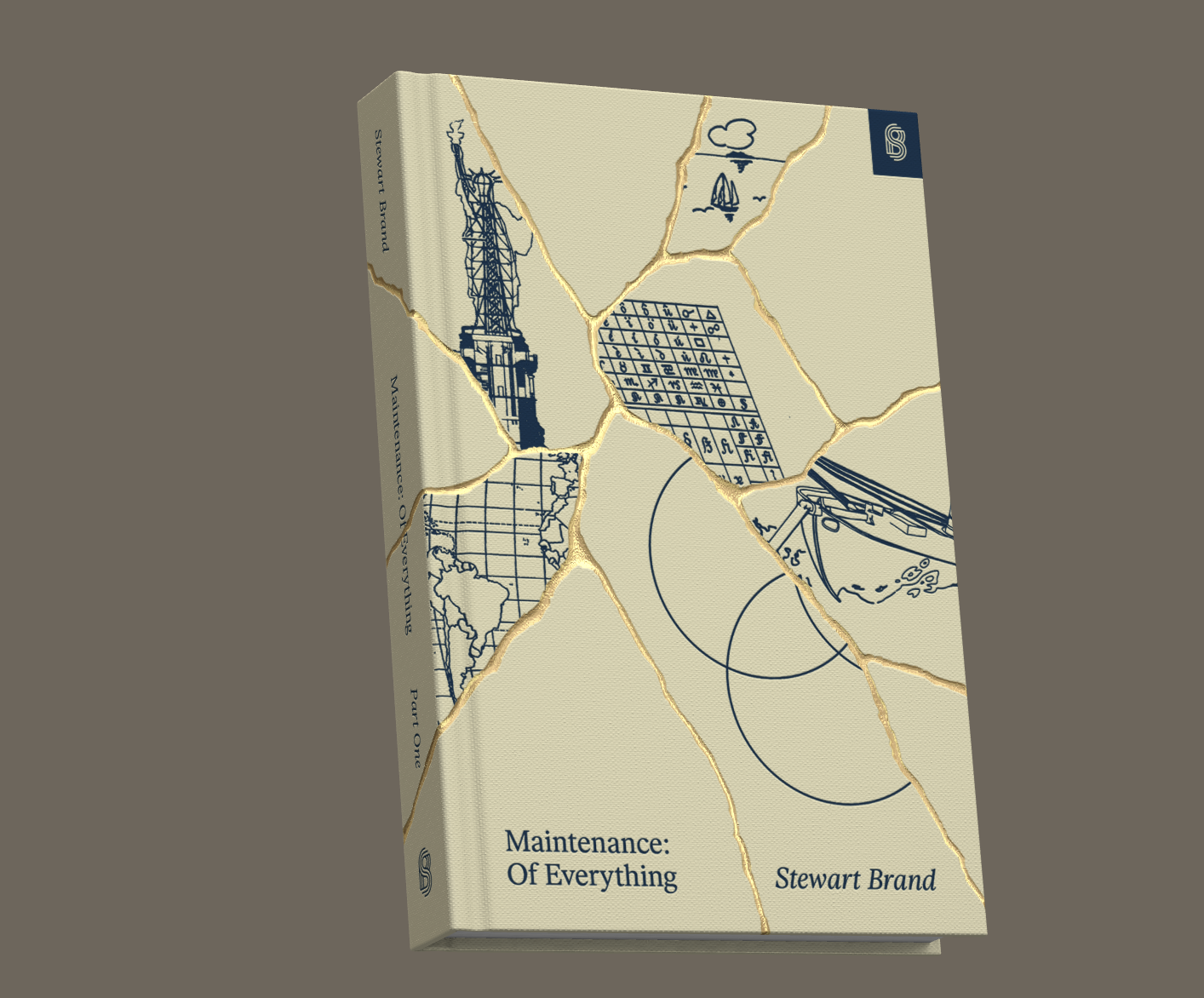
Its aesthetic is seductive: glossy photos of handcrafted tools, sailboats, mechanical clocks; the romance of tinkering; the spiritual discipline of upkeep. But its politics are disingenuous.
Brand’s Long Now philosophy has always tried to “stabilize” civilization against “short-termism.” But when stability becomes the highest value in a broken system, “long-term thinking” becomes a euphemism for infinite stasis.
“The book explores the insights that can be gleaned from the maintenance of sailboats, vehicles, and weapons… It invites us to understand not only the profound impact maintenance has on our daily lives but also why taking responsibility for maintaining something—whether a motorcycle, a monument, or our planet—can be a radical act.”
Stripe Press packages maintenance not as the gritty, precarious struggle of tenants dealing with black mold or communities fighting for clean water, but as a design problem for the already-insulated. Maintenance becomes a luxury hobby, a lifestyle virtue. It aestheticizes survival while hiding who can’t afford to survive right now.
It’s no coincidence that Stripe—a financial infrastructure company—would champion such a vision. The promo’s emphasis on objects and upkeep fits the interests of a payments infrastructure firm. For a firm like that, the maintenance that matters is the maintenance of transactionality: uptime, reliability, seamless flows of money. They want a world that works (for commerce), and a world that cares (for people) falls outside the promo’s brief. Whether that omission reflects the company’s actual priorities, or is just the natural self-interest of any infrastructure vendor, is a question the promotional material can’t answer on its own. The reading here is an interpretation of the emphasis rather than a documented statement of intent.
In their hands, maintenance risks becoming a philosophy of infrastructural obedience — whether it actually does depends on how the book is received and used, which the promo alone doesn’t settle.
What the Capture Has Cost Us
Across these arcs, the pattern is unmistakable:
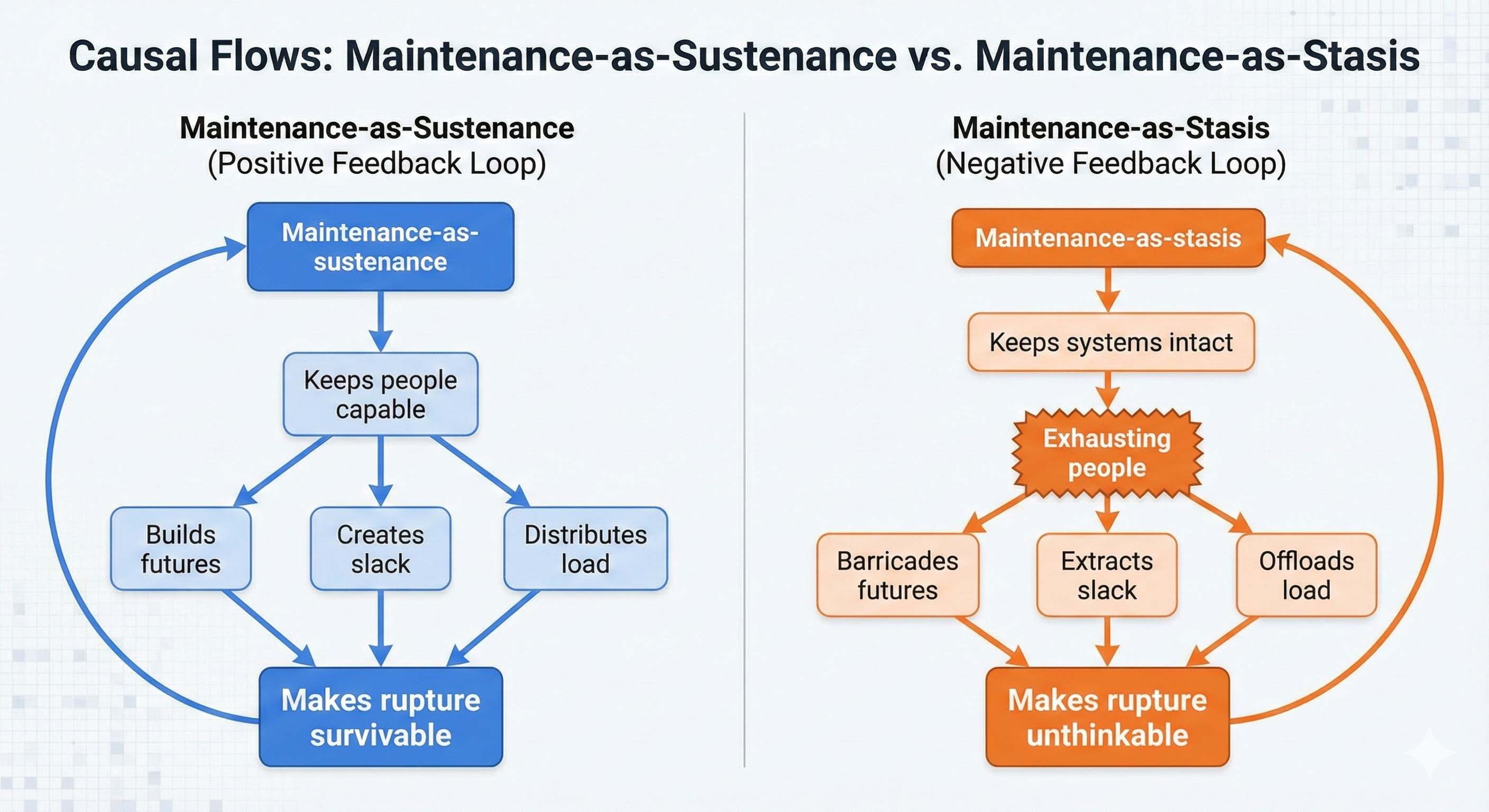
- Maintenance-as-sustenance keeps people capable.
- Maintenance-as-stasis keeps systems intact by exhausting people.
- Sustenance builds futures; stasis barricades them.
- Sustenance creates slack; stasis extracts it.
- Sustenance distributes load; stasis offloads it.
- Sustenance makes rupture survivable; stasis makes rupture unthinkable.
The Maintenance We Need to Reclaim
We can’t reject maintenance, since we need it more than ever, but we can choose which kind.
Reclaim maintenance-as-sustenance:
- maintenance that restores capacity rather than consuming it
- maintenance that distributes harm rather than concentrating it
- maintenance that builds redundancy rather than demanding heroism
- maintenance that prepares the world for change rather than prevents it
- maintenance that treats people as lives worth making room for rather than as components that carry the load
This kind of maintenance refuses the nostalgic, the soft, and the slow. It’s the only maintenance that allows for the world we desperately need but haven’t built yet.
Maintenance-as-stasis keeps civilization running in place.
Maintenance-as-sustenance keeps civilization capable of moving at all.
Any budget, plan or book that promises maintenance can be read for which of the two it pays for.
Note 1.
That became what I later called Critical Bioengineering, where the design of failure determines which bodies absorb which harms.
Note 2.
Paid in Praise traces the same dynamic in hospitals, schools and tech companies, where praise for devoted workers stands in for pay and staffing.
Note 3.
Later essays describe the maintenance this essay reclaims as compensatory labor, the work a person does when an institution will not adapt to them. The Rule Works. She Doesn’t Fit. names the residue it reconciles, and Rank Means Never Having to Adapt names who is licensed to stay rigid while the maintenance is assigned.