Everything works until it doesn’t; hospitals set records for throughput, platforms break engagement highs, and the economy keeps expanding. By every metric, things are fine. Yet each success feels thinner than the last. Engagement rises as trust collapses. Unit costs fall as resilience erodes. Dashboards glow green while the foundations crack.
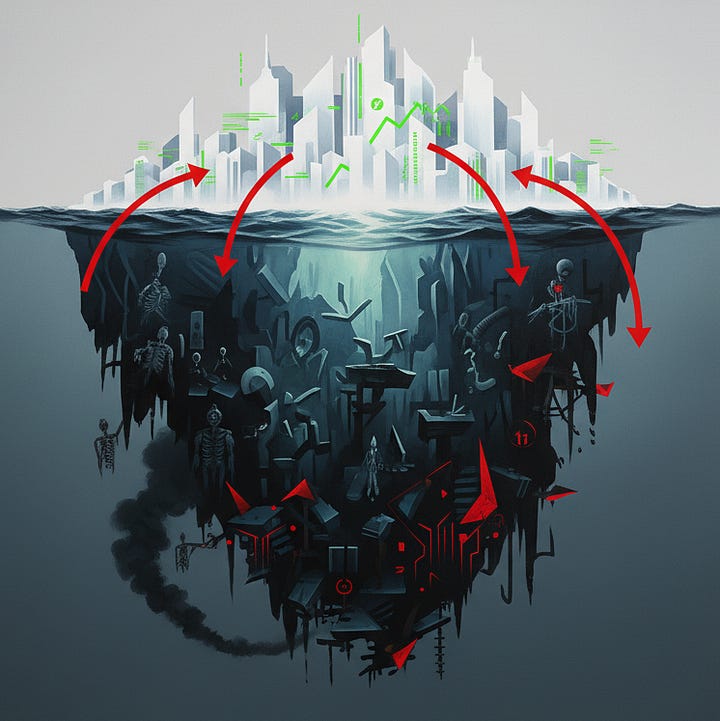
Most systems fail by continuing to work long after it makes sense. As Ivan Illich warned, institutions turn counterproductive when they harden into the institutional embodiment of their own purpose. Hospitals that make people sick and platforms that isolate each reveal what happens when function outlives sense.
This is a system that keeps going by consuming the reason it exists: it meets each target while the work the targets were meant to track gets worse. What begins as an adaptive strategy, as Joseph Tainter noted, hardens into a maintenance burden whose costs rise faster than its benefits.
The system runs on externalization. This is more than a market flaw; it is how an order sustains its self-image. Economist Herman Daly described the economy as a subsystem of the environment, or, in Gaylord Nelson’s phrase, a wholly owned subsidiary of it. This remains true but incomplete. The system’s logic relies on a geography of elsewhere: colonies, peripheries, racialized labor, and ecosystems cast as empty.
What looks like universal reason is built on selective blindness. As philosopher Sylvia Wynter put it,
“the struggle of our new millennium will be one between the ongoing imperative of securing the well-being of our present ethnoclass (i.e., Western bourgeois) conception of the human, Man, which overrepresents itself as if it were the human itself, and that of securing the well-being, and therefore the full cognitive and behavioral autonomy of the human species itself/ourselves.” - Sylvia Wynter
Pushing costs onto others works only if the people running the system stop acting on reports of harm. That produces incorrigibility.
Incorrigibility is feedback without learning: an institution grows information-saturated while staying correction-proof. Dashboards, surveys, and listening sessions proliferate, yet they function ceremonially, translating contradiction into reassurance. Its managers treat feedback as a risk to contain and redesign as an admission of failure. An institution that cannot be corrected repeats the same harm until something outside stops it, and large-scale abuses grow under that condition.
The material result of this epistemic failure is maintenance denied. Maintenance (the work of alignment, upkeep, and repair) exposes the very costs the system is designed to hide. It is interpreted as weakness, a drag on performance. Because it does not scale, pitch, or publish well, maintenance is the first budget cut and the last prestige.
Stress migrates until it breaks something or someone quieter. Who patches things and who runs them until they break rarely shows up in a budget or an org chart.
When the feedback debt grows unpayable, the system implodes. Collapse can be reduced to bookkeeping: the moment when off-ledger costs re-enter the ledger as financial loss, ecological shock, or civic distrust. From inside the system, it appears abrupt and moralistic, a drama of “bad actors.” From the margins, it looks mechanical and inevitable.
The design question isn’t who to blame, but why feedback was forced to arrive in the form of crisis.
If there’s an alternative, it may lie in what AI researchers call corrigibility, the capacity to accept correction without paralysis. But even this language can be captured. An institution can announce a listening tour and call it humility while nothing in its plans changes. The goal must be to stop mistaking correction for continuation.
The obstacle isn’t coordination itself, but its scale. Planetary management imagines a single system steering the world as an object, a word built on separation, boundary, and mastery.
Living grammars of endurance, like Māori kaitiakitanga or Andean ayni, are not “alternative systems.” They are practices that refuse the fiction that feedback can be separated from obligation.
As systems centralize, they narrow the channels through which experience is legible. The center gets cleaner numbers while people at the edges lose ways to report what is happening to them. A world that coordinates too tightly burns through the slack that keeps it alive.
What’s needed are federations of repair, replacing top-down models of control. The aim is reciprocal awareness, rather than frictionless integration.
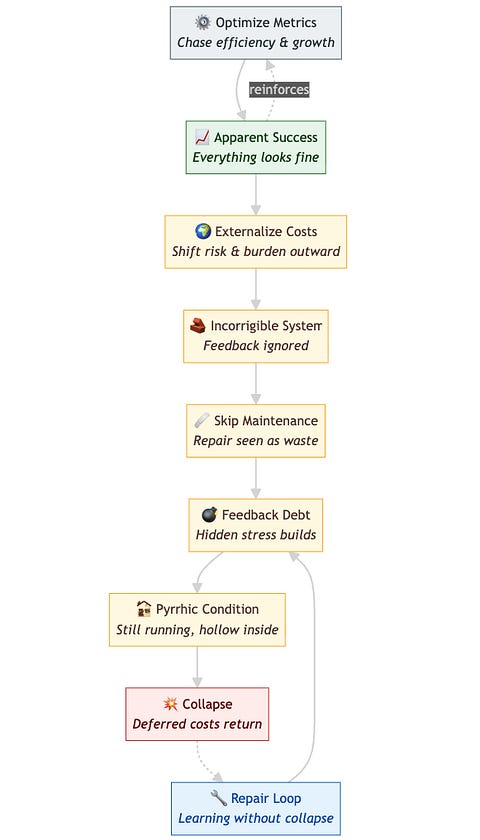
A system closed to correction drifts toward a Pyrrhic state. Unless people keep it open through maintenance, correction, and repair, its stated values turn into performance.
Staying in operation does not show that a program works. A hospital, a platform, or an agency shows whether it works by pausing or ending a program when the feedback says it is failing.