In September 2020 Bank of America changed how it handled fraud reports from people who received state unemployment benefits on its prepaid debit cards. When a cardholder reported a charge they hadn’t made, the bank now ran the report through an automated filter with three indicators. If the report met any one of them, the bank decided without further investigation that no unauthorized charge had occurred, denied the claim and froze the account. The freeze left the cardholder unable to reach the benefits in it and stopped new payments from being deposited. An internal presentation that month acknowledged that deciding which flagged accounts were actually fraudulent would take a detailed review of each one, which at that volume was “unmanageable.”1
Undoing a freeze took far longer. Cardholders went weeks, and some went months, without their benefits; some ran up late fees, missed utility bills, or faced eviction, foreclosure or repossession. In California, most claimants were paid on the bank’s cards. Cardholders there spent hours a day on the phone with the bank, were disconnected and transferred, and were sometimes told, wrongly, that the state had ordered the freeze. The bank made them reverify their identity with the state unemployment agency, which in August 2020 had answered and resolved 1 percent of its incoming calls. Until March 2021 the only way around the agency was a hardship complaint that reached the bank’s executives through a legislator, a legal aid group, a lawyer or the press.1 Freezing an account cost the bank no investigation at all. Unfreezing one cost the cardholder weeks. The bank’s bill came in July 2022, when federal regulators fined it $225 million. They also ordered it to repay what its filter had wrongly denied, plus a lump sum to each affected cardholder for the harm done by the time the account had stayed frozen. The bank neither admitted nor denied their findings.2
That asymmetry now runs through the banks, platforms and agencies most people deal with, and it reverses an older default. For a long time you were assumed to be who you said you were, and assumed to be acting in good faith until you broke a rule. The burden of proof sat with the accuser. Online, the default is Zero Trust, a cybersecurity concept that leaked into governance: no entity is trusted, every request is verified, every interaction is conditional, and every user is a potential threat until they prove otherwise through whatever proof-of-work the system demands.
The shift came from arithmetic more than malice. At the scale of billions, the tail of bad actors (spammers, fraudsters, state-sponsored attackers) is larger than the population of most countries, and to a system administrator, attack traffic and legitimate traffic look the same. So the system builds a wall that treats everyone as adversarial, and a society emerges running on a new default: guilty until verified.
Automated suspicion, manual exoneration
Institutions have automated the power to suspect and left the power to exonerate manual. A fraud filter freezes an account in milliseconds; a moderation model bans a ten-year-old business in the time it takes to render a pixel. Correction runs on human time: tickets, hold music, uploads, agents who mostly can’t override the machine.
Because the institution pays nothing for the error and you pay everything for the correction, the system learns the obvious lesson. It’s always safer to block a good user than to admit a bad one, because a false positive is “friction” for you and a false negative is “risk” for them.

View source
%% title: Asymmetric irreversibility
%% caption: Suspicion scales at machine speed. Exoneration remains manual, scarce, and expensive, so blocking stays cheaper for the institution than trusting.
flowchart TD
    A["User request"] --> B["Automated suspicion"]
    B --> C{"False positive?"}
    C -- "No" --> D["Access continues"]
    C -- "Yes" --> E["Freeze / ban / fraud flag"]
    E --> F["Manual appeal path"]
    F --> G["Tickets / uploads / waiting"]
    G --> H["Scarce human review"]
    H --> I{"Restored?"}
    I -- "Yes" --> J["User loses time"]
    I -- "No" --> K["Locked out"]
    J --> L["Blocking remains cheap for institution"]
    K --> L
Due process, rationed
Human review is expensive, so it’s saved for the users who matter: the verified, the continuous, the ones with a stable address, a ten-year phone number, a consistent biometric profile and a standard income. Those people pass the filters because they have slack.
Poor, transient, unbanked or irregular, and you trigger the immune system. You’re in the tail, and because you lack the resources to survive the reversal process, the delay ends with you locked out for good.
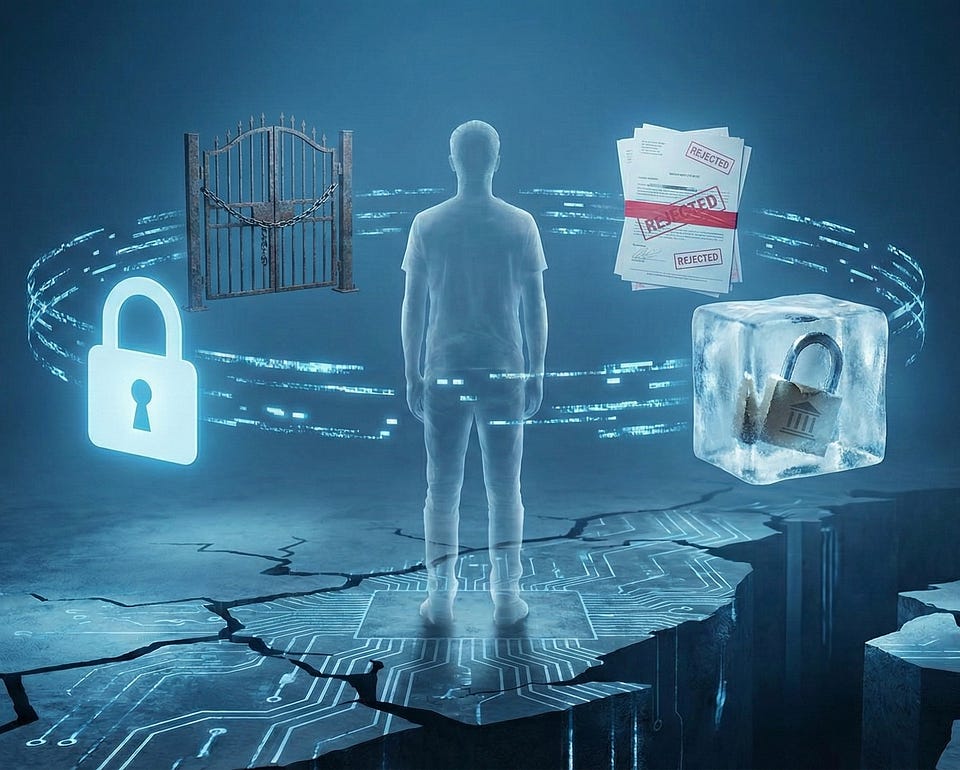
Call it administrative homelessness: people who cannot rent because of a zombie eviction record, cannot work because of a background-check error, cannot bank because of a fraud flag, and cannot prove otherwise because the record that would prove it is the one that’s wrong.
Bad behavior becomes rational
This architecture explains a good deal of what looks like a shift in character. It’s a rational adaptation to a system that assumes you’re an enemy.
Cheating becomes rational. When the official recovery form is a dead end and a paid fixer works, honesty is a survival disadvantage. Rage becomes pointless. Anger is a signal meant to shame a community into enforcing its standards, and you’re shouting at a no-reply inbox. Politeness becomes humiliating. To get help you say please and thank you to the entity that froze your rent money, and you validate its apology scripts to keep the ticket open. Withdrawal starts to look like the only sane move. If every interaction carries some chance of an uncorrectable ban or a frozen wallet, people stop posting, stop verifying, stop experimenting, and standardize their lives to the machine’s template of a good user.
Suspected users return the favor
Correctness is becoming a luxury good, available to whoever can afford the tier with a human in it. Everyone else gets the model, which sees the world through one suspicious lens.
If the system treats every user as a potential threat, eventually the users return the favor. To a cardholder whose benefits were frozen by a three-indicator filter, a new form looks like another way to be denied, and a delay looks deliberate. People have kept their values; what changed is that the population has learned what the machine assumes about it, and started assuming the same about the machine.
Notes
Consumer Financial Protection Bureau, Consent Order, Bank of America, N.A., File No. 2022-CFPB-0004, July 14, 2022, ¶¶ 14–39, files.consumerfinance.gov. The filter ran from September 28, 2020; from March 18, 2021 the bank blocked flagged cards instead of freezing accounts, and it relied on the filter alone for more than 100,000 cardholders’ reports until June 8, 2021. The bank had not told California’s Employment Development Department in advance that it would freeze accounts.
Consumer Financial Protection Bureau, “Federal Regulators Fine Bank of America $225 Million Over Botched Disbursement of State Unemployment Benefits at Height of Pandemic,” July 14, 2022, consumerfinance.gov. The bureau’s penalty was $100 million and the Office of the Comptroller of the Currency’s $125 million; the bureau described people on hold for hours every day for weeks.