Your card declines at the grocery checkout. The benefits you counted on don’t show up, and an account is suddenly “under review.” A letter arrives announcing a decision you didn’t know was being made.
Most people have lived some version of this. Each time, the change is instant, and the fix, if it comes, lives somewhere behind hold music, web forms, “high volume,” and a promise that someone will look at it.
Power used to look like a decision maker. Now it looks like an undo button you don’t get to press.
I’ve come to think the political center of gravity has to move from who decides to how hard the decision is to reverse.
Fast harm, slow repair
Systems can change your status in real time. Repair happens on human time, slowly, optionally, and mostly by making you do the labor.1
Healthcare is the easiest place to prove it, because delay there gets biological fast.
Denials are common. In 2023, ACA marketplace insurers denied 20% of in-network claims, roughly one in five.
Appeals are rare. Across tens of millions of denials, consumers appeal under 1%.
Appeals work. When people do appeal, denials get overturned at least partially 44% of the time, and prior auth appeals succeed in some studies 80%+ of the time.

View source
%% title: Fast harm, slow repair
%% caption: High-speed systems can change your status instantly, but reversal is routed through a slow, manual, and costly path that many people cannot survive.
flowchart TD
  classDef actor stroke-width:1.6px;
  classDef system stroke-width:1.2px;
  classDef gate stroke-width:1.6px;
  classDef binding stroke-width:3px,font-weight:bold;
  classDef status stroke-dasharray:4 3;
  classDef burden stroke-width:2px;
  classDef repair stroke-width:2.4px,font-weight:bold;
  classDef failure stroke-width:2.2px,stroke-dasharray:6 3;

  A["Institution acts at scale"]:::system --> S["Status changed instantly"]:::system
  S --> H([Harm already live]):::failure
  S -.-> P["Appeal exists on paper"]:::status
  P --> M["Manual reversal path"]:::system
  M -- "delay + friction" --> C["Time + money + procedural labor"]:::burden
  C --> O([Drop-off / harm continues]):::failure
  M ==> R([Reversal]):::repair

A system that denies one claim in five and faces appeals from almost nobody can afford to be wrong on many of the denials it issues. But whether it denies because it knows people will not fight back is a separate question, and the appeal figures don’t answer it. The reason most people don’t appeal could be cost, exhaustion, or the belief that appeals do not work; the success rate among the few who try does not tell us which.
Being right has nothing to do with it.
The system wins by making correction expensive enough that most people can’t afford to try.
The ones who push through often win. Most people never get to find that out.
Everywhere high-speed systems touch high-stakes lives
Benefits: payments stop overnight; hearing dates land months out. Pennsylvania unemployment appeals can run 2–6 months. You still need rent and groceries during “the process.”
Housing: filing to removal can be weeks. Illinois eviction cases can reach a hearing in 7 days. Appeals exist, but they often don’t pause the harm, so “you can appeal” is technically true while you’re already on the curb.
Platforms: a flag erases an account and an income instantly; review has no binding timeline and can stretch to weeks or months. The platform decides if you get your life back, and when.
Immigration: removal and detention move fast while the system that hears contests is backlogged for years. The right to contest exists inside a machine designed to outrun it.
The new class divide is error survivability

In a high-speed administrative world, class is increasingly measured in error survivability: who can absorb or reverse a wrong decision before their life comes apart.
Who can afford to sit on hold for two hours on a Tuesday without getting fired. Write in institutional jargon without melting down. Front money while “it gets sorted out.” Keep backup accounts, backup housing, backup childcare. Pull in a lawyer, a union rep, or a journalist who gets a response. Stay functional while their status is “pending.”
When a wrong decision is fast and its repair is slow, money serves as insurance against errors and procedural literacy as a credential. In healthcare, how much bureaucracy you can endure helps decide whether a denied claim gets paid.
The same formal right is a safety net for some people and a dare for others.2
Why the usual fixes miss
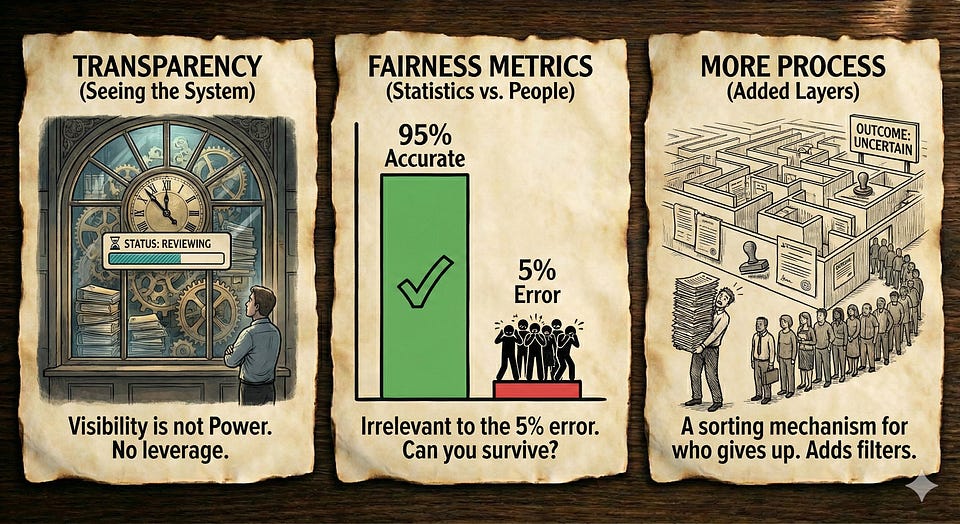
Transparency: you can see the policy, understand the reason code, watch the status bar, and still have no leverage. Visibility is not power.
Fairness metrics: a system can be “95% accurate” and still concentrate its errors on the people least able to contest them. For the person in the 5%, the metric is irrelevant. What decides their outcome is whether they can survive the mistake.
More process: extra forms and extra layers mostly add more filters for time, literacy, stamina. If process isn’t coupled to binding timelines and real outcomes, it is a sorting mechanism for who gives up.
Cheaper appeals: the denial side automated first. ProPublica and The Capitol Forum reported that over two months in 2022, doctors at Cigna denied more than 300,000 payment requests through a review system called PXDX, spending an average of 1.2 seconds on each. Cigna disputed the description.3 A class action alleges that UnitedHealth used an algorithm called nH Predict to cut off post-acute care for Medicare Advantage patients, and that about 90 percent of the denials patients appealed to federal administrative judges were reversed. UnitedHealth said the tool was not used to make coverage decisions.4 Now the other side is building too. Counterforce Health’s assistant reads a patient’s policy and drafts an appeal in under a minute, and the open-source Fight Health Insurance does something similar.5
That’s a real gain: a denial that relied on nobody bothering starts to cost something. It also leaves the cause where it was. A denial issued in 1.2 seconds and an appeal drafted in sixty are two machines exchanging documents about a decision neither made carefully. The rule behind a wrongful denial survives every appeal that wins, one case at a time.6 Cheap appeals invite a reply, too: an insurer can make denials cheaper still, raise the documentation an appeal needs, or route more of them to a slower second review. And the tool moves the work without moving the responsibility. The person denied still has to catch the error. Using the tool takes knowing it exists, trusting it with your records and having the energy to start, which selects for the same people the old process did. Appeal tools give back time nobody should have had to spend, but progress is fewer wrongful denials, not faster appeals.
All of these change how systems talk about themselves, or how fast they argue, without changing what they can be forced to do.
What would actually work
Automatic stays for survival stakes. If an appeal is active, harm should not proceed for money-for-food, housing, essential medical care, or physical presence in a country. Default to continuity until someone with real authority resolves it. Who pays while a decision is disputed is set by that default, as Winning Your Appeal Can Still Cost You Everything works through.
Binding deadlines with teeth. Pick numbers, 14 days, 30 days, and enforce them. Missing the deadline should not be a “service failure.” It should trigger reversal or a real penalty. Some of this is already law. The federal Interoperability and Prior Authorization rule, finalized in January 2024, requires Medicare Advantage plans and Medicaid and CHIP programs to decide standard prior-authorization requests within seven days and urgent ones within 72 hours starting in 2026. Covered payers must give a specific reason for a denial and publish their approval, denial and timing figures.7
Burden on the actor. If a system flips your status, it carries the burden of proving it was right, instead of making you prove it was wrong while you’re under duress.8
Reasons on the record. A denial should name the rule it applied and the evidence it used. In KFF’s 2023 marketplace data, the most common reason insurers gave was “Other,” which should not count as a reason.9
Count the burden. The hours patients and clinicians spend on appeals are part of what a denial costs, and they belong in the published figures beside approval rates. Bureaucracy Eats the Time People Have Left Together is about what those hours come out of.
Proportional capacity. If you can act on 100,000 people a day, you have to be able to process 100,000 appeals a day within guaranteed timelines. Otherwise “you can appeal” is brochure text.10
Cost-shifting when wrong. When the institution is wrong, it pays the person’s costs: fees, lost wages where applicable, and recognition of the harm delay caused. Right now almost all of that sits on the individual.
None of this requires us to believe institutions are evil. It means we have to refuse to let them be careless for free.
What rights actually are
A right is the machinery that moves when a sentence on paper is violated.
I explored this more fully in You Were Free to Choose.
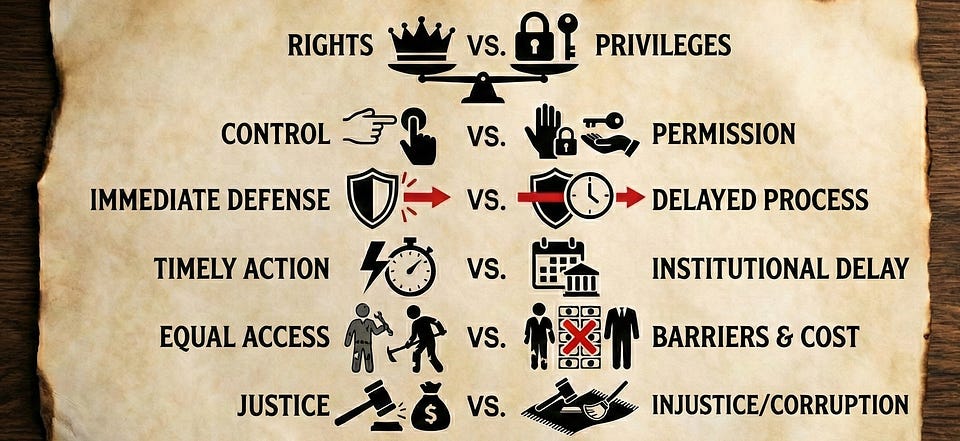
Machinery that works is something you can trigger yourself, without asking permission. It stops the harm while it runs instead of letting it continue during review. It’s timed to your crisis, not to institutional convenience. It works when you are broke, sick, exhausted or scared, not only when you are composed and resourced. And it makes the institution pay when it is wrong instead of just walking the decision back.
If most of that is missing, you do not have a right.
You have a story about a right, plus a test of whether you can survive the cost of making it real.
The formal constitution says you have rights, due process, equal protection. The operational constitution is what institutions can actually be forced to do, and it says something else entirely.
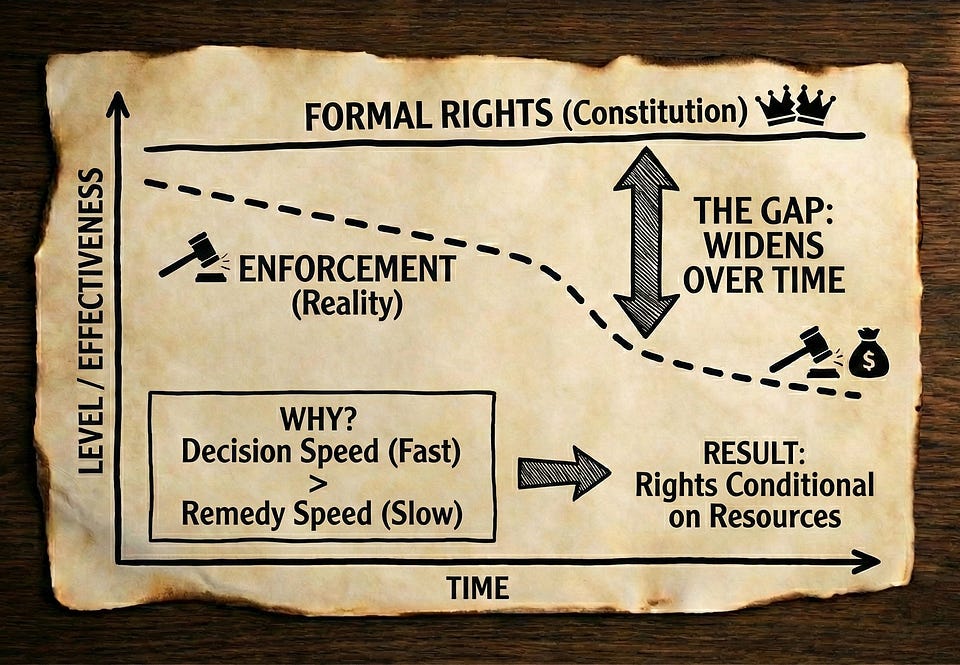
The gap is widening as decision speed goes up and remedy speed stays flat. That’s a new form of domination: rights that are formally universal and practically conditional on resources.
Under high-speed, high-scale systems, the most important political question is no longer “who decides?” or “what do the rules say?”
It is: when the system gets it wrong, who can force reversal, how fast, and at what cost to whom?
Until that question sits at the center of how we talk about healthcare, housing, welfare, platforms, policing, immigration, and everything else, we’re arguing about whose turn it is to get the pamphlet.
If you’ve lived the gap between having a formal right and being able to enforce it, or you’re building systems trying to close that gap, I want to hear about it.
Notes
That asymmetry is, increasingly, the governance model. I have written before about how this works as governance by exhaustion: systems designed to make you quit rather than to get things right.
I mean the capacity to make standing matter; standing in the legal sense is a separate question. I wrote about the distinction in “We Believe You” Is Not a Decision
Patrick Rucker, Maya Miller and David Armstrong, “How Cigna Saves Millions by Having Its Doctors Reject Claims Without Reading Them,” ProPublica and The Capitol Forum, March 25, 2023. Cigna said the description of its process was incorrect.
Estate of Gene B. Lokken et al. v. UnitedHealth Group et al., filed November 14, 2023, U.S. District Court for the District of Minnesota. The 90 percent figure is the complaint’s allegation; the case was ongoing at the time of writing.
Axios Raleigh, “RTP startup uses AI to fight health insurance denials” (August 20, 2025), on the assistant reading the patient’s policy; CityView NC, “How a N.C.-based company uses AI to help appeal health insurance claim denials” (April 2, 2025), and Spectrum News, “Fighting fire with fire: Using AI to beat health insurance claim denials” (August 19, 2025), on a draft in under a minute. Fight Health Insurance was built by Holden Karau; its source is released under an Apache 2.0 licence.
Why winning the case leaves the rule in place: Appeals Test the Clerk, Never the Rule.
Centers for Medicare & Medicaid Services, CMS Interoperability and Prior Authorization Final Rule (CMS-0057-F), January 17, 2024. The decision deadlines do not apply to qualified health plans on the federally facilitated exchanges.
Where the work of coordination and verification should live, and how to move it: Where difficulty lives.
KFF, “Claims Denials and Appeals in ACA Marketplace Plans in 2023”. The analysis covers HealthCare.gov insurers; in-network denial rates ranged from 1 to 54 percent by insurer.
The healthcare numbers are a telling pattern: when success rates are high but attempt rates are tiny, capacity and cost look like the bottleneck — but until we know why people do not appeal, and can compare appealed with unappealed cases, it is a strong inference rather than proof.