A concern raised early resurfaces months later as a crisis, with a task force and a budget, and the original warning is erased from the official record. What follows traces the person who raised it and the record that would have held it.
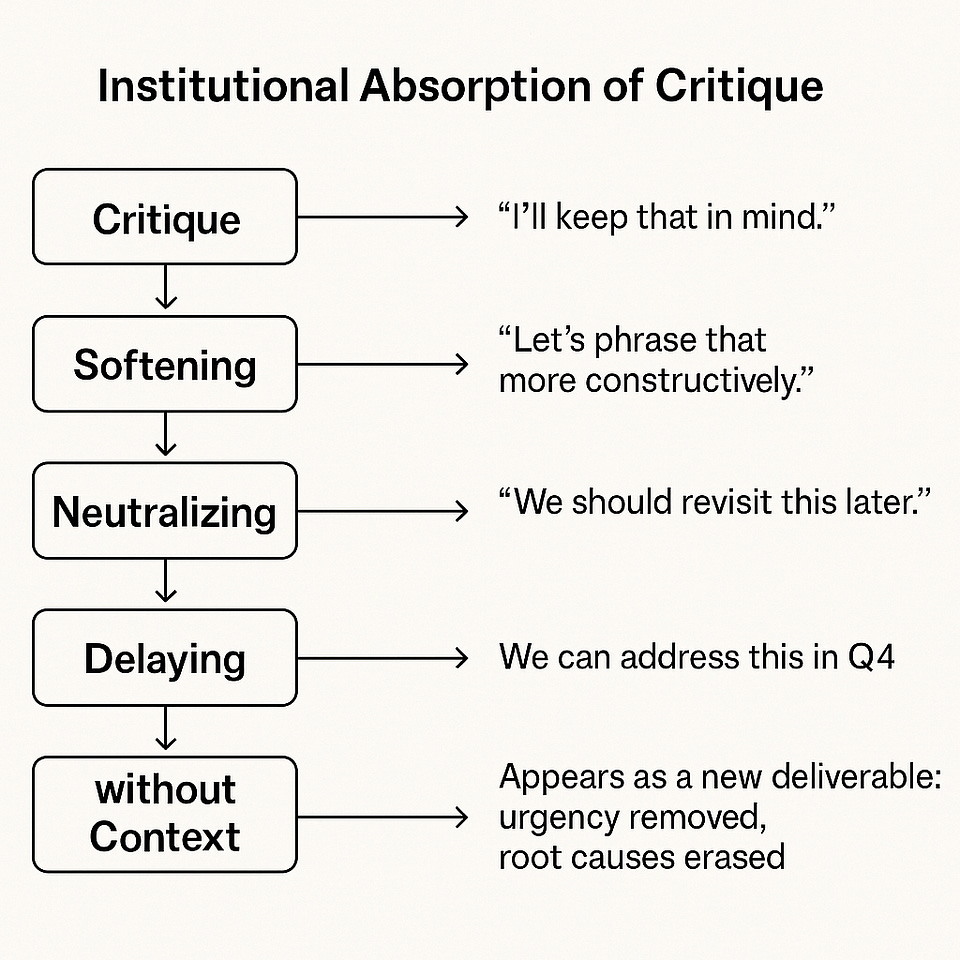
How critique gets absorbed
Institutional memory loss is rarely a simple oversight. It’s embedded in organizational structure. Systems convert uncomfortable insights into manageable items that fit neatly into existing priorities, workflows, and authority structures. Over time, specific concerns get softened, neutralized, recast as mere feedback or future considerations. Eventually, they re-emerge as initiatives, stripped of the urgency and context that made them necessary.
Call it governance by forgetting. Communication may be perfectly good; institutions absorb critique by delaying action until harm turns visible enough to warrant formal acknowledgment. By then, early warnings appear irrelevant, and the delay itself is erased from the record.

View source
%% title: What happens to one employee’s early warning
%% caption: A disabled employee flags barriers in hiring and is asked to wait for the budget review. The barrier comes back as a crisis with a task force and a budget, her first email drops out of the record, and the organization gets the credit.
flowchart TD
    A["Disabled employee flags<br/>barriers in hiring"] --> B["Thanked, asked to wait<br/>for the budget review"]
    B --> C["No owner assigned<br/>to the fix"]
    C --> D["Barrier filed as feedback<br/>for a future cycle"]
    D --> E["Wait until the harm<br/>shows up in hiring"]
    E --> F["Hiring access<br/>declared urgent"]
    F --> G["Accessibility task force,<br/>new budget line"]
    G --> H["Her first email left<br/>out of the timeline"]
    H --> I["Organization praised<br/>as proactive"]
    I --> C
Institutions are structured to respond. Anticipation disrupts budgets, roadmaps, and leadership narratives, and acting early would mean admitting existing shortcomings.
Crisis response, however, appears authoritative and agile.
Institutions learn to prefer last-minute interventions over preventative adjustments, reinforcing a cycle of systemic forgetting.
What the delay costs
A disabled employee identifies barriers to access in hiring processes and is asked to wait for budget reviews. A tenant organizer flags zoning regulations that could displace residents, only to be asked for more evidence. Volunteers in mutual aid groups point out burnout, but leadership defers action due to capacity constraints. In each case, early signals are set aside until conditions worsen, without anyone ever denying them outright.
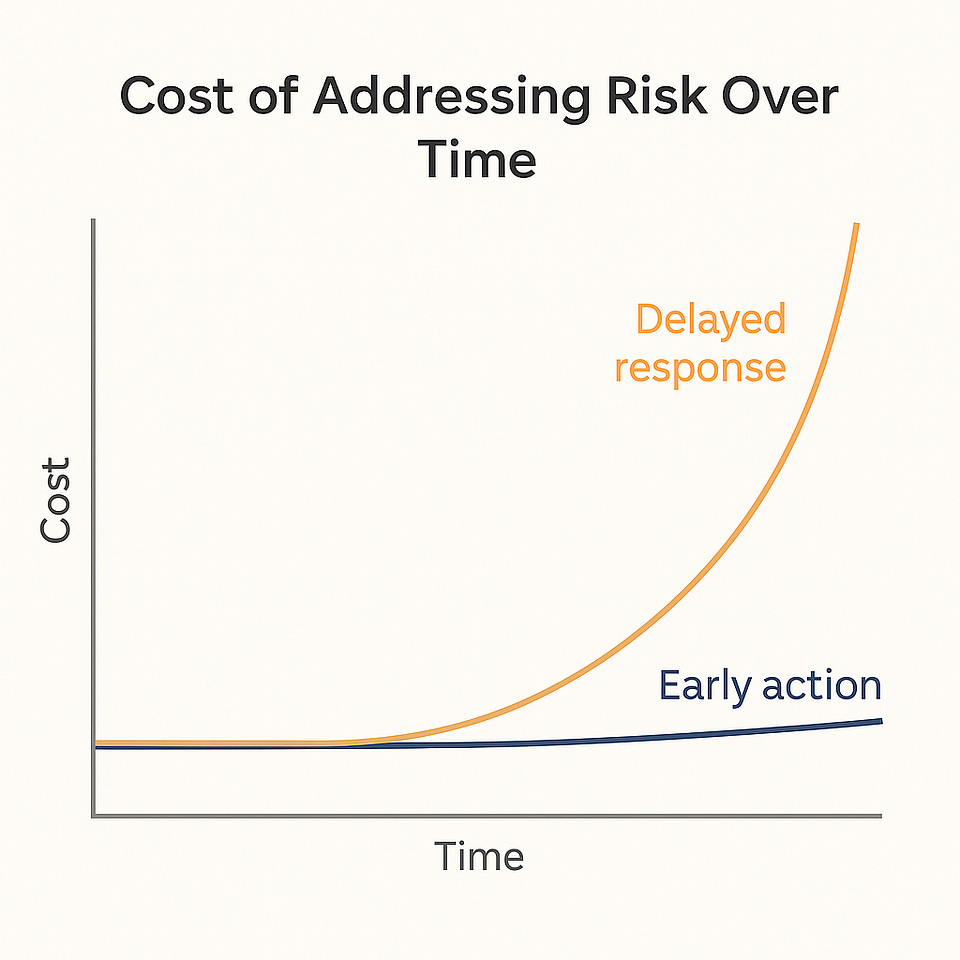
By the time institutions mobilize a response, the early context is lost: the factors that initially made the issue visible and actionable. Those who raised the issue may have moved on or stopped speaking. The resulting solutions are narrower, less effective, and more costly, because the original clarity wore away during the delay.
The critical loss goes beyond individual recognition to organizational learning and preventive capability. When context is removed, solutions address symptoms without acknowledging root causes. Reactive interventions, which could have been minor adjustments, turn into major initiatives, and resources shift toward crisis management rather than proactive design.
Employees and participants who repeatedly experience the erasure of their insights learn to disengage. Eventually, out of learned institutional futility, many stop raising concerns entirely. Organizational knowledge fades, replaced by superficial “lessons learned” that omit deeper structural understanding.
Over time, organizations grow brittle. They increasingly rely on visible failures to drive action, and gradually lose sensitivity to subtle early warnings. A pattern emerges: institutions get good at responding to problems precisely because they have lost the capacity to anticipate them.
The messenger becomes the problem
The person who raises the warning early pays a separate price. Clarity that arrives before the group is ready gets coded as friction, and friction gets managed, not engaged.
Maybe someone thanked you in the moment, then left your comment out of the notes. Maybe the meeting moved on without acknowledgment and you got a couple of validating DMs. Or maybe you were told, gently or not, that you needed to be more constructive, more strategic, or that this isn’t the right forum. Either way, you understood that your timing made people more uncomfortable than the risk itself.
Soon the focus stopped being the issue you raised and became your presence in the conversation. The substance faded. You didn’t. You weren’t being asked to explain the risk. You were being asked to explain yourself.
- In product teams, someone identifies a vulnerability in a feature or model and is told to “stay focused on what we can ship.”
- In a hospital, a nurse raises a safety flag and is treated as a drain on morale.
- In a school, a teacher speaks up about bias in evaluation metrics and is reassigned or sidelined.
- In a nonprofit, someone brings up access barriers and gets left off the next invite list.
- In families, a member names a harmful dynamic and is told they’re making things harder than they need to be.
In each case, someone notices something early, names it, and gets repositioned as misaligned.
This doesn’t mean the insight was off. It’s usually right. It arrives before the group is ready to admit it.
Usually is not always. Some early warnings are false alarms, and institutions say that is why they discount them: a team that stopped for every flag would never ship. The answer is a record. Write down what was flagged, by whom and when, and check it against what happened. A team that kept the record would learn whose early warnings tend to be right, and would stop judging a warning by how uncomfortable its timing felt.
By then, the person who saw it first may have left. Or gone quiet. Or been recast as difficult, intense, inflexible, or “not a great culture fit.” That story doesn’t show up in notes or performance reviews. But it follows you anyway.
The failure is structural. Interpersonal style and better packaging are beside the point. Institutions tend to evaluate feedback based on timing rather than validity: they treat early as threatening and late as consensus.
Making forgetting harder
You cannot force an institution to retain memory, but you can make forgetting harder.
- Capture initial signals. Save the original documents, early emails, first drafts.
- Note the dates. Document when concerns were first raised.
- Track the language. Observe how “harm” shifts to “tension,” how “exclusion” shifts to “variance.”
- Build timelines. Share pattern recognition across roles, not just up the chain.
- Refuse resets. Don’t support initiatives that erase the history of refusal they depend on.
- Repeat it, on the record. A memo usually gets buried because acting on it would cost money or face for whoever sets the agenda. Repeat your point until it sticks: a memo ignored last quarter becomes a subpoena next quarter. One tenant’s note about an inaccessible lobby is an anecdote; a dozen tenants, each with time-stamped photos, is evidence. Algorithms and auditors pay attention to volume, and every forward, retweet and hallway mention cements lived experience into data that can’t be shrugged off.
These practices preserve organizational intelligence, and blame has little to do with them.
When nobody keeps the record, nobody can show how long the institution waited to act.
Keeping that record is disruptive. It shows that the people who decided were told in time and waited. It insists that problems were not inevitable, that harms were foreseeable, and that solutions are often far simpler than institutions portray.
A record kept by several people across roles is harder to erase than one person’s memory of a meeting.
The counsel here has a cost. It asks the person who was ignored to keep carrying the memory, and correction that depends on the vigilance of the affected is a burden transfer with a grievance procedure attached. The point of the record is to end that: an institution that changes only when someone repeats themselves keeps no memory of its own, and the repair belongs to it — a record holding what was reported, without anyone having to say it twice.
Governance by forgetting stops correction at its first step, because a warning nobody recorded cannot later be used to show the harm was foreseen. Forgiveness Is for the First Mistake argues that an organization which arranges not to know about a problem loses the forgiveness owed to an honest mistake. Apologies Are Cheap When No One Can Challenge the Error follows the Post Office case, where the inquiry’s record is what keeps the same error from recurring unnoticed.
Further reading
- Neutral Isn’t Fair: how procedural neutrality disguises structural erasure
- Mariame Kaba, on abolition and transformative justice
- Sara Ahmed, on institutions reframing complaints
- James C. Scott, on institutional legibility and erasure
- adrienne maree brown, on fractal memory and relational timelines
- Fred Moten and Stefano Harney, on institutional absorption and the politics of the undercommons