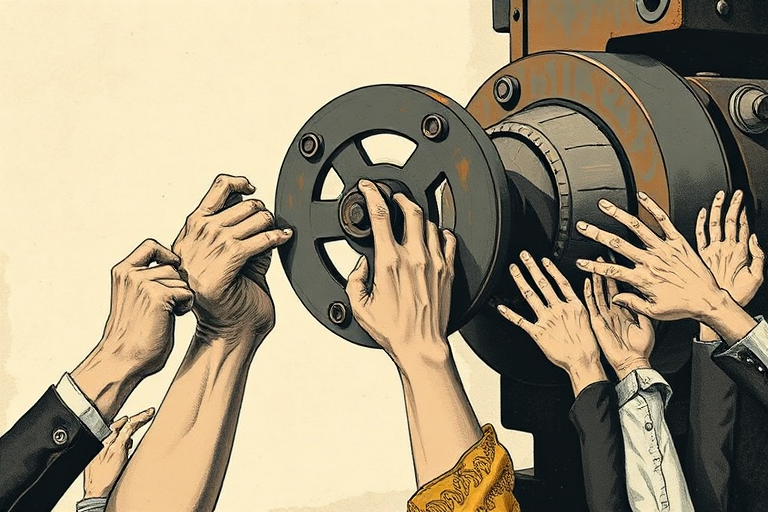
 “Things will improve once the old guard dies off.” It sounds neat at first, a tempting picture of progress delivered by generational turnover. Underneath it is a darker logic: that our future depends on waiting for older adults to disappear rather than on solidarity or systemic design.
I used to nod along. It felt pragmatic. If history itself is holding us back, then we just need the clock to run out—right? Over time I’ve come to see it as ageist, and also as a surrender. It concedes that some lives stand in the way of the future, and that the fix is waiting for those people to die.
Worse, the idea masks the real source of stagnation: exclusion embedded in the systems we inhabit.
The rules outlive the people blamed for them
The grievance under the quip is real. When the 119th Congress opened in January 2025, the median senator was 64.7 years old, and Baby Boomers held 60 of the 99 Senate seats then filled.1 In mid-2026 Boomers held about 52 percent of American household net worth and 41 percent of household real estate, by the Federal Reserve’s count.2 People who came after them have waited a long time for the leadership and the houses. But the turnover the quip waits for has already started: Generation X, not the Boomers, is now the largest generation in the House.1 What turnover doesn’t reach is the rules.
So many of us buy into the idea that we’d be better off once older people are gone because it offers an easy scapegoat. Companies that run on profit benefit when the blame for a failure lands on someone else. Instead of questioning how healthcare, insurance, or labor markets push out those deemed “unprofitable,” we point fingers at older adults as though they’re the sole culprits.
Meanwhile, popular discourse frames aging as an inevitable decline. “They’re outdated,” the story goes, “and it’s only natural we leave them behind.” It’s a con that turns systemic failings into common sense: older adults didn’t keep pace, so they’re obsolete.
But that story ignores how exclusion actually works. People aren’t left behind because they’re slow; they’re worn down by systems designed to gatekeep care, filter out unprofitable users, and prioritize margins over dignity.
Generational turnover replaces the people and leaves their rules running. The re-authorization loops, appeal queues and patient portals that wear older adults down were written by people who will retire. Those systems will go on filtering whoever is old or sick next, including the people now waiting for the turnover. Nobody Is Too Expensive calls this friction-based eugenics, and it outlasts every cohort it is blamed on.

Medicare’s three-day rule shows how long a rule can run. When Congress created Medicare in 1965, it required a patient to spend at least three days as a hospital inpatient before Medicare would pay for a stay in a skilled nursing home. The House Ways and Means Committee wanted to keep that benefit for people coming out of real hospital treatment, and to make long hospital stays less likely.3
In 1972 the average hospital stay ran about 12 days. By 2012 it ran about 5, and hospitals were holding more and more patients under “observation,” a status Medicare counts as outpatient care however many nights the patient spends in a hospital bed. That year Medicare patients had more than 600,000 hospital stays of three days or longer that didn’t qualify, because the patient was an outpatient for some or all of the stay, and a patient sent from one of them to a nursing home can owe the nursing home’s costs.3
When Congress dropped the rule for 1989, covered skilled-nursing admissions rose 16 percent, and the rule was back the next year.3 The committee that wrote it has turned over many times since. The rule filters whoever is old and sick this year, and nothing in it expires when the Boomers do.
Insurers filter by attrition too. In 2024 Medicare Advantage plans denied 4.1 million requests for prior authorization in full or in part. Only 11.5 percent of those denials were appealed, though in every year since 2019 more than eight in ten appealed denials have been overturned.4 This steady stream of paperwork and technical barriers filters people out through exhaustion rather than outright denial.
Attrition by design reaches beyond older adults and overlaps with ableism, classism, and racism. But ageism often has the lightest political resistance—after all, everyone ages, so society tends to treat it as inevitable. We rarely protest a force we assume to be part of nature, even when it’s actually manufactured by policy and profit motives.
What the quip throws away
Recognizing this quiet violence meant confronting my own cynicism. For years, I moved fast and prided myself on being able to outwork or out-think the friction in my path. Cynicism became a shield I could adjust at will. If a system was unfair, I’d keep my head down and find a loophole. But I failed to see that my so-called competence was a form of complicity.
This mindset made it tempting to adopt the casual quip that “all our problems will vanish with the boomer generation.” But underneath that dark joke lay an ethos of survival rather than solidarity: if the system is broken, just last longer than the other guy. That’s a death match with prettier branding.
The myth of generational obsolescence hides the fact that many older people are survivors of past crises, policy betrayals, and corporate “innovations” that failed to deliver on their promises. Their caution, if we listen to it, can be a form of collective wisdom rather than stubborn backwardness.
Someone skeptical of the latest shiny “disruption” might have seen firsthand how disruptions often favor profitability over ethics. Dismissing their skepticism as nostalgia throws away what they saw.

Older adults perform enormous amounts of unpaid labor: caregiving for grandchildren, volunteering in communities, preserving cultural practices. These contributions sustain the social fabric more than any GDP or quarterly report can capture.
Systems that age with us
It’s easy to imagine we’ll personally escape the fate of being labeled “too old” or “too expensive.” Perhaps we think our skill set will keep us relevant, or that we’ll have the resources to buy premium care. But the same paperwork, risk scoring and repeated appeals will apply to us too when we get old or sick. If we deem older adults expendable, we’re rehearsing our own disposability.
The real horror of scapegoating older adults is that it normalizes an economy that sees humans (especially those past peak “profitability”) as liabilities.
Rejecting generational obsolescence means unlearning the logic of disposability, and that starts with the rules still running. The three-day rule leaves paper to ask for. A hospital has to tell a Medicare patient in writing once they’ve been under observation for more than 24 hours, and Medicare’s own advice is to ask the hospital or the doctor whether you’re an inpatient or an outpatient.5 A traditional Medicare patient admitted as an inpatient and then switched to observation must now get a notice of the change, and can file a fast appeal before leaving the hospital, under a 2024 rule a federal court ordered Medicare to write. A patient placed under observation from the start still has no appeal.6 Those are questions to ask for a parent now, and for yourself later, unless someone rewrites the rule first.
The myth that things get better once older people die off gets power wrong. Aging isn’t the real issue; our acceptance of that disposable logic is.
All of us are aging into each other’s care. When we hope certain people exit the stage, we miss the chance to build a society where wisdom and vulnerability reinforce one another. Instead of waiting for “the old guard” to vanish, we could ask what made them vulnerable in the first place—so none of us ends up written off next.
If you’ve ever felt comfort in the idea that older adults will be gone soon, consider who actually benefits from that mindset. You, your loved ones, and the broader community gain nothing from it. The gain goes to insurers, hospitals and employers that profit from scarcity and competition, and they will treat you the same way once you cost more than you earn them.
Further reading
- Nobody Is Too Expensive
- Actuarial Medicine & Hidden Exclusion
- Cynicism is an Adjustable Shield
- Bad Rules Outlast Bad People
Notes
Drew DeSilver, “Age and generation in the 119th Congress: Somewhat younger, with fewer Boomers and more Gen Xers,” Pew Research Center, January 16, 2025. Generation X held 180 House seats (41 percent) to the Boomers’ 170 (39 percent). Pew Research Center
Federal Reserve Board, Distributional Financial Accounts, generational levels for the second quarter of 2026: Baby Boomers held $97.4 trillion of $185.7 trillion in household net worth and $20.5 trillion of $49.8 trillion in real estate. Shares are computed from those levels. Federal Reserve data
Congressional Research Service, Medicare’s Skilled Nursing Facility (SNF) Three-Day Inpatient Stay Requirement: In Brief, R44512, June 2, 2016, quoting the 1965 Ways and Means report and citing the HHS Office of Inspector General’s July 2013 report on observation stays. The 1989 repeal came with the Medicare Catastrophic Coverage Act, which also changed other parts of the benefit. EveryCRSReport
Jeannie Fuglesten Biniek, Nolan Sroczynski, Meredith Freed and Tricia Neuman, “Medicare Advantage Insurers Made Nearly 53 Million Prior Authorization Determinations in 2024,” KFF, January 28, 2026. KFF
Medicare.gov, page on inpatient or outpatient hospital status. The written notice is the Medicare Outpatient Observation Notice, required by the NOTICE Act of 2015. Medicare.gov
CMS, “Medicare Appeal Rights for Certain Changes in Patient Status Final Rule (CMS-4204-F),” fact sheet, October 2024, implementing the order in Alexander v. Azar, affirmed by the Second Circuit in January 2022. The court held that placement in observation itself carries no appeal right. A separate retrospective appeal for stays since 2009 closed on January 2, 2026. CMS fact sheet; CMS