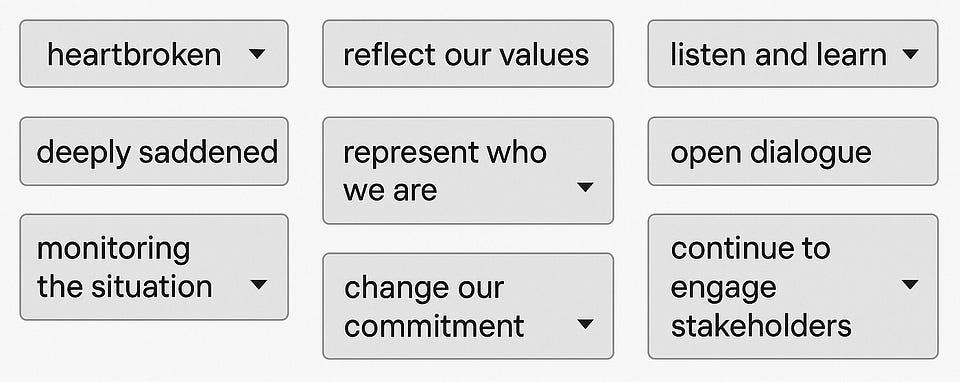
In the hours after public catastrophe, there is now a script so familiar it barely registers. A tragedy unfolds (violence, negligence, state failure), and within moments, a statement appears. It begins with heartbreak. It moves into reaffirmation. It ends with a gesture toward reflection or process.
“We are heartbroken.”
“This does not reflect our values.”
“We’re monitoring the situation.”
These phrases are never random. They are polished, preapproved, and remarkably consistent across sectors. They arrive quickly, fulfill an obligation, and disappear. They give shape to grief, but only in ways that avoid consequence.
This is bigger than corporate cowardice or bureaucratic inertia: language functions as a stabilizer within a broader system.
When something catastrophic happens, the role of the statement is to manage emotional escalation: to acknowledge feeling while displacing responsibility. In this sense, institutional grief has moved past the symbolic into standard procedure, written in advance and kept on file.
Most public-facing organizations have some version of a crisis communications template. Copy lives in a shared drive. Names, dates, and locations are dropped in as needed.
These statements often feel sincere. Many people involved genuinely care. But the structure is designed for continuity.
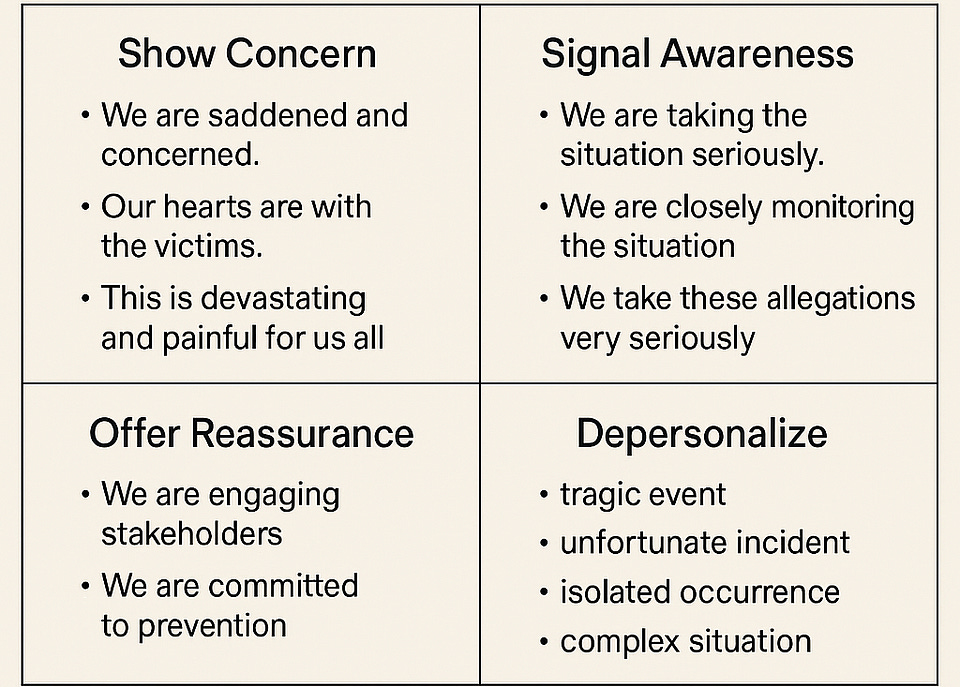
The key to this language is what it avoids. Words like “tragedy,” “unimaginable,” or “incident” scrub the record clean of decisions. Grief is offered in place of authorship. Structural harm is recast as ambient misfortune. You don’t have to name the contract, the budget, or the vote—only the community’s pain.
OceanGate’s statement after its Titan submersible imploded on a dive to the Titanic, in June 2023, shows how it works. Five men “have sadly been lost,” it said, and “Our hearts are with these five souls and every member of their families during this tragic time.”1 One of the five was the company’s CEO, Stockton Rush, who designed and piloted the vessel, so the statement mourns the man who made the decisions alongside the four men who dove with him. Two years later a Coast Guard board supplied what it left out. “This marine casualty and the loss of five lives was preventable,” its chair said, and the report found that Rush “ignored safety warnings, skirted regulations and exhibited negligence.”2
This is most visible in moments of crisis where power is unequally distributed but rhetorically flattened.
In some of the most documented cases, such as police killings, bombardments abroad, and deaths in custody, the language tends to move quickly toward balance.
All sides are urged to remain calm.
Both parties are called to de-escalate.
The public is asked not to politicize the moment.
Even when power is lopsided, the grief is distributed evenly, so the party that held the power is asked to answer for no more than the party it harmed.
These statements do something. They offer the public a sense that the situation is under review, that someone is listening, that care is in progress.
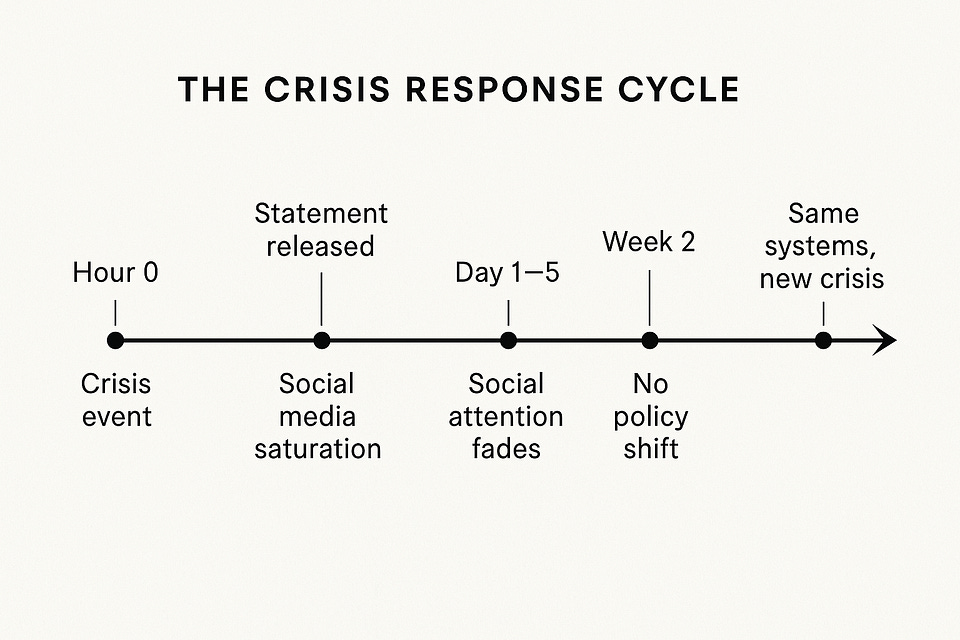
But often that sense of process is the product, a narrative closure that arrives faster than any material change.
There are ways to say something different. The clearest statements are the least theatrical.
- They name decisions.
- They identify who approved what.
- They describe the cost of the error and the consequence of doing nothing.
These responses tend to be rare because they are unscripted. They require institutions to move beyond sentiment into something accountable, attaching sorrow to structure.
And yet, even for readers outside those institutions, the script is easy to adopt: You read a statement, you feel sadness, you keep scrolling.
There’s a sense of being present, of witnessing harm with seriousness.
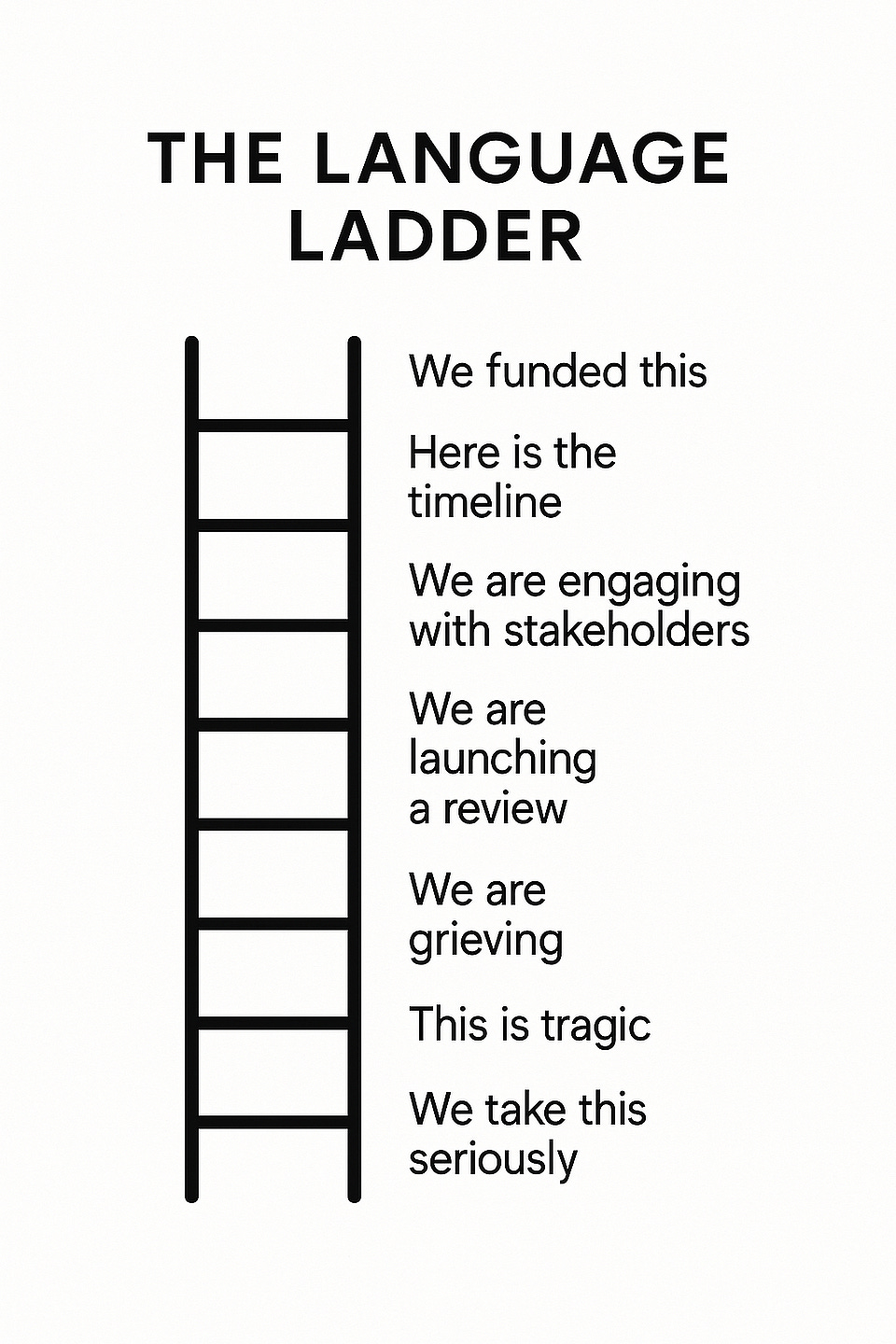
If the cost of public mourning is that we move on before asking why the harm happened, then the statement has done its job.
“Heartbroken and devastated” can be a starting point. But if that’s where it ends, it was a pause long enough to wait things out.
So when an institution appears to grieve, how do you arm yourself against the scripts they use to deflect accountability? Here’s a quick test, to separate accountability from PR:
- Actor. Who, by name, made the choice that caused harm? If no one is named, it’s deflection.
- Change. What will be materially different in 30 days? If nothing is promised, it’s delay.
- Consequence. What happens if nothing changes? If the answer is “nothing,” the statement has no stakes.
OceanGate’s statement fails all three. The five “have sadly been lost,” and the man who designed the vessel is one of them. Nothing is promised, and nothing is at stake.
Jacinda Ardern’s statement the day after the March 2019 attacks on two Christchurch mosques passes the second. She named the licence the attacker held, acquired in November 2017, and the five guns. “I can tell you one thing right now,” she said. “Our gun laws will change.” She listed the attempts that had failed, “in 2005, 2012 and after an inquiry in 2017,” and set a date: officials would report to Cabinet on Monday.3 On April 10, less than a month after the attacks, Parliament voted 119 to one for a law banning military-style semi-automatic weapons.4 Her statement names no person as the actor, but it puts the state’s own licence on the record.
If all three answers are missing, it’s reputation armor. Bin it.
The same ritual runs at the personal scale. Self-blame performs the private version (self-condemnation staged as accountability) and lands where this does: a confession that changes nothing is not repair, however sincerely it is worded. The quieter version, where an institution turns you down without ever saying no, is in Neutral Isn’t Fair.
Notes
“OceanGate Titan statement in full,” PA News, published by the Inverness Courier, June 22, 2023. inverness-courier.co.uk
Victoria Hansen, “Coast Guard says Titan submersible deaths were preventable and faults company’s CEO,” NPR, August 5, 2025, on the report the U.S. Coast Guard Marine Board of Investigation, chaired by Jason Neubauer, released that day. KPBS (NPR)
Jacinda Ardern, statement at the Beehive, March 16, 2019, as transcribed by The Spinoff. Her words on the date: “I have instructed ODESC to report to Cabinet on Monday on this sequence of events.” The Spinoff
“Parliament overwhelmingly votes for tougher new gun laws in wake of Christchurch terrorist attacks,” 1News, April 10, 2019. 1news.co.nz