
Every empire of innovation builds a conscience department. Its purpose is not to reform themachine, but to bless its velocity. This is the institutional function of the in-house ethicist: to make moralnoise without moral consequence.
They are hired to translate the messy friction of dissent into the smooth hum ofgovernance, ensuring that ethics serves as an internal shock absorber, not an external brake.
Inside an institution, the ethics team lives where an‘accountability department’ would be. It exists to absorb the impact of public outrage and internal anxiety, converting
that moral volatility into procedural stability.
The result isa stream of artifacts: bias dashboards, safetyplaybooks, “responsible AI” charters. Eachdocument re-centers the authority it pretends to critique, offering the feeling of rigor without the risk of structural change.
Real accountability requires an outside force with the power to impose consequences. The in-house ethicist is hired to prove theoutside is unnecessary.
“Feasibility” is Power in Disguise
The in-house ethicist learns quickly that theirmost valued trait is “realism.” They master the language of the launch schedule, of what can be shipped, integrated, ordelivered this quarter. But this pragmatism is a mask. “Feasibility” is the favorite disguise of power. Itshrinks the moral horizon to the size of a balance sheet, replacing the difficult question of “should we?” withthe simpler one of “can we afford to?”
This cult of pragmatism leads directly to the worship ofmeasurement. To survive management review, every ethical problem must become a number. Justice becomes precision; fairnessbecomes variance reduction. Metrics feel safer than politics, and measurement feels like action. But measurement is notaccountability. It lets power decide exactly how far its conscience is allowed to run before being pulled back.
The Containment System
Institutions tell a convenientstory about a healthy dialogue between internal reformers and outside critics. But this a myth; it isn’t really a dialogue.It’s a containment strategy.
Internal ethicists are funded to treat symptoms—bias, misinformation, harmfulcontent—because these are problems that can be managed with technical fixes. External critics, who diagnose thedisease—extractive business models, precarious labor, concentrated ownership—are thanked for their input and thensystematically ignored. One group gets a budget and a seat at the table; the other gets a keynote invitation. It is notcollaboration; it's keeping rabble-rousers in their lanes.
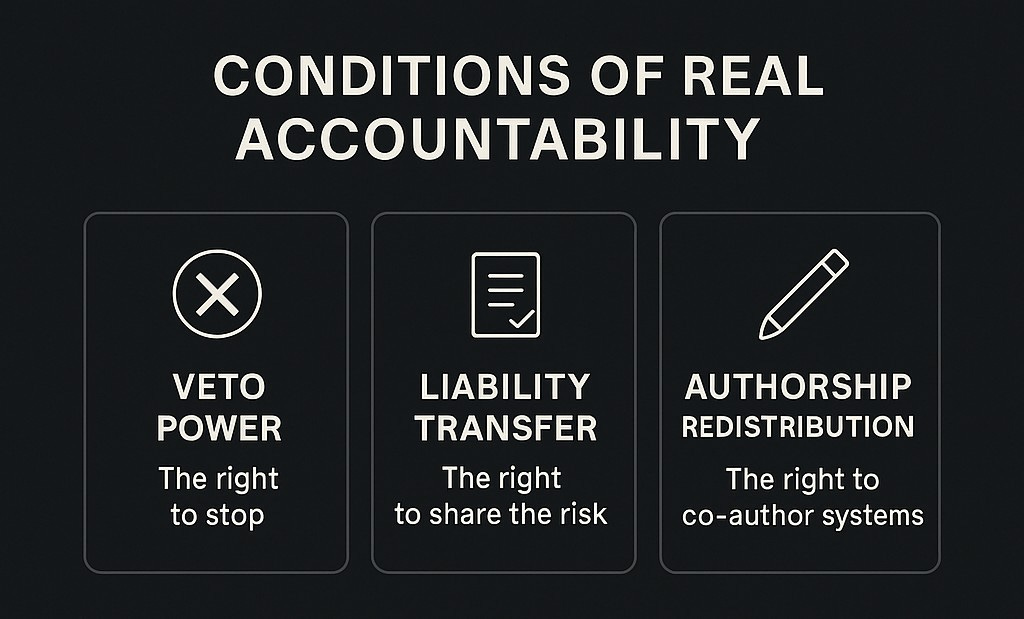
What institutions trulyfear isn’t criticism; it’s being changed by it. They fear permeability. They fear that outsiders mightgain real power through:
- Veto rights over product launches.
- A share inliability for harms.
- Co-authorship in the governance process.
These are the tests of real accountability. If an ethics function cannot veto, reassign, or redistribute, it is no betterthan a public relations asset.
The Closed Loop
And so the ethicist is trapped in a closed loop. They become the highpriest of the institution’s faith in itself—the comforting belief that it can be its own watchdog.
As long as poweranswers only to itself, every internal correction is just a dress rehearsal for the next harm.
Thesolution isn’t to get rid of ethicists, but to place conscience on the outside. Real accountability begins only where self-trust ends, in systems that cannot congratulate themselves—where contradiction, veto, and consequence are not optionalfeatures, but are built into the foundation.
What we need, and sorely lack, is a set of boring, institutional, and repeatablesystems designed to replace the need for heroes and happy accidents.
Until that happens, the in-house ethicist willremain what every empire needs most: a conscience that clocks in, clocks out, and is paid by the hour.