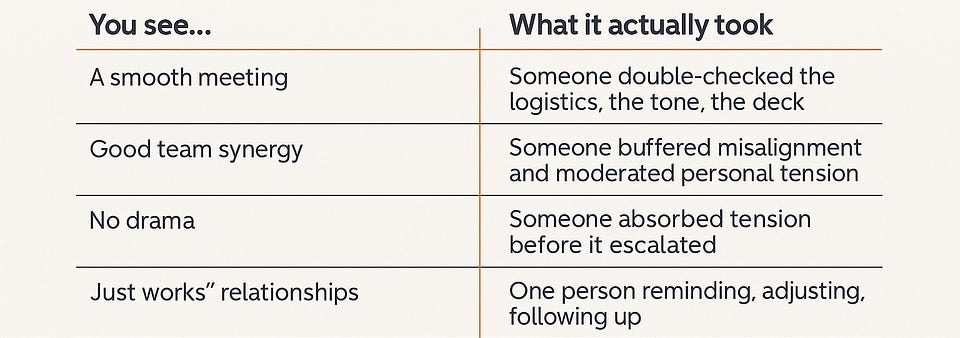
At 8:57 AM, the HDMI cable is missing.
By 8:58, Jordan has hot-spotted the deck, mirrored the slides, handed over a spare charger, and made a quick joke to reset the tone.
By 9:00, the meeting starts on time. Everyone applauds the team’s agility.
No one logs what Jordan just did.
The save disappears into the day. The system keeps moving.
We call this professionalism. Maturity. “Being good under pressure.”
But it’s really risk absorption—someone noticing a potential failure point and adjusting for it before anyone else even noticed.
Because nothing broke, we go on assuming nothing needed holding.
This isn’t rare.
A coworker softens a Slack message that could have escalated. A friend changes the dinner venue without a word so no one gets excluded. A partner reroutes a conversation before it turns into a fight. After hours, a colleague edits the client-facing doc because something felt off.
When this happens once, it’s appreciated.
When it happens constantly, it stops being seen.
Eventually, people mistake it for the person’s identity.
“She’s just steady like that.”
“He’s emotionally intelligent.”
“They’re so easy to work with.”
These aren’t always compliments. Sometimes they’re assignments.
The more someone becomes known for holding things together, the less room they have to stop.
And when they do stop?
- When the tension isn’t caught in time.
- When the correction doesn’t come.
- When the room starts to feel heavier for reasons no one can quite name?
The heaviness gives it away: it was never effortless.
Someone was smoothing it out, and now they’re not.
This kind of labor usually isn’t asked for. But it gets expected anyway.
Some people get to focus on the work.
Others are expected to manage the atmosphere around it.
That expectation tends to fall along familiar lines.
People who’ve been told they’re “too much” learn to modulate early.
People who’ve been made to feel replaceable stretch a little further than they should.
Anyone trained to sense friction before it shows up (because of gender, race, disability, class) gets good at rerouting risk before anyone else sees it.
And the more skillfully they do it, the easier it is for others to believe the system is smooth.
This isn’t just interpersonal. It scales.
According to Oxfam, the unpaid care work that women and girls do—cooking, cleaning, childcare—is worth at least $10.8 trillion a year (read PDF 📄).
That’s more than three times the global tech sector.
Calendars, org charts, and performance reviews record none of it. It vanishes the moment it succeeds, like a tutor who loses their job for having done it too well.
At work, in relationships, in communities, when someone drops a load, the default reaction is discomfort, and few people get curious about what was being carried.
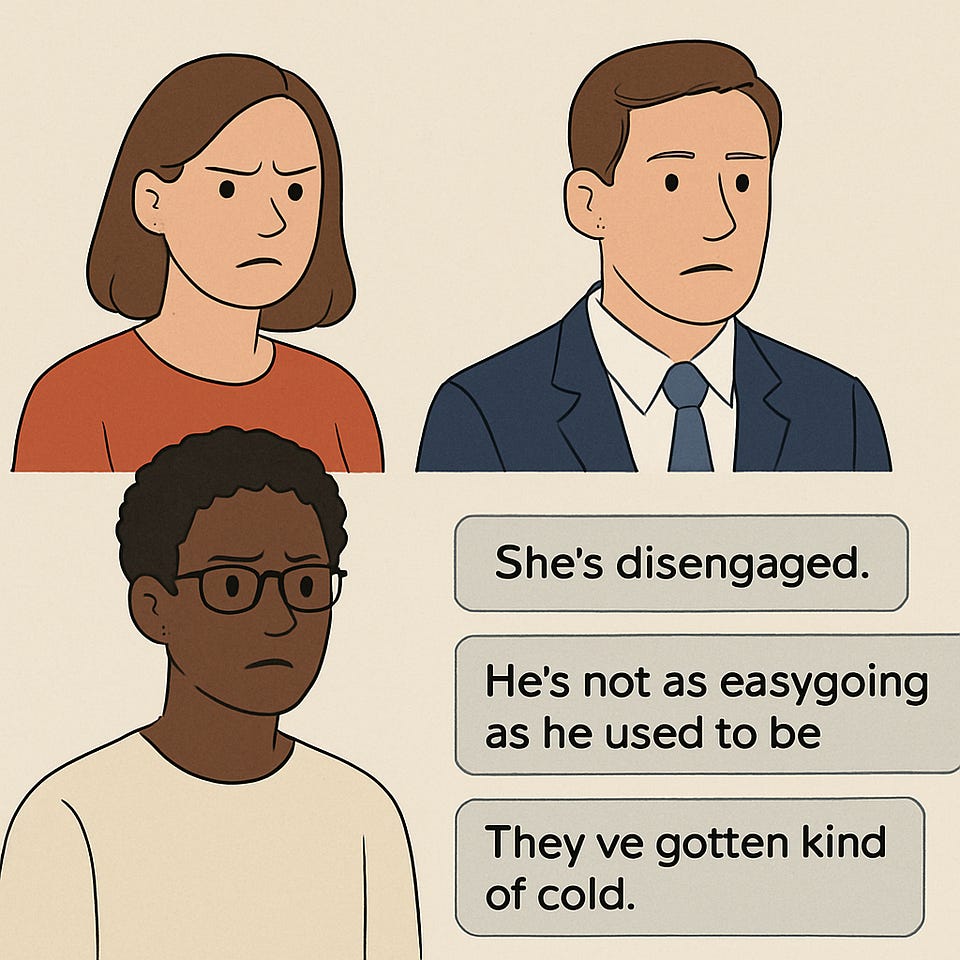
“She’s disengaged.” “He’s not as easygoing as he used to be.” “They’ve gotten kind of cold.”
Nothing about them changed.
They just stopped stretching to cover the gap.
This dynamic isn’t inevitable. But it is patterned.
Some people carry the hidden scaffolding that keeps systems stable.
That labor has names:
Emotional labor,1 glue work, and the social buffering that keeps a room calm.
And so does the logic that makes it disappear:
Professionalism. Maturity. “Low maintenance.”
These aren’t neutral terms. They’re scripts. They describe how people are expected to behave in order to stay safe, useful, or included.
In Undoing Gender (2004), Judith Butler argued that the demand to be recognized can reinforce social hierarchy and state power unless it challenges the norms that supply recognition. For Butler, gender is performance that is repeated and governed by norms. A similar mechanism plays out here: the recognition those scripts hand out lasts only as long as the performance is repeated, so the system rewards those who absorb drag and penalizes those who stop.
What looks like burnout is often just someone exiting a role that was never viable.
What looks like emotional volatility is sometimes the first honest signal the system has been running on silent labor.
We don’t call it effort until it stops.
We don’t call it work until no one is doing it.
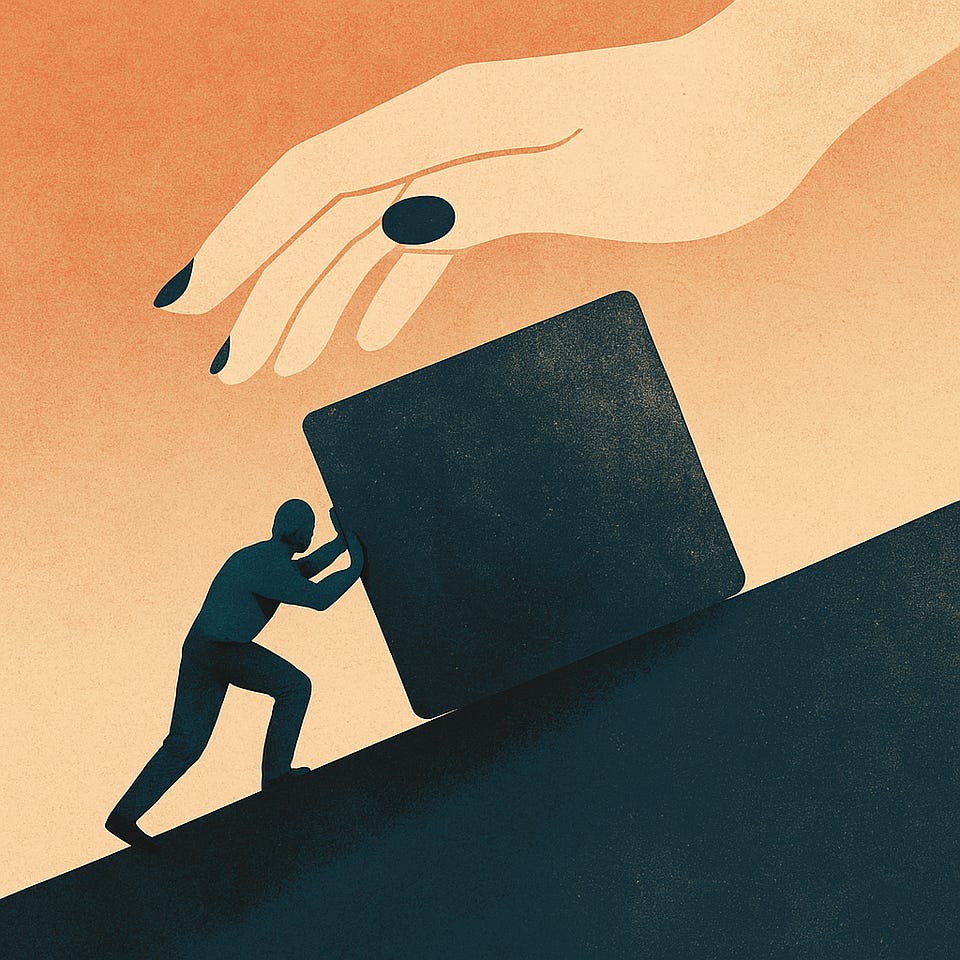
This isn’t a call for praise or better manners.
If a system relies on one person’s silent effort to function, it’s not working—it’s coasting.
So what now?
- If a task happens every week, log it.
- If someone’s the go-to for calming the room, rotate that role.
- If a system breaks when someone says “I can’t,” the system was already fragile.
If you’re someone whose ease is made possible by others’ emotional labor, take note.
You may be doing nothing wrong, and there’s still probably something invisible holding your comfort up. Look for it and make change.
And if you’re the one who’s been holding it together—
You’re not difficult or fragile.
You’re just tired of doing two jobs in one body.
That’s not a personal failing. That’s a signal.
Notes
This essay stands on the shoulders of people who named this long before I did. The care feminists who treated maintenance as political, the disability justice organizers who refused to separate emotional labor from survival, and many others.