From corporations and political parties to the algorithms that govern attention, we’ve mistaken survival for success. If something has lasted, we assume it must be doing something right.
But endurance often signals insulation rather than virtue. The longest-lived systems—oil companies, financial institutions, monopolistic tech platforms—survive not by merit but by making themselves irreplaceable. The damage they’d do by failing becomes the argument for keeping them, as the 2008 bank bailouts showed.
Survival is not a moral argument. It tells us only that something has found a way to persist, not what that persistence costs or who pays for it. A parasite survives by draining its host. A bureaucracy endures by making people replaceable. The most durable systems export their stress outward—onto workers, consumers, ecosystems, and future generations—and then call this resilience.
We confuse continuity with health because stability looks calm on the surface. But systems that never face consequence become brittle over time.
Resilience is the ability to recover rather than the absence of setbacks. A system that cannot adapt without breaking is rigid, whatever its size.
Sometimes endurance is just rot with good PR.

Lasting by removing whatever would test it
Without competition, a firm that has lasted has little reason to improve. When switching costs replace improvement, continuity becomes capture. The so-called Lindy effect mistakes age for virtue, assuming that whatever has endured must have some inherent quality. This logic fails when entities survive by eliminating the very forces that would test their worth.
Institutions deemed “too big to fail” survive by offloading mistakes onto the public. The 2008 financial crisis showed this dynamic with brutal clarity: banks gambled recklessly, triggered global collapse, then survived through bailouts while millions lost homes and savings.
Unrepaired flaws compound over time into structural pathologies. What began as a slight bias in hiring becomes, fifty years later, an organizational culture of discrimination. What started as a minor legal loophole becomes, across decades, a highway for corruption. The entity survives, but transforms into something toxic.
Dominant systems maintain power not by being better but by preventing “better” from emerging. Tech platforms acquire potential competitors before they pose real threats. Established industries lobby for regulations favoring incumbents. Both moves turn a head start into a monopoly.
As layers of dependence accumulate, replacing a failing system feels impossible. Every dependency adds weight: login credentials, legacy contracts, sunk-cost regulations. Often what looks like stability is a set of old harms that have become too costly to undo. Continuity turns into moral currency. The longer something survives, the harder it becomes to question, even after it’s stopped serving anyone but the people who run it.
Whole businesses then make money from keeping failing systems running, postponing their collapse by charging the people who depend on them. Climate adaptation gets rebranded as “stability protection,” translating a planetary emergency into fiscal terms. That looks less like repair than like accounting dressed up as ethics.
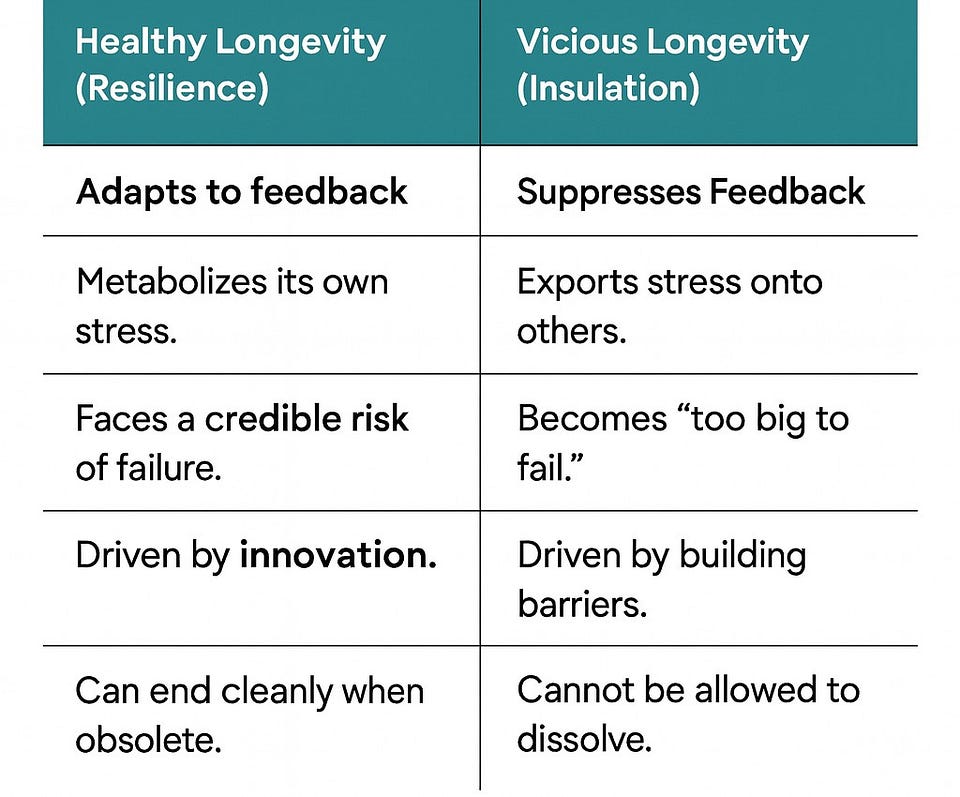
Measure a system by how well it learns
Can it correct itself without coercion? Can it end cleanly when its purpose expires? A just institution earns the right to endure only if it absorbs its own stress and remains accountable to those it affects.
The systems worth keeping are those that can heal, adapt, and—when the time comes—end with honesty.
Longevity should never count as proof of worth. It should prompt a question: what has the world had to pay for it?