There’s a comforting fiction under most institutional reform: the machine is cruel because it is blind.
If the executives only saw the burnout rates in the ICU, if the board only understood the bias in the training data, if the officials only heard the stories from the front lines, they would act. We treat dysfunction as a knowledge deficit.
The organization can see the harm perfectly well, and it has set its operations to tolerate a certain amount of it.1
In the data-saturated modern organization, assume maximum awareness as the working prior: the institution rarely lacks visibility into its own harms. When reporting has been delivered, warnings repeated, and correction tried and failed, “we did not know” stops being an explanation and becomes a claim that has to be defended.
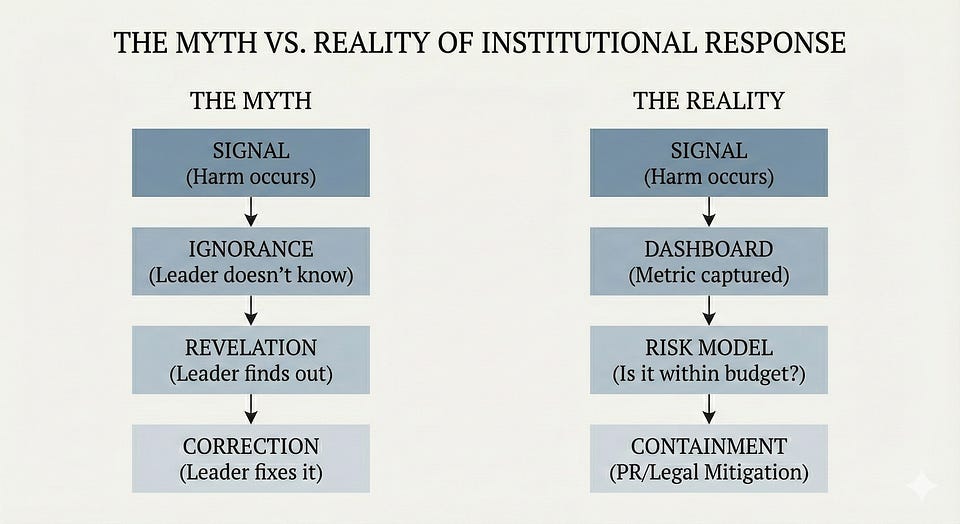
Harm that has been seen and priced
Large organizations now have industrialized telemetry capturing the granular reality of their operations in near real time.
Hospital administrators don’t need a nurse to tell them staffing is dangerous. They have dashboards showing nurse-to-patient ratios, call-light response times, medication error rates and readmissions, all trended against payroll. Platform executives don’t need a whistleblower to tell them the product harms teens. They have A/B tests, engagement heatmaps, churn models and sentiment analysis quantifying exactly how much psychological distress correlates with a 5% lift in ad revenue. Warehouse managers know exactly how many workers are skipping bathroom breaks. The productivity software flags “time off task” to the second.
The data exists. It is collected, cleaned, stored and visualized. The problem isn’t that it doesn’t reach the top. The problem is what happens when it gets there.
The Ignorance Hypothesis, leadership unaware of ground truth, might have been true fifty years ago. An institution that has arranged not to know has already chosen. But the telemetry cuts the other way too: a dashboard that has been read is not a decision that has been changed, and coordinated calculation is a further step from data arriving at the top. Once the numbers exist, the burden of proof moves to whoever claims ignorance, whatever any particular boardroom knew.2
If you assume the problem is ignorance, you assume knowledge plus power equals action.
In a tragic institution, one that sees the harm clearly and accepts it as a cost, the formula is different: knowledge plus power equals pricing.
When leadership reviews data on harm, they rarely see a moral crisis to solve. They see a variable to manage. They’re looking for the tolerable harm band.

View source
%% title: The staffing dashboard that becomes a budget line
%% caption: Hospital administrators can see dangerous staffing on the dashboard, and the numbers go into the budget as a priced cost. Short staffing stays while settlements and attrition cost less than fixing it, and a union grievance that raises that cost is what moves it toward repair.
flowchart TD
  classDef actor stroke-width:1.6px;
  classDef system stroke-width:1.2px;
  classDef gate stroke-width:1.6px;
  classDef binding stroke-width:3px,font-weight:bold;
  classDef status stroke-dasharray:4 3;
  classDef burden stroke-width:2px;
  classDef repair stroke-width:2.4px,font-weight:bold;
  classDef failure stroke-width:2.2px,stroke-dasharray:6 3;

  T["Dashboard: nurse ratios,<br/>call-light response times"]:::system --> V["Administrators see<br/>dangerous staffing"]:::system
  V --> P["Burnout becomes a<br/>recruitment budget line"]:::system
  P --> B{"Settlements and attrition<br/>cheaper than fixing staffing?"}:::gate
  B -- "yes" --> O(["Priced in: short staffing<br/>as an operating expense"]):::status
  O -.-> S["Patient death goes public:<br/>‘deeply concerned’"]:::system
  S -.-> N["Listening tour,<br/>task force, small tweaks"]:::system
  N -.-> O
  B == "no" ==> C[["Union grievance raises<br/>the cost of short staffing"]]:::binding
  C ==> R(["Repair: staffing<br/>redesigned on the ward"]):::repair
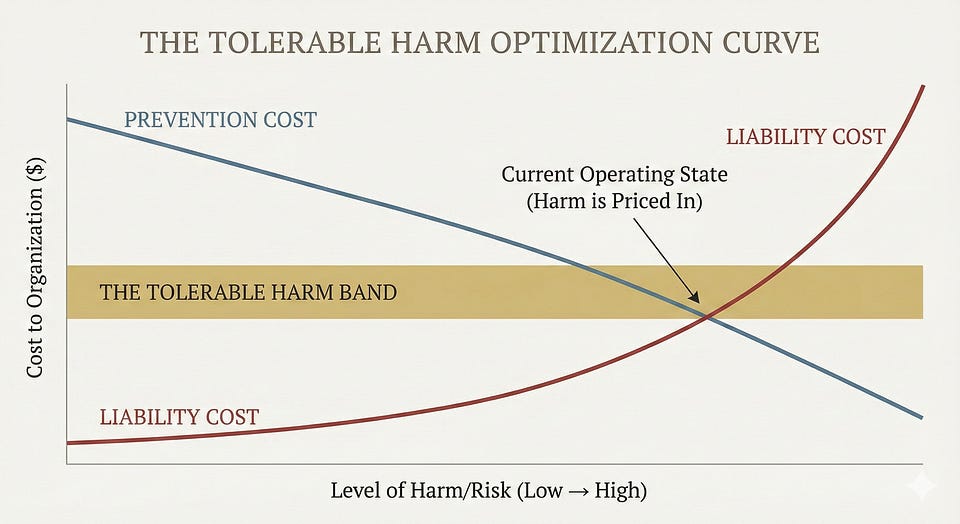
They ask the rational questions of their role. Is this illegal, or just regulatory gray zone? Will this cause a PR crisis, or just low-level complaints? Does the cost of fixing it exceed the cost of settling the lawsuits?
Once the harm sits inside the tolerable band, where settlements, attrition and bad press cost less than structural change, the harm is priced in.
The burnout rate is a budget line for recruitment. The safety violations are the calculated yield of an efficiency model.
Call it the banality of optimization. Fiduciaries doing their legal job: maximizing value inside the constraints of risk.
The ritual of surprise
Institutions this aware still look shocked when the scandal breaks.
They look shocked because surprise is a legal and reputational necessity.
When a crisis goes public (a data leak, a walkout, a patient death), leadership performs the ritual of surprise. Statements about being “deeply concerned.” “Independent investigations” to “get to the bottom of this.”
The performance shields liability: admitting “we knew this would happen” creates legal exposure, negligence or malice, while “we were unaware” preserves the defense of incompetence, which is legally safer than complicity. It also preserves the ignorance myth, inviting the public and the workforce back into the comfortable fantasy. Now that we know, surely we will fix it.
It resets the clock. It buys another cycle of listening tours and task forces that end in performative tweaks instead of structural redesign.3
Stop teaching, start negotiating
If you believe the Ignorance Hypothesis, you spend your energy on education. Longer memos, more heartbreaking stories, “raising awareness.” You exhaust yourself teaching a lesson that’s already been learned.
Accept maximum awareness and you realize education is a trap.
You stop trying to inform leadership of the costs. You accept that they’ve already calculated the costs and decided you’re going to pay them.
That moves your strategy from pedagogy to leverage. You do not write a memo about “moral distress”; you file a union grievance about unsafe working conditions. You do not explain why a product is unethical; you refuse to sign the compliance certificate that lets it launch. You do not appeal to their better angels; you raise the material cost of the status quo until it is no longer priced in.
Assuming maximum awareness is painful, because it means admitting the people in charge are comfortable with the damage they are doing.
It is also liberating. It lets you see the terrain:
You are not a teacher in a classroom of confused pupils.
You are a negotiator in a room where the other side has already run the numbers against you.4
Notes
Diane Vaughan’s The Challenger Launch Decision (University of Chicago Press, 1996) is the strongest version of that comfort. Normalization of deviance is a structural drift in which every step looks reasonable and nobody chooses the outcome. From inside an institution the two cases are hard to tell apart, and that difficulty is part of the argument. Where the pattern repeats across scandals, survives audits, and prices out cleanly, stop extending the benefit of the doubt. Treat that as a reading prior rather than a factual claim about any particular boardroom: assume awareness first, because the cost of being wrong differs by direction.
Robert N. Proctor and Londa Schiebinger, eds., Agnotology: The Making and Unmaking of Ignorance (Stanford University Press, 2008), names the study of culturally produced ignorance. Ignorance as an achievement, someone’s work. The Ignorance Hypothesis is that field’s target, and the ritual of surprise below is its public-relations arm.
John W. Meyer and Brian Rowan, “Institutionalized Organizations: Formal Structure as Myth and Ceremony,” American Journal of Sociology 83, no. 2 (1977), describe organizations that decouple formal structure from practice, keeping a ceremonial layer for legitimacy while the real operation runs underneath. The listening tour and the task force are that layer, procured on demand.
Tragic institutionalism is the premise the corrigibility essays build on. Forgiveness Is for the First Mistake turns it into a gradient: uncertainty is a defense that depreciates as the evidence arrives, and an institution that has arranged not to know has made the first theft. Crackdowns and Task Forces Are One Policy draws the strategy of leverage that follows once the numbers have been run.