First Amendment: The right to free speech and assembly will technically remain intact, but the practical reality will see public discourse increasingly controlled by those with access to wealth and media ownership. While the government may not directly suppress speech, the dominance of corporate media and wealthy individuals in shaping narratives will silence marginalized voices, particularly those advocating for systemic change. Religious freedom will be upheld but, in some cases, leveraged as a tool to restrict the rights of others—especially on contentious issues like reproductive justice and LGBTQ+ rights. While not universal, this dynamic highlights how the balance of influence skews in favor of those with power.
Second Amendment: The right to bear arms will persist, but the tangible benefits will disproportionately favor the gun industry and individuals who can afford extensive security measures. Marginalized communities, however, will face the brunt of gun violence, as inadequate state protections leave them vulnerable. This will create a paradox where the right to self-defense is more accessible to the wealthy, while the poor experience a cycle of violence and over-policing rather than meaningful protection. Although not uniformly experienced, the socioeconomic divide will continue to influence who truly benefits from this amendment.
Third Amendment: While the literal quartering of soldiers in homes may no longer be a concern, the state's invasion of privacy has evolved into mass surveillance, digital tracking, and data collection—ostensibly for national security but often serving corporate interests. The wealthiest citizens will be shielded by private property rights and digital protections that are less accessible to the average person. Though the extent of surveillance may vary, the state's increasing reach into personal privacy will generally favor the powerful while further entrenching inequalities.
Fourth Amendment: Protections against unreasonable searches and seizures will theoretically apply to all, but in practice, those challenging established power structures or living in marginalized communities will experience heightened surveillance and policing. National security justifications will erode privacy rights, especially for Black and Brown communities disproportionately subjected to aggressive law enforcement tactics. While the privileged may navigate these systems with fewer repercussions, the racial and class disparities in law enforcement will persist, making the promise of protection uneven.
Fifth Amendment: The right to due process will exist, but access to meaningful legal defense will depend heavily on one's financial resources. For the wealthy, justice will be accessible, while the poor will face a system defined by coercive plea bargains and underfunded legal representation, diluting the principle of fairness. Additionally, eminent domain will continue to prioritize private developers, displacing low-income communities under the guise of public good. This imbalance will disproportionately affect the most vulnerable, though not all communities will experience displacement to the same degree.
Sixth Amendment: The right to a fair trial will remain a constitutional guarantee, but systemic inequalities will ensure it is a reality mainly for those with financial means. Public defenders will be overburdened, leading to coerced plea deals for the poor, who may feel compelled to plead guilty even when innocent. Systemic biases, particularly along racial and class lines, will continue to skew trial outcomes. Though some may receive a fair trial, these disparities will make justice far less attainable for marginalized communities.
Seventh Amendment: While the right to a jury trial in civil cases will still be formally recognized, corporations will increasingly use forced arbitration clauses in contracts to strip away this protection from workers and consumers. This trend will ensure that corporate interests are safeguarded from public scrutiny and accountability, effectively undermining the intended protections of the amendment. Although not universal, forced arbitration will significantly limit access to justice for many.
Eighth Amendment: Though the prohibition on cruel and unusual punishment will technically remain, its application will often fail to address the lived realities of poor and marginalized individuals. Overcrowded prisons, solitary confinement, and capital punishment will persist, disproportionately affecting Black and Brown populations and reinforcing mass incarceration. While these practices may not impact all equally, they highlight the ways in which punitive measures disproportionately target vulnerable communities, often with tacit state approval.
Ninth Amendment: The unenumerated rights intended to protect essential freedoms will largely go unrecognized in practice, as courts interpret them narrowly, often to the detriment of marginalized groups. Rights to healthcare, housing, and education will remain underdeveloped and largely unprotected, with corporate interests and conservative judicial rulings acting as major obstacles to their realization. While some limited expansions of rights may occur, the broader structural barriers will prevent meaningful social protections from being fully implemented.
Tenth Amendment: The powers reserved to the states will allow for varying interpretations of rights, often enabling resistance to progressive federal policies. States with entrenched conservative leadership will uphold laws that perpetuate voter suppression, weaken labor protections, and restrict reproductive rights, while wealthier states may implement more equitable policies. This uneven distribution of rights will deepen existing inequalities, though the extent of these disparities will depend on state-level governance. The patchwork of rights across the country will ensure that wealth and geography dictate the degree of equality and justice individuals can expect.
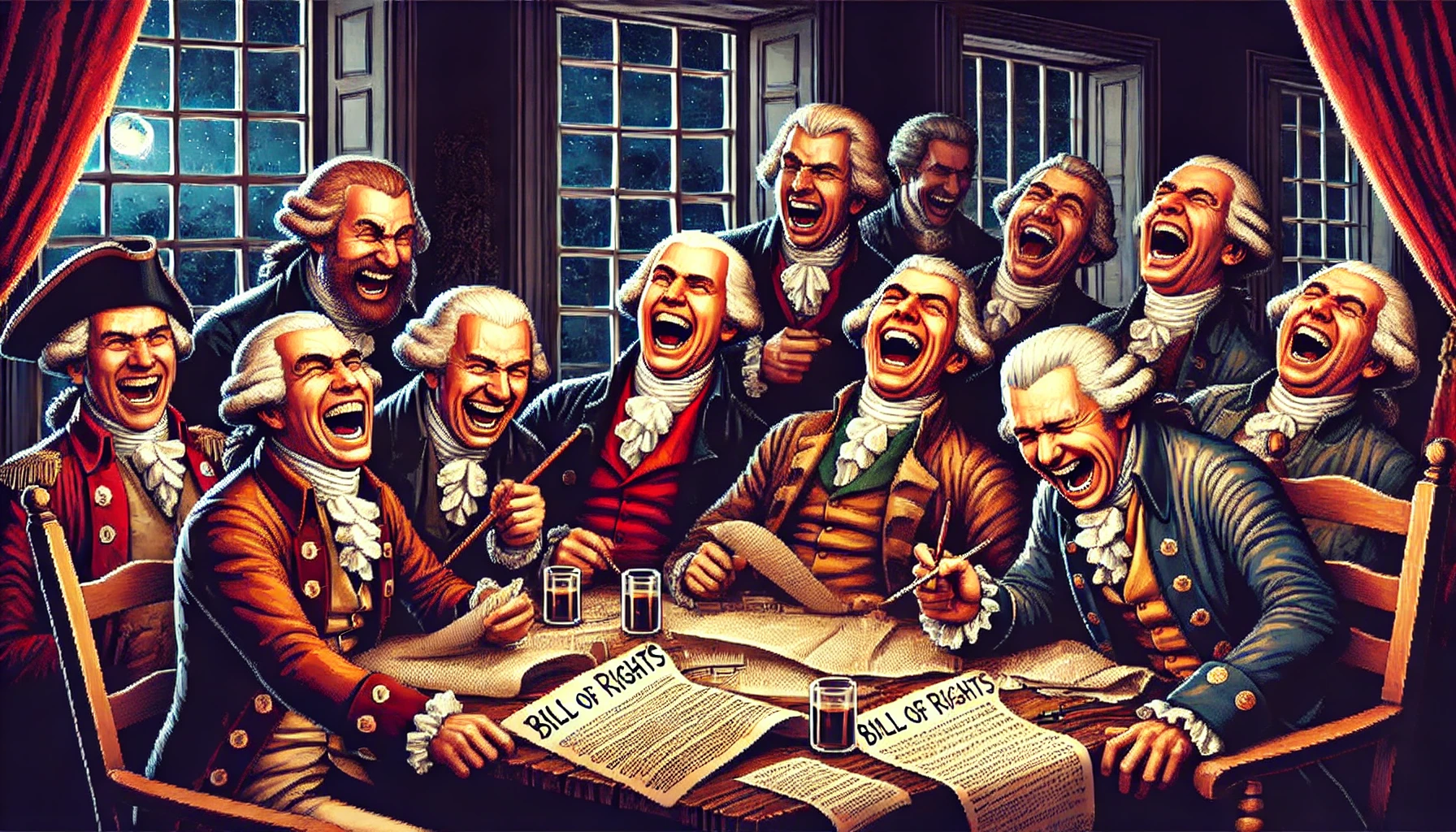
This reframed Bill of Rights exposes the systemic inequalities beneath theoretically universal rights, revealing how they primarily serve the wealthy and powerful.