You open your phone to check the news; twenty minutes later you’re overstimulated and underinformed.
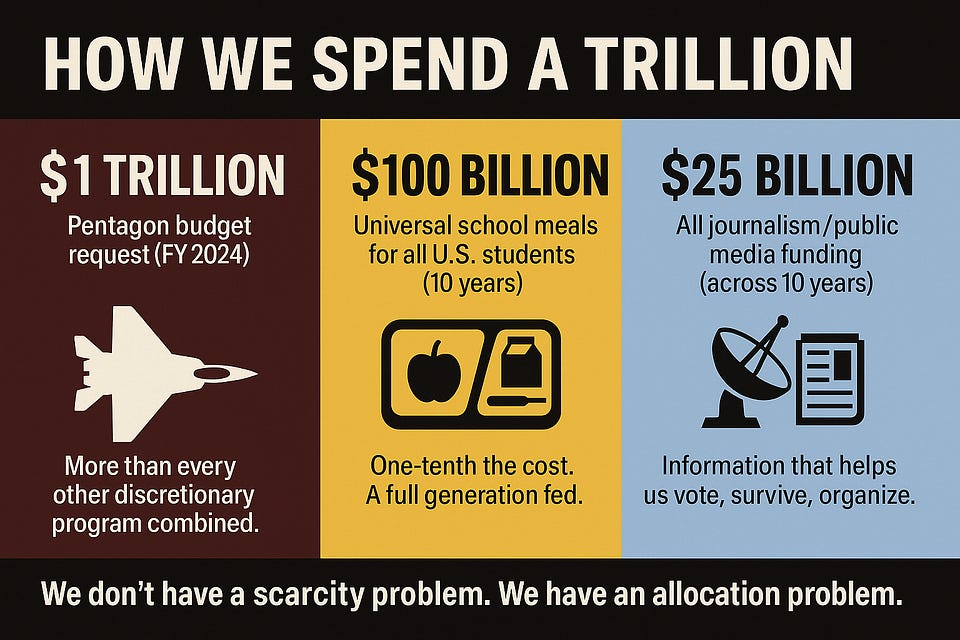
A trillion-dollar budget scrolls by, but there’s no sense of what it costs your household. Wildfire footage loops without emissions context. “Unprecedented” flashes for the fifth time this month.
You close the app with more anxiety than understanding.
That feeling follows from how news is now paid for.
When subscription loyalty gave way to ad-tech targeting, journalism’s business model inverted. The goal stopped being comprehension and shifted to retention: how long a story could keep your eyes fixed.
Alarming stories hold attention longer than explanatory ones.
Headlines could stay accurate while leaving readers with nothing to act on.
Yet the muscle memory of public-minded reporting isn’t lost. Once, budget coverage routinely translated figures into per-capita costs. Local journalists traced zoning policies to eviction spikes. Evening anchors unfolded war fronts on studio-floor maps. Their job was to equip people as well as alert them. That instinct won’t survive the decade unless we fund it, scale it, and demand it.
Drills that restore clarity
In practice, it starts with five drills:
1. Translate scale
Lead every major dollar figure with its per-household cost. A trillion works out to roughly $7,800 per U.S. household, which turns noise into a decision a reader can weigh.
2. Show the curve
Don’t report static numbers—report growth rates. “Cases are doubling every nine days” teaches more clearly than “28,000 new infections.”
3. Date the damage
Tag climate stories with emission dates. “This flood traces back to coal burned in 1991.” Memory sharpens when cause meets effect.
4. Name a life
Pair every statistic with a named story. It keeps data from numbing us.
5. Back-cast the deadline
End speculative tech stories by tracing the conditions needed to avoid disaster. “To achieve safe AI by 2125, liability reform must begin by 2050.”
The instinct behind them already survives in practice. ProPublica tracks policy change post-publication. The Dutch platform De Correspondent reports on the slow, structural developments that shape society rather than the daily news cycle.
During the pandemic, the Financial Times showed the curve: it became a global benchmark because it charted exponential growth with clarity. People trusted the FT to tell them what was actually happening.
But we should be alarmed that one legacy outlet carries so much of the burden. If precise reporting becomes a product only some readers buy, the rest get the confusing version by default. They are the ones who then make health and money decisions on it.
Churn pays, clarity doesn’t
Outrage is easy, fast, and cheap to scale. Context—policy tracing, data timelines, long-run accountability—requires resources that hedge-fund owners and SEO-chasing startups won’t fund. Clarity slows output, so clarity gets cut.
If public orientation is a public good, it needs public-good infrastructure: co-ops, municipal underwriting, nonprofit endowments, university partnerships. All weaken ad-driven acceleration without requiring a utopia.
And we need new performance metrics—not “monthly uniques,” but comprehension retention.
How many readers can explain a piece the next day?
How many can name its core facts and sources?
Almost no outlet asks those questions, let alone answers them.
Not only a media problem
I feel coherence like others feel temperature—subtle until it’s uncomfortable. As an autistic person and former product builder, I know how interface choices shape mass behavior, and “clicks over comprehension” produces disorientation at the scale of a whole public.
If you run a newsroom, stamp per-household costs on your next budget story. Date-stamp emissions in wildfire coverage. Publish the results: what changed, who complained, who learned something new, so other newsrooms can copy what worked.
If you’re a reader, vote with your attention. Subscribe to outlets that leave you better able to explain what you read. Unsubscribe from what leaves only cortisol behind. Each click trains the system. Each subscription funds one future over another.
We can keep paying for the panic loop with our clicks, or we can pay for newsrooms that run these five drills.
I love your perceptive and yet also straight-to-the-point writing, your great summary graphics, and how your work can on-ramp people into more radical political ideas without feeling inaccessible. I hope more people find your newsletter!
Comment by Devon
We know the pressure points!
We have the tools to push them.
All that remains is to choose where to press.
P.S. Some of my favorite writing on news, journalism, and human-computer interfaces comes from none other than my fiancée aditi in her blog Casting a Wide Net, and I hope you give it a read!

for curious minds navigating choppy waters...
By aditi