Alternative journalism sells itself as a counterweight to corporate media and promises a democratic voice. But nonprofit newsrooms and crowdfunded platforms stay tangled up in the capitalist structures they claim to oppose. They offer incremental reforms that reassure their mostly affluent readers while keeping the financial dependencies that stop them from challenging the structures that fund them.
Backers set the limits of independence
Editorial independence is alternative journalism’s central myth. Outlets like The Intercept, launched with a mission of adversarial journalism, were first seen as breakthroughs against corporate influence. But billionaire Pierre Omidyar backed The Intercept from its founding. In 2020 co-founder Glenn Greenwald publicly resigned, accusing the outlet of editorial interference on a piece critical of Joe Biden. The episode showed how even the most radical platforms stay tethered to the interests of their financial backers, whose priorities can shape what gets published.
The Intercept has kept drawing criticism for editorial decisions that expose the tension between its original mission and the realities of donor-funded media. It isn’t alone. Vox Media is partly owned by NBCUniversal, a corporation with large investments in mainstream media. Vox presents itself as an explainer outlet covering wealth inequality and social justice, but it seldom critiques corporate media monopolies or NBC itself.
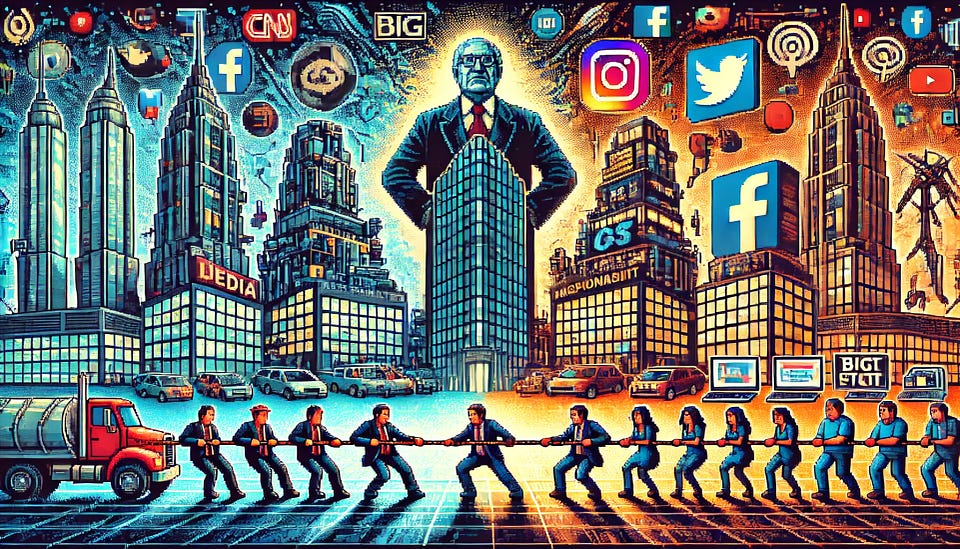
Even Open Democracy, which publishes sharp critiques of corporate power and neoliberalism, avoids targeting the philanthrocapitalist structures that fund it. Its backers include the Open Society Foundations. As long as alternative outlets rely on donors inside the system they want to dismantle, their independence is compromised.
Paying readers and paying foundations
Alternative journalism leans more and more on subscriptions and reader support, and these models have limits. The Guardian gets praise for keeping its journalism free of paywalls by relying on reader donations. That lets it reach a broader audience, but its donor base skews wealthy and progressive. The feedback loop pushes The Guardian to cater to affluent, educated readers and to avoid the more radical critiques that might alienate them.
Substack extended the subscription model further, letting journalists like Matt Taibbi, Bari Weiss, and Glenn Greenwald build independent ventures. But these platforms mostly serve people who can afford to pay for content, and that leaves out working-class audiences.
De Correspondent, once held up as the model for reader-funded journalism, closed its English-language edition because of financial trouble. Its subscribers, mostly middle-class progressives, couldn’t sustain it over the long term.
Depending on wealthy donors is another obstacle to editorial independence. ProPublica is known for critical reporting on tax evasion and corporate malfeasance. But its funding from foundations such as the Sandler Foundation and the MacArthur Foundation limits how far it can go: it can expose tax evasion, but it avoids challenging the structures that let billionaires amass such wealth in the first place.
In 2022, The Intercept and ProPublica reported on how philanthropies fund initiatives to keep influence in sectors like healthcare and education. That only underlines how embedded these outlets are in the wider capitalist infrastructure. The Marshall Project, which covers criminal justice reform, is funded by the Chan Zuckerberg Initiative and the MacArthur Foundation. Its work on mass incarceration and police reform is valuable, but its ties to Silicon Valley elites mean it rarely addresses the tech industry’s part in worsening surveillance and injustice.
Even NPR, often treated as a model of impartiality, relies heavily on corporate sponsorships from companies like General Motors and on grants from the Bill & Melinda Gates Foundation. Some of that foundation money is earmarked for coverage of subjects the funder chooses. The earmarks leave NPR open to the charge that donors shape what it reports. In July 2024, Sen. Ted Cruz wrote to NPR alleging that the timing and content of some of its articles aligned with earmarked foundation donations, including a Gates Foundation gift for global health coverage.
Audiences and clicks shape the coverage
Substack fragments the media, isolating journalists in ideological silos where they have to cater to paying audiences. Greenwald’s newsletter, for example, often mirrors the views of his libertarian-leaning audience, which limits the range of critical perspectives he can offer without alienating it.
The Red Scare podcast, known for contrarian takes on politics and culture, shows how niche audiences shape and constrain content. The podcast has a loyal following, and the loyalty is limiting. The hosts have to keep producing content that fits their listeners’ ideological preferences, and that makes it harder for them to move into more diverse, radical critiques.
Larger outlets like The Young Turks (TYT) have also faced pressure to compromise their independence. After taking a $20 million investment led by a venture capital firm in 2017, TYT softened its tone on certain issues, a sign that scaling alternative journalism often costs it independence. TYT has since struggled to balance its identity as an independent outlet with the demands of corporate backers and a fragmented audience.
Even the most independent outlets have to deal with the attention economy. YouTube, Facebook, and Twitter shape what gets produced and shared, rewarding short, clickable, sensational content over long-form investigative reporting. Democracy Now!, for instance, has to cut its long interviews into bite-sized clips to stay visible on social media. The platforms extend Democracy Now!’s reach, but they also help commodify journalism and force independent outlets to play by Big Tech’s rules.
Vice Media declared bankruptcy in 2023 after years of trying to reconcile its editorial mission with the demands of the attention economy. Once known for immersive, edgy journalism, Vice came to depend on viral content and shifted from in-depth reporting to click-driven stories built for shares and engagement. Despite its huge audience, Vice couldn’t sustain its financial model in a market that rewards quick clicks over substantive journalism.
Reform that leaves the roots alone
Alternative journalism’s most pervasive problem is incrementalism. HuffPost regularly covers police violence and systemic racism, but the solutions it proposes, such as body cameras or diversity training, rarely leave the liberal reformist playbook. Radical alternatives like police abolition or wealth redistribution seldom get taken seriously. The New York Times’ Climate Desk likewise focuses on individual actions, such as reducing personal carbon footprints. It fails to hold corporations and the wider capitalist system accountable for environmental destruction.
ProPublica and The New York Times have been praised for investigations into tax evasion and climate change. But these stories usually call for better enforcement of existing laws rather than going after the structural inequalities that make corporate exploitation and wealth accumulation possible.
Running on Big Tech’s infrastructure
Big Tech’s control of the digital infrastructure alternative media runs on is another problem. An outlet that hosts its website on a cloud platform such as Amazon Web Services (AWS) is at the mercy of the company that runs a platform it can’t survive without. When AWS shut down the far-right platform Parler in 2021, it showed how dependent any outlet on that infrastructure is, progressive or not. An outlet can keep its editorial independence and still be exposed to censorship, content moderation, or sudden service disruptions through that infrastructure. The dependence extends to Google, Facebook, and Apple, which act as gatekeepers for distributing news to millions.
Google’s control of digital advertising is a particular problem for independent journalism. Many independent outlets depend on Google’s advertising products for revenue and have to follow its content guidelines and algorithms. That dependence puts their income at the discretion of a company whose rules they don’t write. Independent video makers carry the same exposure on YouTube. In February 2021 it demonetized several independent channels and journalists at once with only vague policy reasons.
Blockchain platforms like Civil promised to revolutionize journalism with decentralized, community-supported models. Civil collapsed in 2020 after it couldn’t generate enough interest in its token economy. Its failure showed the limits of decentralized technology that leaves the underlying problem of paying for journalism unsolved.
Mastodon and Diaspora, decentralized alternatives to Facebook and Twitter, have struggled to attract mainstream audiences. They have dedicated users but can’t match Big Tech’s scale and resources. That leaves alternative outlets with a bad choice: stay on mainstream platforms with more reach and less control, or move to decentralized ones that limit visibility and engagement.
A reformist force, not a revolutionary one
Newsroom unionization is an important step forward for workers, but it can’t fix the larger financial pressures on digital media. Union drives at BuzzFeed, Vox Media, and The New York Times have won better wages and working conditions for journalists. The economics of digital media haven’t changed.
BuzzFeed News was shut down in 2023 anyway, largely because of financial instability. Unionized newsrooms aren’t immune to the demands of profitability and venture capital.
As long as alternative journalism depends on the same financial structures as corporate media, it will be a reformist force rather than a revolutionary one.
Getting past these limits takes systemic change. Journalism’s job is holding power accountable, amplifying marginalized voices, and helping build a more just and equitable society. It can do that job only once the root causes of media inequality are dealt with: capitalist control, consolidation, and information turned into a commodity.
Breaking up the monopolies
Big Tech’s dominance of both digital infrastructure and the attention economy is one of the largest barriers to independent journalism. Google, Facebook, and Amazon control how news is produced, distributed, and monetized. Freeing journalism from these monopolies takes strong antitrust legislation that limits how far a few corporations can dominate public discourse.
In 2023, calls to break up Big Tech got louder as more evidence came out of monopolistic practices and of the companies’ hold on public communication. Legislators in the U.S. and the EU have introduced antitrust measures aimed at the largest tech firms. The measures could mark a turning point for media and information. Breaking up Big Tech would make room for alternative platforms and decentralize control over the flow of information. No single company could then dictate which stories get told or whose voices get heard.
Decentralization has to reach the technology as well as the ownership, so that outlets can operate without answering to corporate gatekeepers. That could mean investing in open-source technology, building cooperative media platforms, and expanding digital public infrastructure.
Public and cooperative ownership
The future of independent journalism lies in public ownership, free of the financial pressures of advertising, donors, and venture capital. Publicly funded journalism under democratic governance can be a sustainable alternative to both corporate and donor-driven media.
Worker-owned media cooperatives offer a more democratic approach too. The Bristol Cable in the UK has experimented with a cooperative model in which workers and community members decide content and direction together. Such models are small for now, but they show what a more equitable media system could look like, one that puts workers and the public ahead of profit margins.
Publicly funded media has long been held up as an ideal, but it needs to grow a great deal to counter corporate media monopolies. The UK and Canada have public broadcasters, the BBC and CBC, which for all their limitations show what media funded by and accountable to the public can do. Extending that model from broadcasting into digital journalism could be a lifeline for outlets struggling under capitalist pressure.
Alongside public funding, collective financing, such as community subscriptions, cooperatively owned platforms, and grassroots donations, can support journalism more democratically. These models move power away from corporations and wealthy donors, letting outlets keep their editorial independence and focus on what matters most to the communities they serve.
Incremental reforms like crowdfunding individual pieces, launching a lone cooperative outlet, or diversifying newsroom staff are steps in the right direction. But they leave the basic problems of journalism under capitalism in place.
Alternative journalism has to refuse the temporary fixes and quick wins that keep the status quo going, and push for publicly owned, cooperatively run journalism that answers to people rather than profit.