Books like Atomic Habits sell the power of small, incremental habits. That can help many people build routines that last, but it often backfires for neurodivergent people who struggle with executive dysfunction, motivation and consistency.
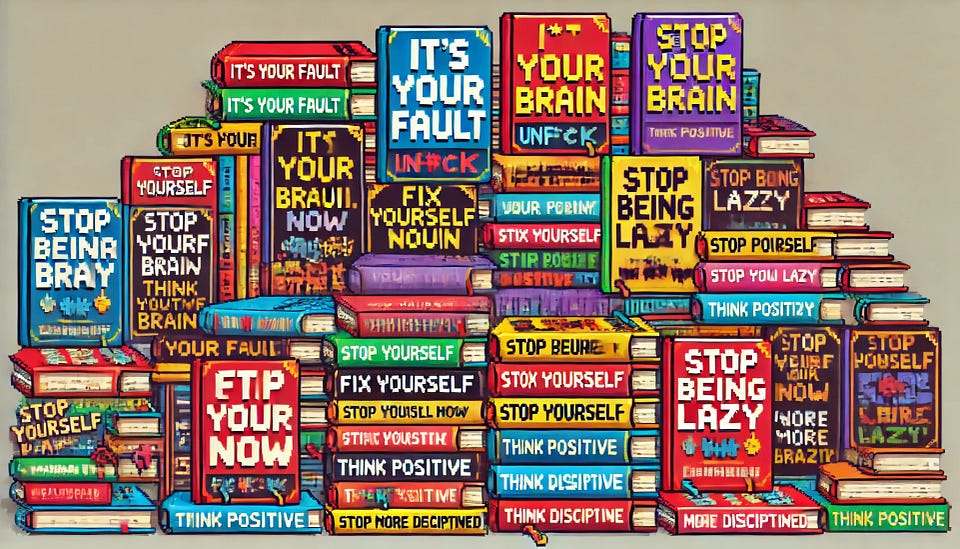
For someone with ADHD or autism, keeping up even simple habits can be a constant fight, and the failures turn into damaging self-talk:
“I’m lazy because I can’t stick to basic routines,” or “If I fail to maintain this habit streak, I’ve ruined my chance at success.”
Atomic Habits and books like it treat success as mostly a matter of well-designed systems and consistency, and ignore the neurological factors that make habit formation much harder for some people. Their systems assume neurotypical executive function, so when one breaks down, the breakdown reads as a personal failing. That feeds perfectionism, where every lapse from the ideal routine becomes a reason for guilt and self-blame, and neurodivergent people get stuck trying and failing, each failure confirming that they are inadequate.
We can help neurodivergent individuals develop healthier self-talk patterns, grounded in self-acceptance and well-being rather than conformity and self-blame.
Every lapse becomes evidence against the self
Mark Manson’s The Subtle Art of Not Giving a F*ck tells readers to care only about what matters and detach from things that don’t. Some people find that useful, but it can hurt neurodivergent people, particularly those who already struggle with emotional regulation. For someone on the autism spectrum, it can turn into this:
“Why am I so sensitive? I should stop caring so much.”
Emotional resilience matters, but this approach teaches neurodivergent people to suppress or discount what they actually feel. Neurodivergent people often process emotions differently or more intensely than neurotypicals, and pushing them to detach can lead to long-term burnout and make it harder for them to connect with others.
Productivity systems like Tiago Forte’s Building a Second Brain, and advice from creators like Ali Abdaal, tend to glorify efficiency and output. For neurodivergent people, especially those with ADHD or sensory sensitivities, the pressure to be constantly productive can be overwhelming and unrealistic. The distorted self-talk sounds like:
“I’m falling behind because I’m not productive enough,” or “If I just stuck to my schedule better, I’d be more successful.”
These systems tie self-worth to productivity, which drives neurodivergent people to overwork or to feel like failures when they can’t meet neurotypical standards of output. The chase for efficiency leaves no room for rest, sensory regulation or emotional well-being, and ends in exhaustion and burnout.
Rhonda Byrne’s The Secret promotes the Law of Attraction: think positively and good things come, think negatively and you cause your own problems. For neurodivergent people, who may already face systemic barriers, discrimination or cognitive challenges, this becomes self-blame. The internal dialogue sounds like:
“If I weren’t so negative, everything would be fine,” or “It’s my fault things are going wrong because I’m not thinking positively enough.”
Advice like this plays down the real external difficulties neurodivergent people face and reinforces internalized ableism. It implies people have total control over their circumstances, which is especially cruel to those facing obstacles they can’t control. Too often it ends in deeper frustration and helplessness when positive thinking doesn’t magically fix anything.
Mainstream self-improvement tells people to change or “fix” their perceived flaws so they fit social norms. For neurodivergent people, that becomes the belief that they have to mask their true selves to fit in. An autistic person might think:
“I need to stop acting this way or people will think I’m weird,” or “If I don’t fit in, it’s my fault for not trying hard enough.”
Masking, hiding neurodivergent traits to seem more neurotypical, is linked to serious emotional exhaustion and mental health problems. Pretending to be someone else all the time can’t be sustained, and it confirms the belief that being neurodivergent is something to hide or fix before you can be socially acceptable.
Neurotypical therapy repeats the pattern
Traditional therapy does the same thing. Cognitive Behavioral Therapy (CBT), for instance, works by reframing “irrational” thoughts and changing negative thinking patterns. That helps some people, but it can frustrate neurodivergent people whose thought processes aren’t irrational at all and reflect real neurological differences. Black-and-white thinking is common among autistic people, and CBT’s push to change it can feel invalidating instead of supportive.
Therapies that emphasize social conformity, such as making eye contact or making small talk, push neurodivergent people further into masking, and deepen their isolation and exhaustion.
Masking Is a Property of the Room, Not the Person
For many autistic individuals, navigating social environments often involves a delicate balance between masking and unmasking their true selves. Masking refers to the conscious or unconscious suppression of natural behaviors to align with societal norms, while unmasking allows for authentic self-expression without external pressures.
The legal system runs the same default with higher stakes. What If Courts Assumed Anyone Might Be Autistic? asks what a legal order built for unmasked minds does to the people who mask to survive it.
Support that starts from the difference
Self-help frameworks and therapy need to become neurodiversity-affirming: to acknowledge cognitive differences and to value self-acceptance over the pursuit of neurotypical ideals.
Habit formation, emotional regulation and productivity can look different for neurodivergent people. Instead of rigid frameworks that demand perfection or consistency, strategies should allow flexibility, show compassion and accommodate cognitive challenges, and neurodivergent people should be free to set their own standards for success based on what they need.
Self-help and therapy should stop encouraging masking and the erasure of neurodivergent traits. Neurodivergent individuals should be free to accept their differences without pressure to conform. That would reduce the burnout linked to masking and give people a stronger sense of self-worth and belonging.
Neurodivergent people often face external barriers: discrimination, inaccessibility, systemic oppression. Self-help frameworks and therapy have to account for them instead of framing success as purely a matter of mindset or effort.