A system can make fewer mistakes and still leave people worse off when it makes one. Counting how often harm starts tells you nothing about how long a person stays stuck in it.
Incidence is new cases over a period. It’s one measure, not a synonym for every statistic about progress; prevalence also reflects how long conditions last.1 The narrower problem is a report that counts new failures and leaves out time to relief. Its numbers can improve while the experience of the people still waiting gets worse.
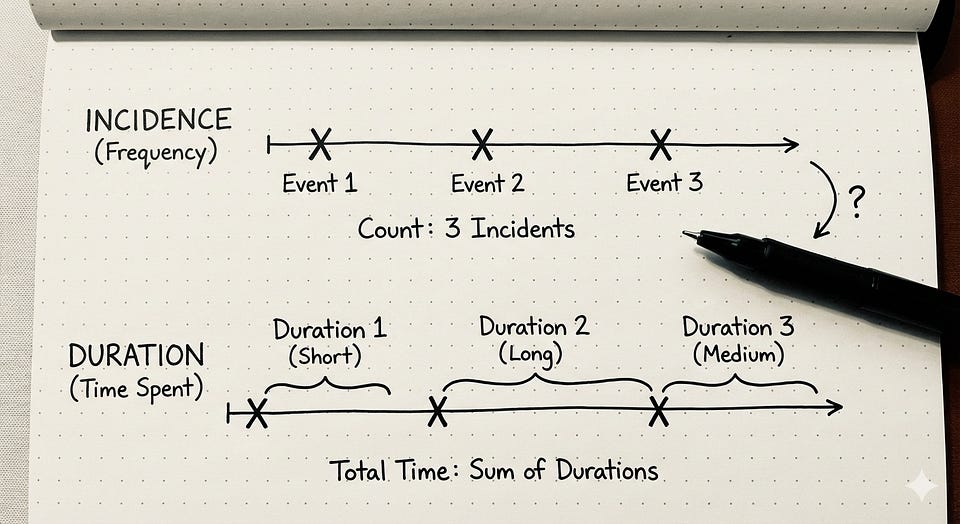
A frozen bank account hurts for as long as its owner can’t use the money. An immigration case can be one row in a database and years of a person’s life. Counting each once leaves that difference unresolved.2
Administrative “pending” states make the gap visible: fraud investigations, visa applications, insurance appeals, benefit claims. While the file waits, a person may be unable to work, travel, access money or get treatment. Resolving the case months later doesn’t give that time back.
Account for duration and you get a measurement paradox: a society can reduce how often people hit certain problems while extending how long those problems last.
Two hypothetical societies. In the first, administrative errors are common but get corrected within a week. In the second, errors are much rarer, but the systems responsible for correcting them move so slowly that a mistake takes three years to resolve.
Count only the frequency of incidents and the second society looks like the more progressive one.3
Measure the total human time spent inside those harms and the first society may be the more humane.
A backlog count alone cannot tell a queue that turns over quickly from one that keeps the same people waiting for years. To see the harm you also need how long cases stay unresolved and what people lose during the wait. Duration isn’t the whole measure either: a day without urgent treatment is not a day waiting for a routine document.
Progress should be measured by how rarely a life is disrupted and by how much of that life gets eaten once the disruption happens.
Incidence tells us how often harm begins. Duration tells us how long people must live through it.
Notes
The CDC distinguishes incidence from prevalence; prevalence is influenced by both new cases and the duration of illness. The criticism here is about using incident counts alone to describe suffering.
The psychology literature documents a related gap from the audience’s side: identifiable victims attract more response than statistical ones (Deborah Small, George Loewenstein, and Paul Slovic, “Sympathy and Callousness: The Impact of Deliberative Thought on Donations to Identifiable and Statistical Victims,” Organizational Behavior and Human Decision Processes 102, no. 2 (2007)), and large death tolls stop registering at all (Paul Slovic, “’If I Look at the Mass I Will Never Act’: Psychic Numbing and Genocide,” Judgment and Decision Making 2, no. 2 (2007)). The claim here sits upstream of perception: the institution’s own accounting erases duration before any audience forms a response, so this is about measurement design rather than empathy.
Malcolm Feeley and Jonathan Simon, “The New Penology: Notes on the Emerging Strategy of Corrections and Its Implications,” Criminology 30, no. 4 (1992), describe actuarial justice: institutions that manage aggregates and distributions rather than individuals. The progress metrics criticized here are that style of accounting applied to administrative harm.