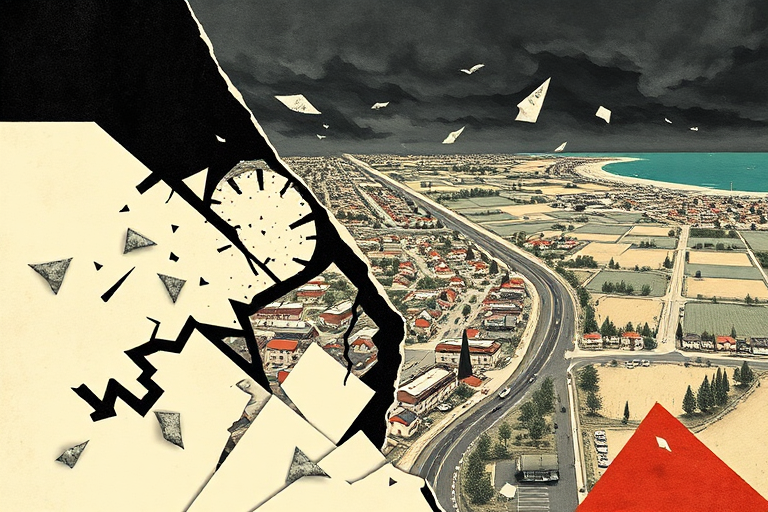
 Speculation gets credit as a driver of innovation and growth. It also does harm over time, across places, to the environment and in social life. I draw on David Harvey and the critics of financialization discussed below to read speculation in financial markets as a violent practice rather than a neutral mechanism for profit. It exploits vulnerabilities, reshapes societies, and passes harm and deprivation on to later generations.

Speculators Profit Without Producing
To speculate is to bet on future outcomes and profit from swings in asset values without taking part in production. That distance from production lets speculators extract value from labor, land, and resources and put profit ahead of human and ecological well-being. By commodifying volatility, speculation hits vulnerable people hardest and widens the inequalities already there.
David Harvey’s accumulation by dispossession explains how. Speculative real estate markets displace communities under the banner of development or gentrification and turn urban space into a commodity. In New York and London, whole neighborhoods have been re-engineered for speculative capital, uprooting working-class residents who had lived there for generations. The damage is economic, social, and psychological: communities are torn apart, their identities dissolved, their access to resources cut.
The 2008 subprime crisis is the obvious case. Speculative financial products drove millions of foreclosures and broke up families and communities. Financial institutions profited from risky bets, and working-class homeowners took the crash. The violence is systemic: speculation drives financialization, which concentrates wealth and power and pushes aside anyone with fewer resources.
Temporal Violence: Betting on the Future Forecloses It
Temporal violence is what happens when speculation turns the future into something to manipulate for profit. Futures markets, whether in commodities, housing, or climate risk, collapse time into the present and strip communities and people of their capacity to shape what comes next. Futures that can turn a profit get financed, and futures that can’t are left out of reach.
Saskia Sassen’s expulsions shows how speculative finance deepens inequality by commodifying basic needs like housing and food, raising their cost and forcing people from their homes. In Mumbai, speculation in real estate has driven up property values and displaced entire neighborhoods. The effect runs forward in time: reduced access to resources pushes marginalized communities into precarious housing and wears away the social fabric that future stability depends on.
Naomi Klein’s disaster capitalism shows how speculative markets turn crisis into profit. After Hurricane Katrina, speculative real estate and aggressive privatization displaced low-income communities and locked them out of New Orleans’ recovery. Exploiting catastrophe at the public’s expense institutionalizes future harm: futures defined by exclusion, austerity, and inequality.
The environmental crisis carries the same temporal violence. Speculation in carbon markets commodifies climate futures and drives policies that may lower financial risk for corporations but don’t do much to stop ecosystems degrading. Future generations inherit a destabilized environment, their possibilities closed off while speculators profit from today’s destruction.
Environmental Violence: Speculative Booms Speed Up Extraction
Jason W. Moore’s cheap nature describes how capitalism, and speculation with it, exploits and degrades the environment. Speculative markets in fossil fuels, mining, and industrial agriculture keep a cycle of extraction going that speeds environmental destruction. Speculators trade long-term ecological stability for short-term profit.
Take the speculative boom in biofuels. As investors drove up demand, the result was mass deforestation, land grabs, and displacement, particularly in the Global South. The boom damaged ecosystems, disrupted local communities, reduced biodiversity, and added to climate change, setting up environmental crises that local populations will bear.
Moore shows how speculation treats nature as an infinite resource for extraction. Speculative investments in oil, minerals, or forests are priced on projected future profits, and the price doesn’t count the environmental and social costs of depletion. Later generations pay that cost, inheriting fewer resources and more competition for them.
Cultural Violence: Only Profitable Futures Get Imagined
Arjun Appadurai’s work on the future as cultural fact traces how speculation reshapes the cultural imaginary and makes the future a product to be bought and sold. Derivatives, hedge funds, and futures markets turn possible future events into tradable assets. That commodifies time and narrows the range of possible futures to the ones that fit capital accumulation.
That narrowing is cultural violence. When entire urban developments are financed with speculative capital, communities lose the capacity to imagine and build alternatives to capitalist exploitation.
Appadurai’s analysis meets Klein’s disaster capitalism where speculative actors use crises to remake societies in their image. After 2008, speculative investors bought up distressed assets and reshaped neighborhoods around their own interests rather than community needs. The future stops being a shared cultural project and becomes a bet to be cashed in, and with it goes the possibility of collective, equitable futures.
Gendered Violence: Women Absorb the Swings
Silvia Federici’s work on reproductive labor shows how speculative economies intensify gendered violence by devaluing the labor that sustains life. Speculation profits from instability and crisis, while the burden of keeping society stable falls on those, mostly women, who do reproductive labor. The violence is economic and social at once, and it hides the labor speculative markets can’t do without.
Federici points to how financialization undercuts social support systems and shifts the burden of care work onto women while profits flow into speculative markets.
Speculative bubbles have historically made gendered exploitation worse. When a speculative housing market collapses, cuts to public services follow and fall hardest on women, who fill the gaps in caregiving, education, and health. Speculation entrenches gender inequality and widens the gap between those who profit from speculation and those whose labor goes unseen.
Speculation isn’t neutral or benign. It extracts value from instability under the cover of economic rationality and passes the harm across time, space, and social structures. A later essay, Collapse Capitalism, looks at what happens when that harm stops being a side effect and crisis itself becomes the source of profit.