At first glance, Jainism and anarchism may seem like an unlikely pairing. Jainism, an ancient Indian religion, is often associated with asceticism, strict non-violence, and a focus on individual liberation. Anarchism, on the other hand, is a political philosophy that emerged in the West, advocating for the abolition of hierarchical structures and the creation of a society based on voluntary cooperation and mutual aid.
Yet, upon closer examination, these two traditions share a number of core principles that, when brought into dialogue, can offer a powerful vision for spiritual and political transformation.
An anarchist Jainism invites us to cultivate a way of being in the world that is rooted in compassion, non-violence, and a deep respect for the inherent dignity of all life. By embodying these principles in our daily lives and in our communities, we can begin to create the conditions for a truly free and flourishing existence.
The Rejection of Authority
One of the most fundamental points of convergence between Jainism and anarchism is their shared rejection of unjustified authority. Jainism is a non-theistic religion, asserting that the universe is eternal and self-sustaining, without the need for a supreme creator deity. This worldview challenges the notion of divine authority and the hierarchical structures that often accompany it.
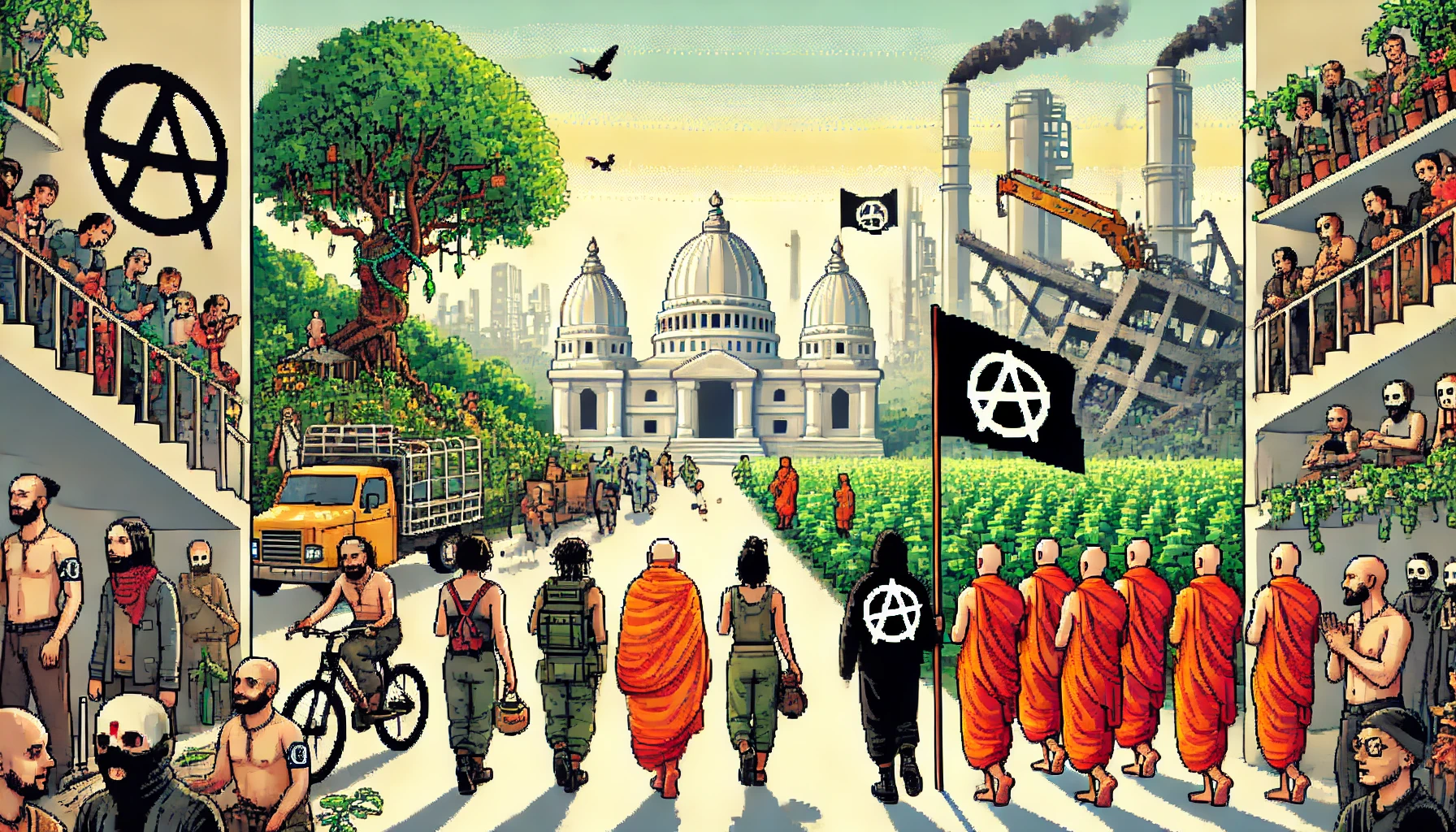
Similarly, anarchism rejects all forms of unjustified authority, including that of the state, capitalism, and organized religion. Anarchists argue that these institutions perpetuate oppression and exploitation, limiting individual freedom and autonomy. By rejecting the notion of a divine or earthly authority, both Jainism and anarchism affirm the inherent worth and potential of every individual.
Non-Violence as an Active Practice
Another key point of intersection between Jainism and anarchism is their shared commitment to non-violence. The Jain principle of ahimsa, or non-violence, is not merely a prohibition against physical harm, but a comprehensive ethical framework that encompasses thought, speech, and action. Jains are required to avoid harming all living beings, recognizing the inherent sanctity of life and the interconnectedness of all existence.
This radical commitment to non-violence resonates with the anarchist critique of state violence and the use of force to maintain social control. Many anarchists, particularly those influenced by the tradition of anarcho-pacifism, argue that violence is inherently oppressive and that true liberation can only be achieved through non-violent means. By embracing ahimsa as a way of life, Jains and anarchists alike seek to create a world in which conflicts are resolved through dialogue, compassion, and mutual understanding.
Voluntary Simplicity and Anti-Consumerism
Jainism's vow of aparigraha, or non-possession, is another point of convergence with anarchist thought. Aparigraha encourages detachment from material goods and a simple, minimalist lifestyle. This rejection of consumerism and accumulation aligns with the anarchist critique of capitalism and its endless cycle of production and consumption.
Anarchists argue that capitalism is inherently exploitative, alienating individuals from their labor and the fruits of their efforts. By embracing voluntary simplicity, Jains and anarchists alike demonstrate that it is possible to live a fulfilling life without relying on the accumulation of material wealth. This ethic of self-sufficiency and sharing provides a foundation for building a post-scarcity society in which resources are distributed equitably and in accordance with need.
Egalitarianism and Anti-Oppression
Jainism's emphasis on the fundamental equality of all souls challenges the hierarchical structures that anarchists seek to dismantle. Mahavira, the 24th Tirthankara, rejected the caste system and taught that spiritual liberation was attainable by all, regardless of social status. This egalitarian ethos resonates with the anarchist commitment to anti-oppression and the creation of a society free from domination and exploitation.
Anarchism recognizes that oppression takes many forms, including those based on race, gender, sexuality, and class. By affirming the inherent worth and potential of every individual, Jainism provides a spiritual foundation for the anarchist project of building a world in which all people are free to live with dignity and autonomy.
Decentralization and Self-Governance
The decentralized structure of the Jain community, with its emphasis on individual spiritual practice and self-discipline, reflects the anarchist principle of self-governance. Anarchists envision a society in which power is distributed to the grassroots level, with communities organizing themselves through voluntary association and mutual aid.
The Jain tradition of wandering monks and nuns, who rely on the lay community for their basic needs, provides a model for a society based on interdependence and reciprocity. By cultivating inner peace and compassion, Jains create the conditions for a more harmonious and cooperative social order.
An anarchist reading of Jainism reveals a rich tradition that offers valuable insights for those seeking to build a more just and compassionate world. By rejecting unjustified authority, embracing non-violence, practicing voluntary simplicity, affirming egalitarianism, and embodying self-governance, Jains and anarchists alike challenge the dominant systems of oppression and exploitation.
At the same time, an anarchist critique can help to illuminate and address the hierarchical aspects of Jain tradition that may limit its liberatory potential. By bringing these two traditions into dialogue, we can begin to imagine new possibilities for spiritual and political transformation.