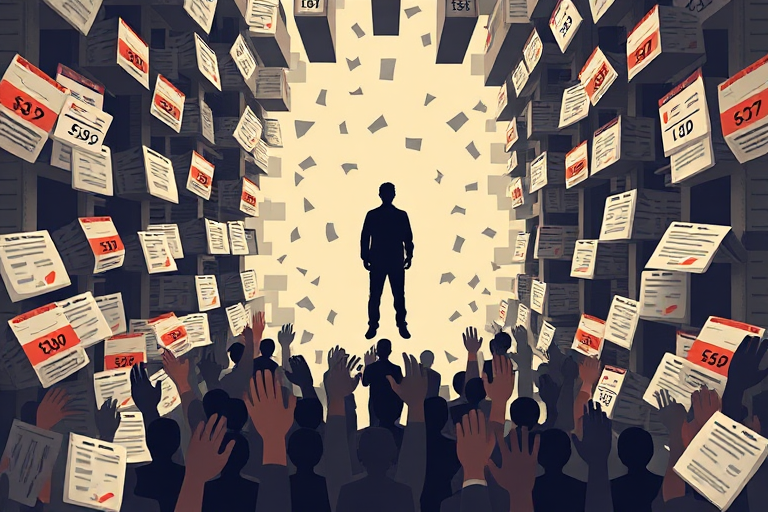
 Rejection rarely comes stamped with a bold, clear "No." It arrives softly—hidden among lost forms, endless phone calls, and the mysterious disappearance of documents you know you submitted.
Initially, I blamed myself—maybe my handwriting was too messy or I forgot to sign page twelve? But then I noticed others, folks just as diligent as me, hitting the same invisible hurdles:
- Disabled people re-verifying permanent conditions repeatedly.
- Trans folks pushed away from affirming procedures labeled "nonessential."
- Older adults stuck proving their frailty despite needing obvious help.
Friction rarely comes labeled "You cost too much," yet that's exactly what it conveys. These systems quietly nudge out anyone deemed too expensive.
In Actuarial Medicine & Hidden Exclusion, I show how indefinite or complex needs get quietly nudged away—in healthcare, jobs, or social systems built for minimal overhead.
Sorted Like a State
Ancient states once mapped wild, irregular farmland into tidy grids, simplifying tax collection but erasing forests and streams from the map. Our modern bureaucracies perform a similar magic trick, flattening beautifully complex humans into simple price tags.
If your needs fit neatly into fifteen-minute appointments or quick-fix solutions, the system welcomes you warmly. But if your needs stretch indefinitely—ongoing therapy, specialized equipment, unpredictable schedules—you encounter polite but relentless friction.

Every now and then a tragedy emerges—someone dies waiting for a procedure or burns out from inadequate support. Outrage spikes. Institutions respond with tiny improvements: a pilot program, new forms. Once the spotlight fades, the status quo endures.
These mid-level changes often appear as progress while ignoring the deeper idea that certain people are "too big a burden." Some resources are patched in, but nothing truly shifts. The labyrinth stands.
Tech Enables Exclusion at Warp Speed
Today, technology promises salvation: automated claim reviews, AI doctors, digital checklists. In theory, these could ease our paths if designed with compassion. But cost-cutting motives have transformed these tools into supercharged sorting machines, swiftly labeling us "too expensive" before we've finished typing our names.
Algorithms reflect the values of those who create them; code might look neutral, but the underlying assumptions decide who's welcome. Digital "innovation" often intensifies the labyrinth rather than dismantling it.
My own experiences as an autistic person show how friction plays out—even in workplaces touting "inclusion." They may celebrate diversity, but rarely alter tasks or environments to accommodate genuine differences. Over time, the constant mismatch leads to meltdowns or burnout. Friction doesn't explicitly say, "We won't change," but you're left with no alternative but to quit. After enough heartbreak—missing paperwork, contradictory forms, repeated dead ends—people often stop trying. From outside, it may seem like they "gave up." Internally, it's self-preservation: you learn the system was never designed to serve "costly" needs.
That sense of disaffection can lead to hidden solidarity—once we recognize that many others face the same friction-based ejection.
Reclaiming "Expensive" Without Shame
I used to hide my own needs, afraid to ask for therapy or accommodations. Eventually, I realized the scandal lies in a society that calculates ongoing or complex requirements as unworthy.
Calling myself "expensive" reveals that budgets are moral stances, not inescapable facts. It lifts the shame from us and places it on a structure that decides some complexities aren't worth covering.
In Nobody is Too Expensive, I argue shame fades when we see budgets as policy decisions, not inevitable truths. We find money for executive salaries and endless "fraud checks," but balk at ongoing or complex care.
Minor tweaks won't dismantle a system wired to exclude. We need a radical ethic of care that refuses to shrink humanity:
- No more endless proof for chronic or permanent conditions.
- Truly adaptive workplaces—flexible roles, supportive environments, genuine communication.
- Tech that helps, not filters—algorithms proactively offering assistance instead of default denials.
We choose: either budgets overshadow human needs, or human needs overshadow budgets. Once we see friction's true purpose, we notice older adults, trans folks, disabled parents, and neurodivergent colleagues all quietly labeled as "too expensive." Real solidarity emerges when we recognize we're in the same labyrinth.
By naming friction-based exclusion, we confront the moral stance behind "We can't afford that." Authentic inclusion invests in every complexity, tearing down the labyrinth instead of merely repainting it.
I used to reduce my therapy needs and mask my real self, terrified of being "too big an ask." Learning about friction's deliberate design changed that. Our complexity is not the problem.
Calling ourselves "expensive" exposes budgets as moral choices, not cosmic laws. Together, we can create a world where we never shrink to survive—where friction-based exclusion surrenders to radical care, and we invest in every life. Period.