Ten years ago, Gilead Sciences did what modern medicine says it exists to do: it cured a disease.
In 2013 and 2014, the company launched Sovaldi and Harvoni, antiviral drugs that cured hepatitis C. Harvoni, a single daily pill, cleared it in more than 90 percent of patients in just twelve weeks, without injections or brutal side effects.1 Clinicians saw the end of a decades-long war against a virus that caused liver failure, cancer, and death. Patients were freed from a lifetime of fatigue, shame, and fear.
Wall Street cheered, then sold.
After peaking above $120 in mid-2015, Gilead’s shares lost 29.2 percent of their value in 2016 and went nowhere in 2017.
The science held up, public trust held, and there was no scandal. Investors sold because the cure was shrinking its own patient pool, and revenue fell from 2016. Competition did part of the work too: rival regimens from AbbVie and Merck pushed insurers to demand discounts, and AbbVie’s Mavyret arrived in 2017 at a fraction of Gilead’s list price. Fewer patients and cheaper courses compounded.
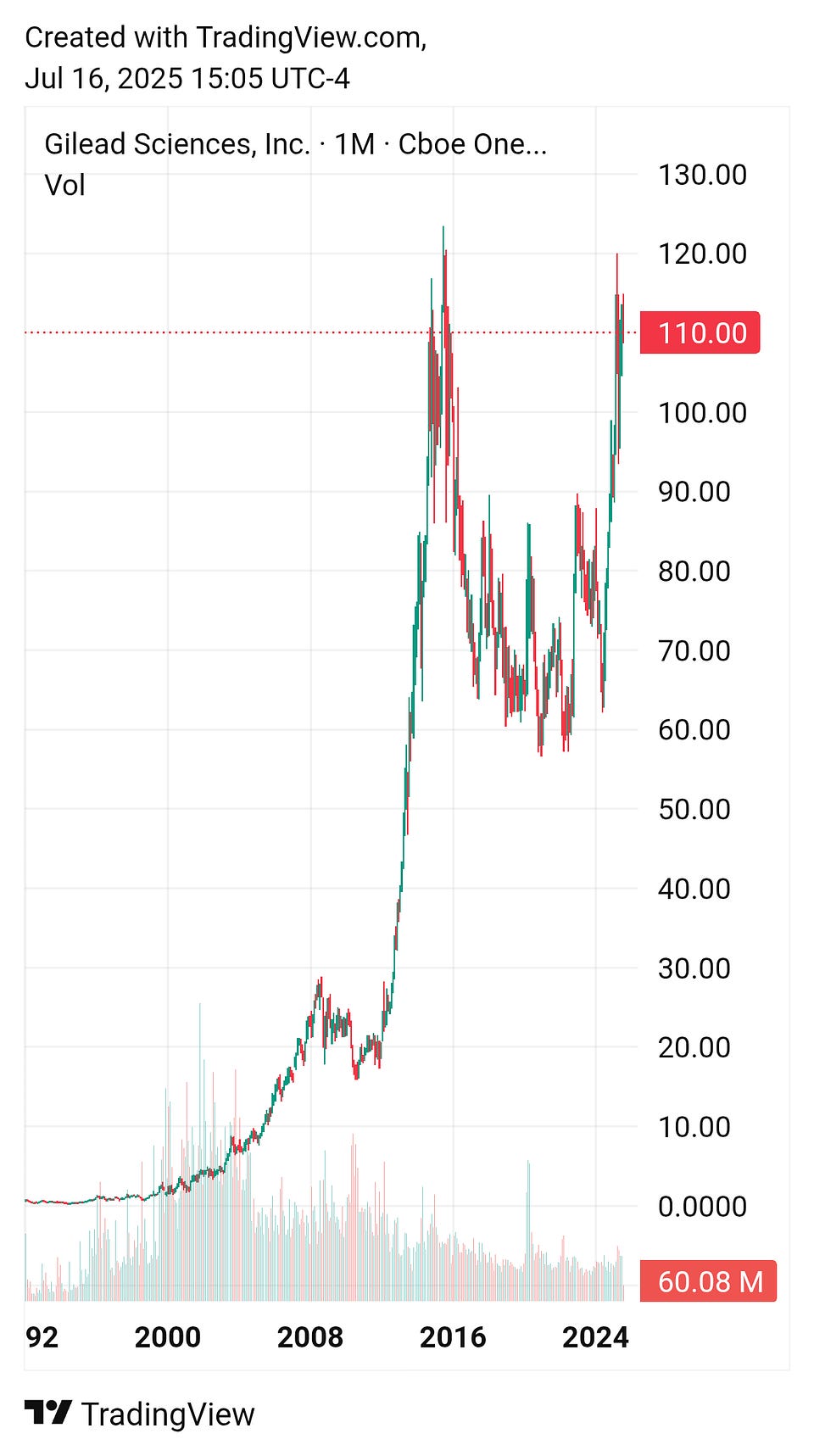
A product that fulfilled medicine’s highest goal, total eradication, was marked down once it began curing away its own revenue.
The market penalizes the cure:
A one-time cure eliminates its own revenue stream, exposing the deep conflict between financial value and human health.
The observation is not speculative. In 2018 a Goldman Sachs report on gene therapy asked clients outright, “Is curing patients a sustainable business model?”, and pointed to Gilead’s hepatitis C franchise as the example.
In 2015, Gilead’s hepatitis C franchise generated $19.1 billion in revenue. By 2017 the same franchise brought in $9.1 billion.
But markets don’t reward past performance. They reward predictable, repeatable, long-term cash flow. And a one-time cure, by definition, destroys its own demand.
Analysts didn’t denounce or deny the science. They just used a more polite vocabulary:
- “Finite patient pool” – too many people got better.
- “Post-peak revenue cliff” – the high-water mark is already behind us.
- “Non-recurring revenue profile” – no repeat purchases.
- “Market-durability challenge” – growth isn’t guaranteed.
- “Cure-saturation headwind” – clinical success is now a drag on returns.
None of these are critiques of the drug’s effectiveness. They’re warnings to shareholders that healing people isn’t sustainable.
The Real-World Cost of Spreadsheet Logic
For patients, this launch was deliverance. Suddenly, people who had spent decades living in fear—of infecting loved ones, of liver failure, of rejection—were cured. They could buy life insurance, apply for jobs without disclosing a condition, be removed from transplant waiting lists. For many, it was the first time in years they could imagine a future.
Clinicians went from managing slow decline to offering actual hope. But very quickly, because of the high launch price Gilead was trying to use to recoup this financially undesirable outcome, insurers reacted by implementing tight restrictions. Doctors had to prove that patients were “sick enough” to deserve the cure, despite knowing that earlier treatment would save lives and reduce costs.
Providers described the resulting moral injury as one of the most disheartening experiences of their careers.
Many of us want to blame greed. But that misses the deeper point.
Gilead’s executives were doing what was expected of them. Under shareholder primacy, the dominant norm of U.S. corporate governance, a CEO who visibly sacrifices returns faces intense pressure from investors and the board.
The problem ultimately lies in how value is measured: finance runs on discounted cash flow (DCF) models. A chronic therapy that generates $3,000 per year for 20 years earns $60,000 in total. Under typical discount rates, retention and cost assumptions, it can beat a one-time cure that brings in $20,000 once. The ordering is real, though its exact size depends on the assumptions.
Chronic illness is more financially “stable” than elimination.
No one in the boardroom had to say “Don’t cure the disease.” The discounted cash flow model already ranked the chronic therapy higher.
Today, Gilead’s experience has become a cautionary tale:
Don’t destroy your own market. Don’t end the revenue stream. Don’t do what Gilead did.
This logic now shapes how venture capital evaluates health startups. It nudges researchers toward treatments that manage conditions over ones that end them. If you’re building a business case, “chronic, durable, and adherent” wins, and “curative, fast, and final” gets chopped.
What Would a System That Wants Cures Actually Look Like
If we want financial incentives to serve public health outcomes, we need structural change. The tools exist:
- Delinkage models: Louisiana already tested a “Netflix-style” deal: paying a flat fee for unlimited cures. Pharma got its profit. The state cured thousands.
- Single-payer systems: When the government pays the healthcare bills, a cured patient is a budgetary win. The incentives line up.
- Public or nonprofit manufacturing: Once patents expire, we can treat essential drugs like we treat bridges, as public infrastructure.
None of these require sci-fi tech or global revolution. They just require political will and regulatory courage.
For what happens when universality is compromised, and how even single-payer models can be undermined by risk segmentation, see Deservingness Is a Sorting Machine.
A decade later, it’s clear: this was a case study. And the lesson landed.
If you eliminate a disease, you eliminate a market. If you eliminate a market, you eliminate recurring revenue. Shrinking recurring revenue removes the financial logic that made the product valuable in the first place, though whether that eliminates shareholder value depends on the discount rate, retention assumptions, costs, and what replaces the lost stream.
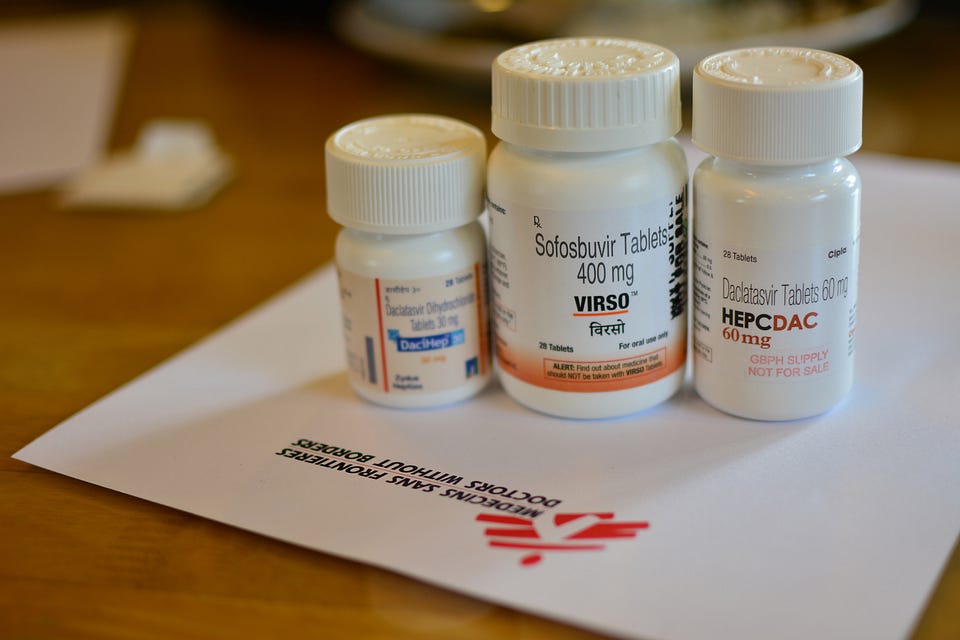
If we don’t change the way we value medicine, the next miracle cure may struggle to leave the lab, because a valuation built on repeat revenue counts its success against it. The Gilead case shows that incentive at work, though it does not show that every cure will be suppressed.
The Gilead Effect is shareholder primacy and discounted cash flow working exactly as they are supposed to.
Do we want shareholder returns deciding which treatments get developed?
Curing hepatitis C was a correction the market made Gilead pay for. An Appeal Process Can Work and Still Be Built Not to Be Used argues that an institution can know its rule is harmful and keep it anyway when the harm is the operating margin. The cure removed exactly that margin, which is why investors sold.
For more on how profit logic treats life as disposable, and what it would take to build systems that break this cycle, see:
- When Your Illness Has No Billing Code
- Exclusion Has Been a Business Since 1493
- Give Everyone the Benefit and There’s No One to Investigate
- Deservingness Is a Sorting Machine
If you want to see how these same incentives operate in housing, credit, and public benefits, start here.
Notes
Nasser Afdhal et al., “Ledipasvir and Sofosbuvir for Untreated HCV Genotype 1 Infection,” New England Journal of Medicine 370 (2014), https://www.nejm.org/doi/full/10.1056/NEJMoa1402454. Across the registration trials the combination cleared genotype 1 hepatitis C in 94 to 99 percent of patients.