When open coercion gets pricey (or just looks bad), the people and institutions that used it keep the control and soften the delivery.
The baton becomes a clipboard, the shout a calm check-in. HR sometimes calls this “support,” parents will call it love, and forum moderators call it civility.
Whatever the label, you end up predictable and grateful, and the person steering you keeps a clean record. It is control that sounds like care and looks like compassion yet never loosens its grip.
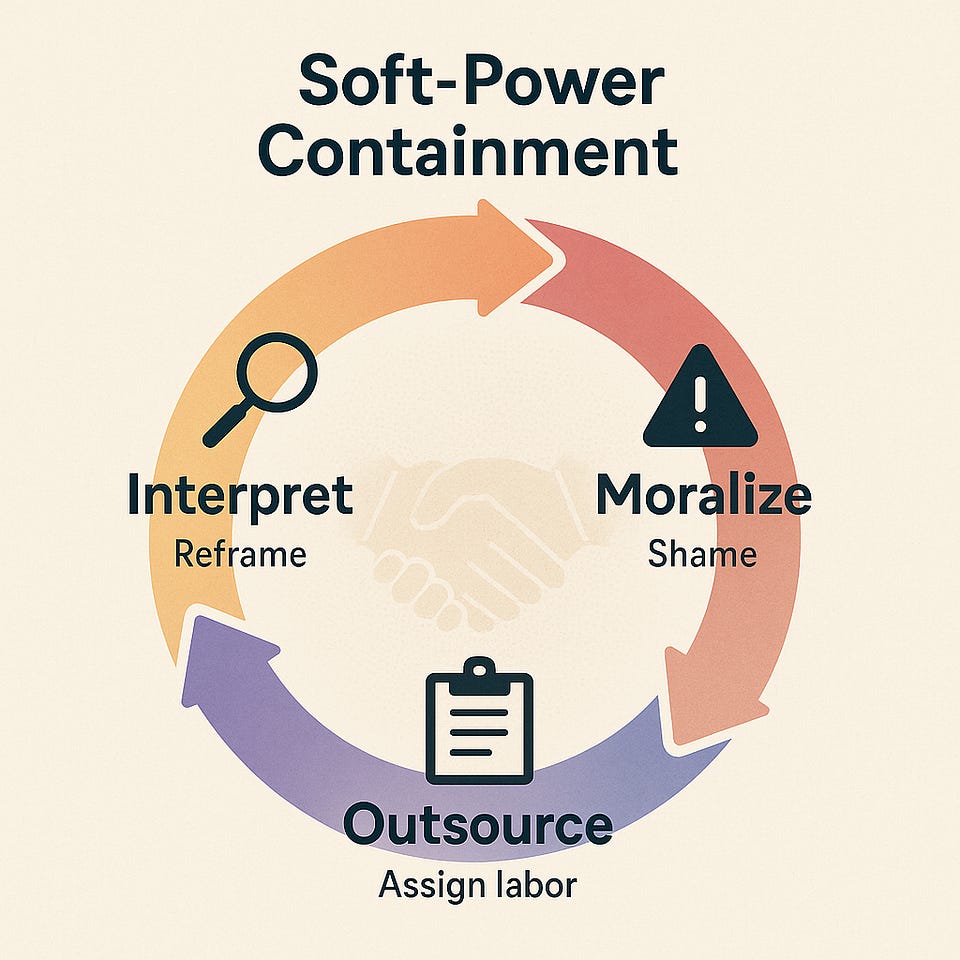
It moves in three beats.
- Interpretation comes first: you’ve barely named the issue before someone reframes it—Let’s be objective, Are you getting emotional? Now the debate is about your tone, and the problem has dropped out of it.
- Moralizing follows: the boundary you set—I can’t work another weekend—is repainted as selfish or immature, warning bystanders not to side with you.
- Outsourcing comes last: having cast you as the issue, the same voice hands you the mop—rewrite the email, calm the room, draft the plan. You end up both defendant and janitor while they stroll off looking reasonable.

View source
%% title: From a weekend refusal to you rewriting the email
%% caption: You say you can’t work another weekend. The reply makes your tone the issue, calls the refusal selfish in front of colleagues, then hands you the email to rewrite, while the person steering it keeps a clean record.
flowchart TD
  classDef actor stroke-width:1.6px;
  classDef system stroke-width:1.2px;
  classDef gate stroke-width:1.6px;
  classDef binding stroke-width:3px,font-weight:bold;
  classDef status stroke-dasharray:4 3;
  classDef load stroke-width:2px;
  classDef repair stroke-width:2.4px,font-weight:bold;
  classDef failure stroke-width:2.2px,stroke-dasharray:6 3;

  S(["You: 'I can't work<br/>another weekend'"]):::actor --> B1{"1. Interpretation<br/>'Are you getting emotional?'"}:::gate
  B1 -- "now the topic is<br/>your tone, not weekends" --> B2{"2. Moralizing<br/>Your no, called selfish"}:::gate
  B2 -- "colleagues learn<br/>not to back you" --> B3{"3. Outsourcing<br/>You get the email to rewrite"}:::gate
  B3 ==> D(["Defendant and janitor:<br/>you calm the room, draft the plan"]):::failure
  B3 -. "they stroll off" .-> P(["Their record stays clean"]):::status
Because the sequence would feel heavy-handed if declared openly, it hides behind familiar voices, masking itself as different forms of pro-social care.

View source
%% title: The seven masks of synthetic care
%% caption: Seven ways of sounding caring that steer a complaint back toward compliance.
flowchart TD
  classDef actor stroke-width:1.6px;
  classDef system stroke-width:1.2px;
  classDef gate stroke-width:1.6px;
  classDef binding stroke-width:3px,font-weight:bold;
  classDef status stroke-dasharray:4 3;
  classDef load stroke-width:2px;
  classDef repair stroke-width:2.4px,font-weight:bold;
  classDef failure stroke-width:2.2px,stroke-dasharray:6 3;

  subgraph DiagnosticMasks["Surveillance & Minimization Masks"]
    direction TB
    M1["Concern: Takes pulse for dissent"]:::status
    M2["Reason: Shrinks urgency into childishness"]:::status
    M3["Curiosity: Spins firm 'no' into endless questions"]:::status
  end

  subgraph LeverageMasks["Obligation & Tone Policing Masks"]
    direction TB
    M4["Allyship: Converts past favors into debt"]:::system
    M5["Nostalgia: Sighs over the compliant 'old you'"]:::system
    M6["Healing: Dissolves responsibility in group hugs"]:::system
    M7["Civility: Polices tone while leaving harm intact"]:::system
  end

  DiagnosticMasks --> LeverageMasks ==> O([Obedience without raised voices]):::failure
Each mask is different; all steer you back to obedience without raising a voice.
Care and control use the same words, so the test has to look past them. Ask what the concern offers, and who pays for it. Concern that’s care comes with an offer that costs the speaker something: the manager who’s worried about your weekends moves the deadline, takes a shift, or tells the client no. Concern that’s control comes with a demand that costs only you: calm down, rephrase, come back with a plan. Then watch what your no does to it. Care can hear a no and stay concerned. Control treats the no as one more symptom, and the conversation turns back to your tone. If the offer costs them nothing and your no becomes a symptom, the velvet glove is squeezing.
Institutions can run the same sequence, and one case has a public record. In February 2017, Susan Fowler published an account of her year as an engineer at Uber.1 On her first day on a new team, she wrote, her manager propositioned her over company chat, and she took screenshots and reported him to HR. HR and upper management agreed it was harassment, but said it was his first offense; upper management called him “a high performer” and didn’t want to punish him for “what was probably just an innocent mistake on his part.” Other women, she later learned, had reported the same manager before.
Then the cleanup came to her. She could find another team, or stay and accept that he’d most likely give her a poor performance review. One HR rep told her that wouldn’t be retaliation, because she had been “given an option.” She moved teams. Months later, after she’d forwarded HR an email chain from her director, the rep who met with her opened by asking whether she’d noticed she was “the common theme” in the reports she’d been making, and whether she’d considered she “might be the problem.” The meeting ended with the rep telling her that reporting things to HR by email was unprofessional.
The beats didn’t arrive in order here, but all three are there. Her complaints became a question about her, her record-keeping became a professionalism problem, and the cost of a manager’s harassment landed on her: weeks spent finding a new team, or a bad review if she stayed. Run the test on the “option” and it fails both ways: it cost the company nothing, and her no to it came with a price attached.
Stopping the loop rarely needs fireworks. Naming the beat while it’s happening is often enough, and naming is the part of the defense that travels. No parent can keep a child out of the attention economy; the most a parent can do is make sure the child can name what is being done to them while it is being done. The adult version is one sentence said in the meeting: “We’ve moved from the weekend to my tone.”
Each mask has a short answer too. To Concern: “I hear the concern; my boundary stands.” To Reason: “The urgency matches the stakes.” To Nostalgia: “That unpaid version of me is retired.” To Civility: “Let’s talk once roles, not volume, are on the table.”
The hush that follows may prickle, but ownership of the next move is no longer yours.
Your resistance can start small: the 10 p.m. “urgent” ping that waits until morning, the meeting declined because it exists only to soothe someone else’s nerves, the dish left in the sink until energy returns.
Nothing collapses, and each micro-no widens the space where your consent actually counts.
Seeing the human behind the mask can soften your delivery without surrendering your limit. A colleague clings to Reason because conflict scares them; a manager hides behind policy to shield a shaky promotion; a parent confuses vigilance with love.
Soft-power persists because it externalizes cost. Institutions bank reputational credit for benevolence while you absorb the stigma of seeming “difficult,” shoulder the metabolic debt of fixes, and lose time to delays that serve power far more than truth. Until those hidden expenses are surfaced—and sometimes refused—the pattern keeps paying dividends.
I keep two red lines. I won’t redesign my boundary to cushion someone else’s comfort, and I won’t perform unpaid emotional triage for the system that caused the wound. When either line is crossed, my exit is just a matter of hygiene.
Concern can be care or control, and the difference is who pays for it. A calm conversation can still leave you holding the mop. Refusing the cleanup work ends your part in it, and sometimes your refusal is the cleanest form of self-care.
Notes
Susan J. Fowler, “Reflecting on One Very, Very Strange Year at Uber,” February 19, 2017. The quotations are from her post. susanjfowler.com