
- Your card declines at the grocery checkout.
- Your benefits don’t show up.
- Your account is suddenly “under review,” or
- A letter arrives announcing a decision you didn’tknow was being made.
Most people have lived some version of this. In each case, the change isinstant, but the “fix,” if it comes at all, lives somewhere behind: hold music, web forms,“high volume,” and a promise that someone will look at it.
Some of this is especially significant in high-speed, high-stakes systems. Power used tolook like ‘a decision maker.’ Now it looks like an undo button you don’t get to press.
I’ve come tobelieve our political center of gravity has to move from who makes the decision to how hard the decision is toreverse.
Fast harm, slow repair
Systems can change your status in real time, but repairhappens on human time, slowly, optionally, and mostly by making you do labor.(note 1)
Healthcare makes it easiestto prove, because the impact of delay isn’t just annoying—it can be biological:
Denials are common. In 2023, ACAmarketplace insurers denied about 19% of in-network claims (roughly 1 in 5).
Appeals are rare. Across tensof millions of denials, consumers appeal at under 1%.
Appeals work. When people do appeal, denials are overturned atleast partially 44% of the time—and prior auth appeals succeed in some studies 80%+ of the time.

Almost nobody appeals. Whenthey do, they often win. **Stop and think about what that means:**The system can afford to be wrong 19% of the timebecause it knows 99% of people won’t fight back.
Which means the system doesn’t win by being right. It winsby making correction expensive enough that most people can’t afford to try.
Denials are cheap and fast. Appealsare slow and costly—in time, energy, uncertainty, and risk.
But in the Age of Appeals, the ones who push through oftenwin.
This isn’t just “a healthcare problem.” It’s a design pattern across high-speed,high-stakes systems
I see the same structure everywhere:
- Benefits: payments stop overnight;hearing dates land months later. Pennsylvania unemploymentappeals can run 2–6 months. You still need rent and groceries during “the process.”
- Housing: the move from filing to removal can be weeks. Illinois eviction cases can reach hearing in 7 days. Appeals exist, but they often don’t automatically pause harm —so “you canappeal” becomes technically true while you’re already displaced.
- Platforms: a flag canerase an account and income instantly; “review” has no binding timeline and can stretch to “weeks or months”. The platform decides ifyou get your life back—and when.
- Immigration: removal and detention can move quickly while the system that hears contests isbacklogged for years. The right to contest exists inside a machine designed to outpace it. As I explored in Pending: The Politics of Non-Decision, indefinite waitingbecomes its own form of control.
The new class divide is ‘error survivability’

Here’s what that
implies, and it’s uglier than it sounds:
In a high-speed administrative world, class is increasinglymeasured in error survivability: who can absorb or reverse a wrong decision before their life comes apart.
Who can afford to:
- Sit on hold for two hours on a Tuesday without getting fired
- Write ininstitutional jargon without melting down
- Front money while “it gets sorted out”
- Keepbackup accounts, backup housing, backup childcare
- Pull in a lawyer, union rep, or journalist who gets a response
- Remain functional while their status is “pending”
So the real Wealth is Error Insurance.
The most importantEducation is Procedural Literacy.
The key determinant of Health is Capacity to Endure Bureaucracy.
The same formal right behaves like a safety net for some and a dare for others.(note 2)
Why theusual fixes miss
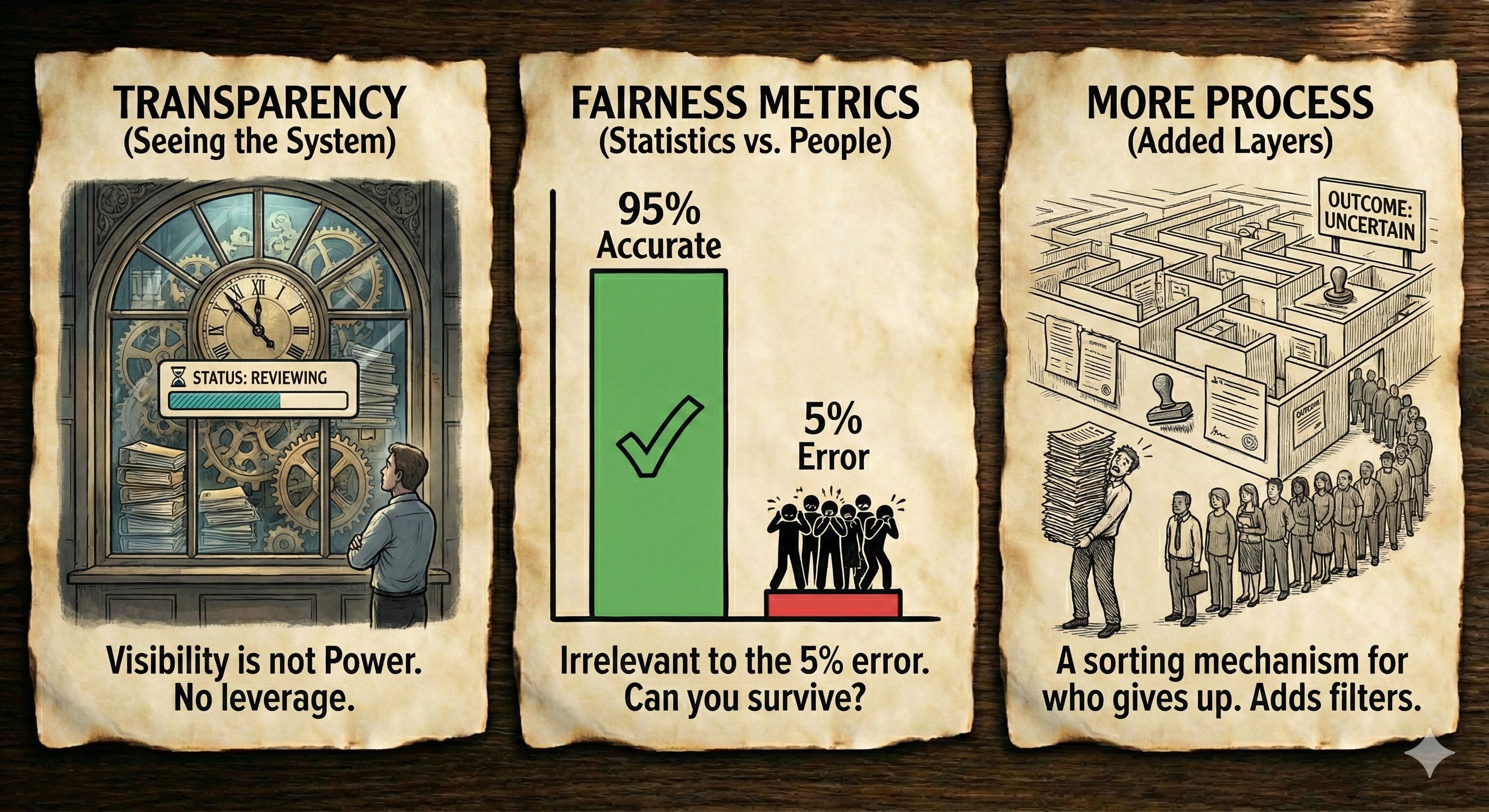
- Transparency: You can see the policy, understand the reason code, watch the status bar—and still have noleverage. Visibility is not power.
- Fairness metrics: A system can be “95% accurate” andstill concentrate its errors on the people least able to contest them. For the person in the 5%, the metric is irrelevant. Thequestion is: can you survive the mistake?
- More process: extra forms and extra layers usually just addmore filters for time, literacy, stamina. If process isn’t coupled to binding timelines and real outcomes, it’s just asorting mechanism for who gives up.
All of these change how systems talk about themselves without changingwhat they can be forced to do.
What would actually work
☐ Automatic stays forsurvival stakes
If an appeal is active, harm should not proceed for money-for-food, housing, essential medical care, orphysical presence in a country. Default to continuity until someone with real authority resolves it.
☐ Bindingdeadlines with teeth
Pick numbers (14 days, 30 days). Enforce them. Missing thedeadline shouldn’t be a “service failure”—it should trigger reversal or meaningful penalty.
☐ Burden on the actor
If a system flips your status, it should carry the burden of proving it wasright—rather than forcing you to prove it was wrong while you’re under duress.
☐ Proportionalcapacity
If you can act on 100,000 people/day, you must be able to process 100,000 appeals/day within guaranteedtimelines. Otherwise “you can appeal” is brochure text.(note 3)
☐ Cost-shifting whenwrong
When the institution is wrong, it should pay the person’s costs (fees, lost wages where applicable, andrecognition of harm caused by delay). Right now almost all costs sit on the individual.
None of thisrequires us to believe institutions are ‘evil.’ It just means we have to refuse to let them be careless for free.
What rights actuallyare
A right isn’t a sentence on paper. A right is the machinery that moves when the sentence is violated.
I explored this more fully in On “Having aRight” to Something.
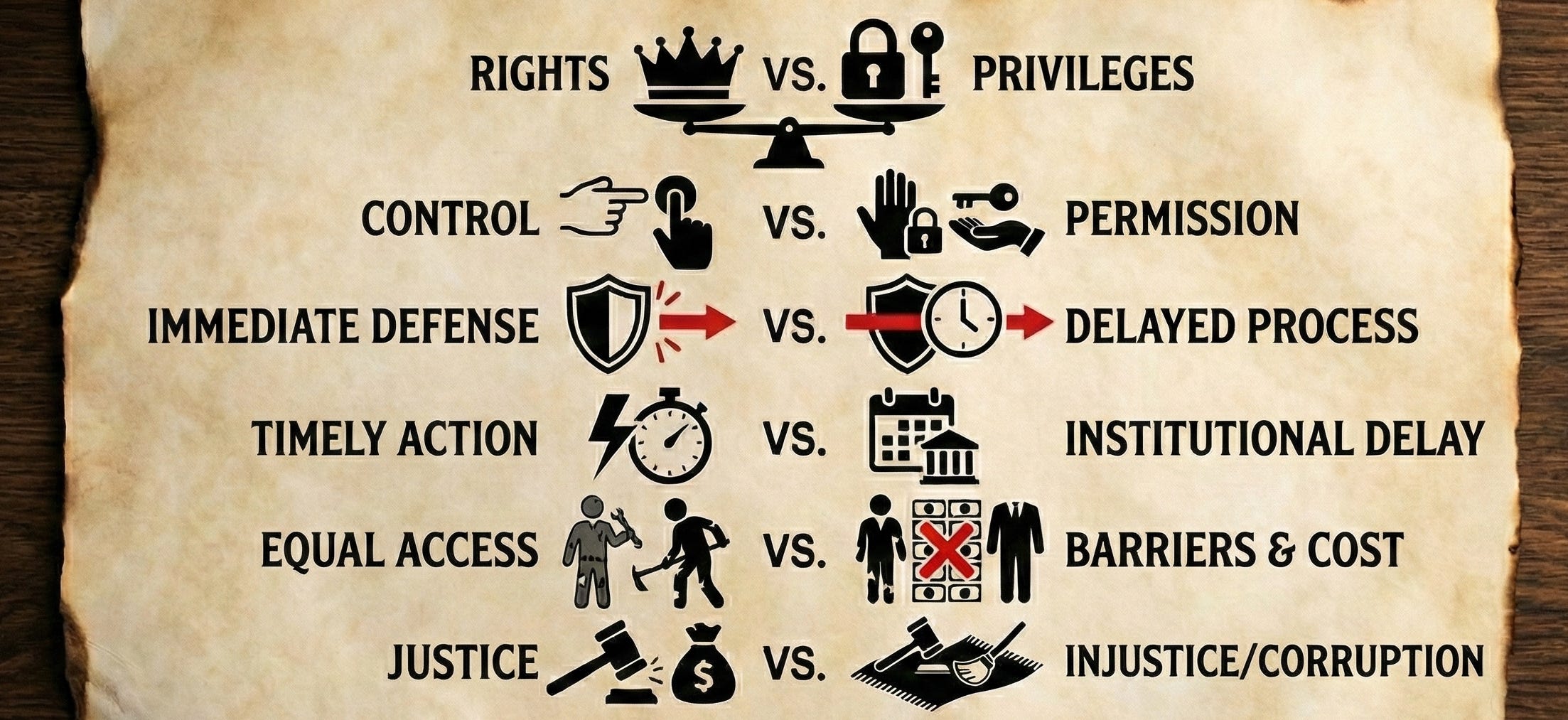
- Can you trigger ityourself, or do you need permission?
- Does it stop harm while it runs, or does harm continue during review?
- Is it timed to your crisis, or institutional convenience?
- Does it work when you’re broke, sick,exhausted, scared—or only when you’re composed and resourced?
- Does it make the institution pay when wrong,or just quietly walk it back?
If the answers are mostly “no,” then you don’t have a right.
You have a story about a right—plus a test of whether you can survive the cost of making it real.
The constitutional crisis nobody noticed
We’re living through the age where having rights andbeing able to enforce them have completely diverged—and most political discourse hasn’t noticed.
Theformal constitution says one thing: you have rights, due process, equal protection. The operational constitution—whatinstitutions can actually be forced to do—is something entirely different.
The gap is widening asdecision speed increases while remedy speed stays constant. This creates a new form of domination: not through explicit denial ofrights, but through making rights practically conditional on resources while maintaining formal universality.
Under high-speed, high-scale systems, the most important politicalquestion is no longer just “who decides?” or “what do the rules say?”
It’s: when thesystem gets it wrong, who can force reversal, how fast, and at what cost to whom?
Everything we currently call“rights,” “fairness,” or “accountability” will either be rebuilt around that question—or goon existing mostly as pamphlet language.
Until that question sits at the center of how we talk about healthcare, housing,welfare, platforms, policing, immigration—and everything else—we’re just arguing about whose turn it is toget the pamphlet.
If you’ve lived the gap between having a formal right and being able toenforce it—or if you’re building systems trying to close that gap—I want to hear about it.
This is part of ongoing work on what governance actually requires under conditions of high-speed, high-scale automated decision-making.
Note 2.
This isn’t just about having standing in the legal sense—it’sabout having the capacity to make that standing matter. I wrote about this distinction in Belief is Not the Bottleneck. Standing is.
The healthcare numbers are the cleanest proof: when success rates are high but attempt rates are tiny,the bottleneck is not correctness—it’s capacity.