Each time you rig your phone into a hotspot mid-presentation, context-switch under pressure, or rewrite lost slides, you’re performing unbilled infrastructure. That unpaid risk absorption is everywhere: from emergency patch calls to last-minute bug fixes. In Time Is a Commons, I traced how unpaid “heroics” accumulate as hidden subsidy for frictionless UX. Recognizing these saves as labor (not badges of grit) lets you reclaim the narrative: these aren’t personal feats, but systemic failures demanding repair.
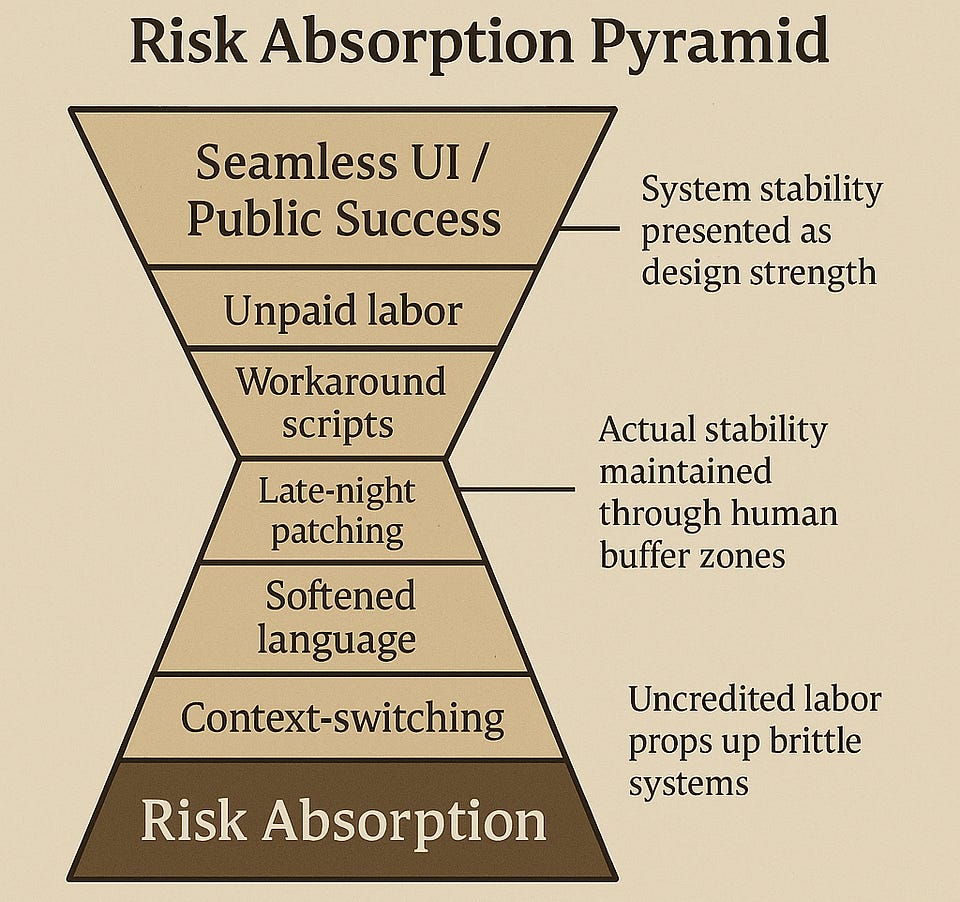
These unpaid rescues have a parallel in how criticism gets rebranded as the company’s own idea. You flag a privacy gap or accessibility barrier; months later, that same insight is lauded as a proactive feature.
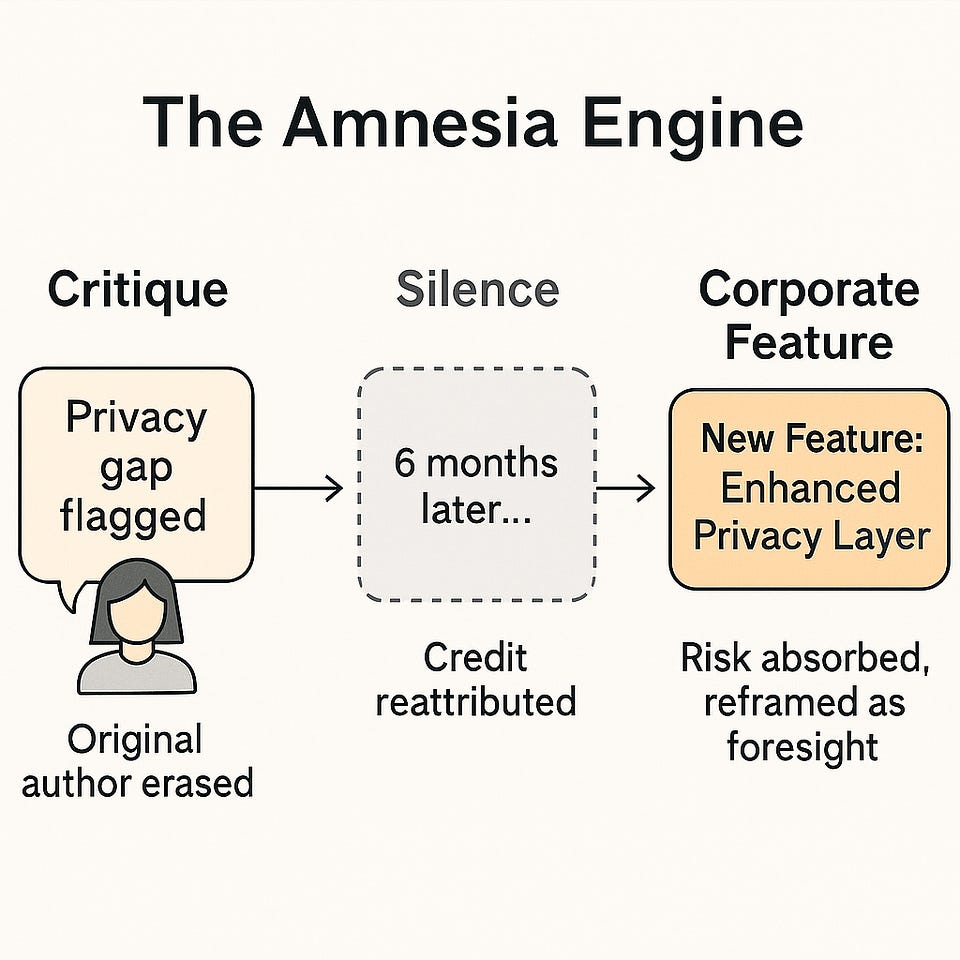
The Amnesia Engine works this way: critique is ingested, delayed, and reissued under someone else’s name. By timestamping your feedback and tracking its route from inbox to roadmap, you reveal memory as a design parameter rather than an afterthought.
Defaults aren’t benign. When a form fails without explanation (no error message, no recovery path), the silence is engineered. In Emergence Is an Excuse, I show how “neutral” defaults encode institutional priorities: compliance quotas, risk buffers, cost savings. Asking whose needs the default serves and whose voice is left out of the margins exposes the choice that “neutrality” hides.
Finally, consider exit flows. A “free” trial that’s effortless to join but punishing to leave isn’t an oversight; it’s containment by design. In How to Build Institutions That Can’t Coerce, I argue that equal ease of exit and entry is the true test of a system’s ethics.
These threads (unpaid labor, selective memory, silent defaults, restricted exits) are not isolated. They reinforce one another, and together they make it harder to refuse. To undo them, we need a unified practice.
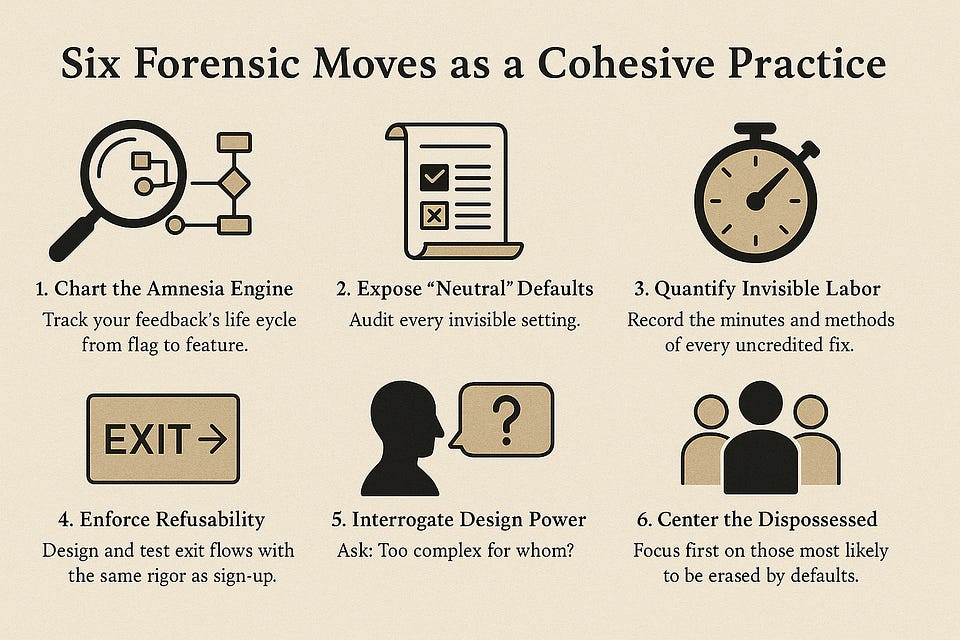
1. Chart the Amnesia Engine
Track your feedback’s life cycle from flag to feature. Note where it dies in backlogs, and where it reemerges as “insight.” Your audit shows how selective memory works against the person who raised the issue. See Institutions Prefer Crises to Early Warnings.
2. Expose “Neutral” Defaults
Audit every invisible setting: auto-expire windows, silent fails, one-touch agreements. Once you name a default, you can ask who chose it and why. See Emergence Is an Excuse.
3. Quantify Invisible Labor
Record the minutes and methods of every uncredited fix. These hours (whether rebooting servers at midnight or clarifying ambiguous prompts) are what pays for an experience that looks frictionless to everyone else. See Time Is a Commons.
4. Enforce Refusability
Design and test exit flows with the same rigor as sign-up. If leaving triggers delays, fees, or coercive messaging, demand parity. This reframes consent as an ongoing, reversible stance. See How to Build Institutions That Can’t Coerce.
5. Interrogate Design Power
When leaders cite “too complex to fix,” ask: Too complex for whom? Behind that shrug lie resource allocations, profit motives, and power imbalances. See Control Makes Institutions Brittle.
6. Center the Dispossessed
Focus first on those most likely to be erased by defaults: low-income users, non-native speakers, neurodivergent bodies. Their exclusions map systemic blind spots. See Collapse Capitalism.
As you apply these moves, begin with your own workspace: patch notes, email filters, onboarding forms.
- Cross-reference findings with essays like Actuarial Medicine & Hidden Exclusion, which shows how algorithms become exclusion engines.
- Leverage insights from Stop Blaming Dopamine to critique metrics that tokenize human activity.
- Ground your refusal in Every Crisis Leaves Capitalism Stronger, understanding how dissent is co-opted into compliance.
Each connection deepens our shared lens. The essays I write are meant to be conversational roots, offering you detailed investigations and real-world examples to enrich your audits.

People built these systems, so people can rebuild them. Each audit you record, default you decode and exit you secure makes it harder for a workplace to erase who did the work or to keep people from leaving. Over time, those records add up to workplaces that credit contributions, explain their defaults and make leaving as simple as signing up.
That, in plain terms, is what I hope happens to us: that you get better at seeing where it spends you — and at refusing to be spent.